


China Develops Muscle Graft That Mimics Exercise
Skeletal muscle is the body’s primary motor tissue, but its role extends far beyond movement. It is also central to whole-body metabolism and plays an important role in maintaining physical function and slowing the effects of aging.
Exercise can help prevent and improve a range of age-related metabolic and degenerative diseases. But for people who are unable to exercise sufficiently because of aging, obesity, or illness, there is still a major challenge: how can they obtain the systemic health benefits normally associated with physical activity?
On August 26, 2026, a research team from the Institute of Zoology at the Chinese Academy of Sciences published a study in Nature Aging titled “Contractile myografts confer systemic anti-aging benefits.”
The researchers developed a method for transplanting differentiated autologous muscle cells under the skin. In mice, these cells formed mature, vascularized muscle tissue that continued to contract over time. In both aged and obese mice, the muscle grafts increased overall muscle mass and function, while also improving metabolic health and promoting tissue regeneration.
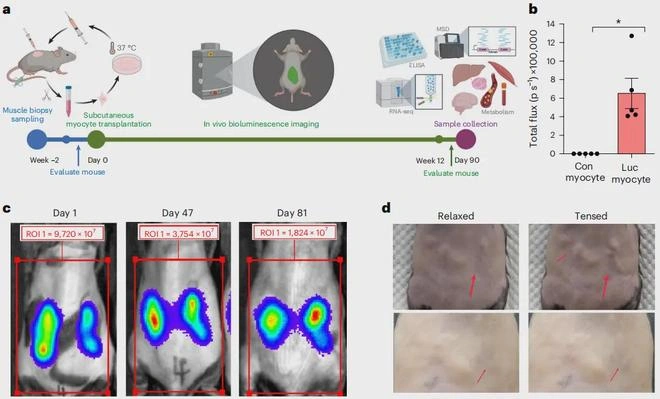
The researchers first isolated muscle cells from the mice themselves, differentiated them in the laboratory, and then implanted them beneath the skin. The transplanted cells developed into muscle tissue containing mature muscle fibers and an established vascular network. The grafts continued to contract spontaneously for at least 81 days, without obvious tumor formation or migration to other organs.
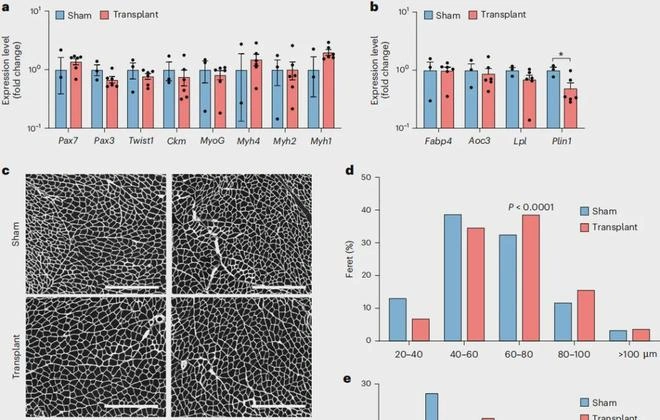
The grafts also showed increased expression of markers associated with muscle maturation and developed new blood vessels. Together, these findings suggest that the approach can generate stable, long-lasting “artificial muscle” tissue inside the body.
Further analysis revealed that these persistently contracting autologous grafts also functioned as endocrine tissues. Their transcriptomic profiles showed increased activity in pathways associated with cytokines and myokines, including IL-6, LIF, GDF15, FSTL1, FGF2, and FST.
In other words, the grafts were doing more than simply adding another piece of muscle. They continuously released a range of signaling molecules that could act throughout the body, potentially reproducing some of the systemic health effects of exercise.
In healthy mice, the subcutaneous muscle grafts caused muscle fibers at distant sites to become noticeably thicker and increased the expression of genes involved in muscle formation. At the same time, levels of the muscle-fat infiltration marker Plin1 and the chronic inflammation-associated gene Ifnγ decreased.
Importantly, the transplantation did not substantially alter the baseline state of the host’s own muscle stem cells. This suggests that the improvement in muscle function was driven primarily by systemic signals released by the grafts, rather than by directly modifying the animals’ resident muscle stem cells.
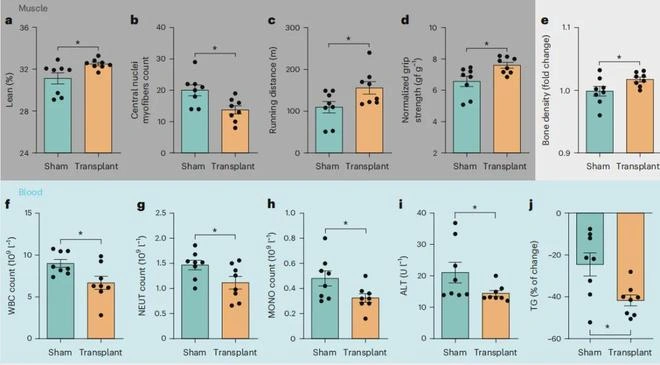
The effects were even more pronounced in aged mice. After receiving the autologous grafts, the animals gained lean body mass and showed improvements in running distance, grip strength, and bone density. Levels of inflammation-associated white blood cells, including neutrophils and monocytes, also declined.
In muscle tissue, pro-inflammatory gene activity was reduced, while expression of the anti-inflammatory cytokine IL-10 increased. The animals also showed higher energy expenditure and a lower respiratory exchange ratio, consistent with increased reliance on fatty acid oxidation.
Taken together, the findings suggest that the muscle grafts could simultaneously improve several hallmarks of aging, including muscle loss, reduced bone density, chronic inflammation, liver injury, and metabolic dysfunction.
The researchers then tested the approach in mice with diet-induced obesity. The muscle grafts improved hanging endurance and increased muscle mass across several skeletal muscle groups. They also improved metabolic parameters, including blood glucose and cholesterol levels.
Changes in genes involved in lipid metabolism and inflammation further supported the beneficial metabolic effects, suggesting that continuously contracting muscle grafts may have potential beyond aging and could also help counter muscle and metabolic abnormalities associated with obesity.
The team also explored whether the grafts could serve as a biological delivery system. They genetically engineered the transplanted cells to produce either parathyroid hormone, or PTH, or growth hormone, GH.
The modified grafts were able to continuously produce these proteins inside the animals and improve phenotypes related to bone or muscle health. Compared with administering high doses of hormones directly, using muscle grafts to release therapeutic proteins gradually and continuously could provide more stable exposure.
This approach could therefore offer a new platform for protein delivery as well as potential applications in cell and gene therapy.
Overall, the study developed a strategy in which muscle stem cells, or MuSCs, are differentiated into muscle cells outside the body and then transplanted back into the same animal beneath the skin.
The resulting myografts were mature, vascularized, long-lived, and capable of sustained contraction. In particular, the findings in aged and obese mice suggest that these grafts can produce systemic, exercise-like benefits, offering a potential new way to harness some of the health effects of physical activity when conventional exercise is not feasible.