



Chinese balloon incident
February 17, 2023 Public reaction to the balloon drama is vastly different on the two sides of the Pacific. The situation could lead to further escalation between the two nations.


Vijay Prashad: Why Rich Countries Become Racist?
June 7, 2023 Why India people believe BBC is telling the truth? Why TikTok struggles to be able to platform and highlight views of the south?Today, Vijay Prashad will continue to tell us why media from the Global South is fighting for their own narrative.
Vijay Prashad: Why Rich Countries Become Racist?
Why India people believe BBC is telling the truth? Why TikTok struggles to be able to platform and highlight views of the south?Today, Vijay Prashad will continue to tell us why media from the Global South is fighting for their own narrative.

Why was China never wiped out like all the other ancient civilizations?
May 26, 2023 China was able to rise and fall many times whereas the ancient Egyptian civilization, the Roman Empire, and the Great British Empire are all “dead”. Why China will not collapse? Prof. Wen Yang will go through each of the great empires and respond to this question.

Vijay Prashad: Why Does India Remain Entrapped by the UK?
May 24, 2023 What is Global South? Vijay Prashad, an Indian Historian, thinks it no longer a geographical concept, but a struggle for dignity from colonialism. Today, we are honoured to have Vijay Prashad to tell us why India still remains under the legacy of colonialism.
Will the real estate sector remain the driver of China’s economic growth?
DEBATE Will the real estate sector remain the driver of China’s economic growth? We’ve chosen and translated competing ideas on the future of China’s economy & the role of the real estate sector from ten top Chinese economists Editor’s note: China’s second largest property developer Evergrande made headlines in recent years for getting into a severe debt crisis, with liabilities of over US$300 billion. Evergrande is just one example of risks in China’s highly leveraged property sector,a sector which once performed as China’s economic engine. In just a few decades, the immense size and speed of China’s urbanization have exceeded the boldest predictions of the reformers who initiated it. The big shift in China’s urbanization policies came in the late 1980s, when the model of financing China’s industrialization and urbanization through agricultural accumulation was determined to be unsustainable. This led to China’s 1994 tax sharing reform, which gave local governments the initial incentives to develop a “land finance system, which later led to China’s real estate boom. This reform adjusted the tax distribution between the central and local governments, so that local governments were able to accumulate original capital at an unprecedented speed. Without land finance, many of the problems of China’s economy, such as soaring housing price, wouldn’t have existed. On the other hand, China’s rapid development wouldn’t have occurred either, as “land finance” provided a much-needed funding solution for China in the 90s. Against this backdrop, we debate this question: Will the real estate sector remain the driver of China’s economic growth? Yes Justin Yifu Lin Director of the Institute of New Structural Econimics, Peking University ” The real estate sector will continue to be the driver of China’s economic growth. But in the coming years, housing will no longer be an asset for speculation, but rather an asset for living, which will make both the housing market and the economy much healthier. I think the Chinese government will find ways to support public housing, as we have seen in Singapore. There will certainly be significant investment in public housing, which will also spureconomie growth. ” Zhang Yuewen Director of Capital Market Research Department, Institute of Finance, Chinese Academy of Social Sciences ” Real estate will be considered all the more pivotal to China’s economy which is projected to be volatile in the near term. In the short run, the government will continue its policy support for the stable development of the real estate sector. In the long run, a transformation of the industry would benefit generations to come. The future of China’s real estate sector lies in further structural differentiation and diversification, which will allow the industry to be more professional in providing housing that meets the needs of the public, especially the need for higher quality housing and higher quality of life. ” Xu Gao Chief Economist of BOC Securities and Director of China Chief Economist Forum ” I think the ‘winter of exports’ has just begun. In the past two years China’s economy can be best described as ‘hot outside and cold inside’, meaning weak domestic demand. As we are likely to see a weakened external demand for China in 2023, the driver of “stable growth” can only come from domestic market. I think it’s crystal clear that it will come from the real estate industry. Since the US subprime mortgage crisis and the subsequent global financial crisis extended its influence on China, deflationary pressures brought about by the lack of domestic demand has always been one of the key restraints on China’s economic growth. China’s economy will likely see fast growth again if new domestic demand is located. What we’ve seen in the past two years is comparatively strong external demand, and a dampened domestic demand. The real estate was not only experiencing low growth rate, but also performing abnormally, almost creating a vicious circle, which resulted in the stalling growth in economy overall. ” Yin Yanlin Chief Economist of BOC Securities and Director of China Chief Economist Forum ” Real estate is the pivotal industry of the national economy, but it is also the industry that has been subject to the most regulation, and the one with the lowest market confidence. Promoting the healthy development of the real estate industry is critical to the improvement of overall economic performance. ” Deng Haiqing Vice President and Chief Investment Officer of AVIC Fund ” Real estate is likely to play a leading role driving China’s economic growth in 2023. In contrast to previous times, real estate purchased for personal use will play a bigger role in boosting China’s economy compared with those purchased for investment purposes. Due to comparatively high unemployment in the past two years, young people were postponing marriage and real estate purchase, creating a pent-up demand in real estate sector. Among the younger generation, especially among those who hope to start a family, property purchase is likely one of the largest purchases of their lives. We expect to see ‘revenge spending’ on real estate for personal use in 2023. ” No Shen Minggao Guangfa Securities: China’s economic growth driven by real estate is unsustainable. ” We believe China’s economy is entering into a post-real estate age. What does it mean? Of course for China there is still room for urbanization. Currently in China, only 60% of the population live in urban areas, whereas urbanization has reached 80% or even 90% in some developed countries. But with the advent of the post-real estate economy, the end is near for an age when real estate and its industrial supply chain function as the main driver for economic growth. As for investment recommendations, areas that are not highly related with the real estate sector, such as power equipment, automotive and electronics, are worth countercyclical investment. ” Xing Ziqiang Chief Economist, Morgan Stanley China ” In the future, average real estate sales will be around 10 million units per year, with a total value of roughly RMB 11-12 trillion – a step down from 16 trillion yuan previously. This will be the New Normal. In 2019 and 2020, housing was oversupplied in China due to excessive leverage commonly practiced in the industry. Under the current policy direction of “housing for living, not for speculation”, it is unlikely that the real estate sector will bounce back to its status of 2019, despite policies put in place to restore and stimulate the real estate sector. China’s policy direction should be interpreted as helping to stabilize real estate under the “New Normal”, and avoiding overadjustment so as to break the downward spiral oflow expectations, low sales. ” Wang Tao Chief China Economist, Head of Asia Economic Research UBS: Real estate will not be the most important engine of economic growth in the future. ” China is recalibrating its real estate policies, as seen through the ’16-point playbook’ released in mid-November 2022. The major policies shifted from ‘deleveraging’ to ‘stabilizing real estate and the economy’. In the long run, real estate will remain as China’s pillar industry, but its importance in economic development will be significantly reduced compared to the decade of 2000-2013; it will not be the main engine of economic growth. ” Ding Shuang Chief Economist of Greater China and North Asia, Standard Chartered Bank and Director of China Chief Economist Forum: “ Real estate investment will be less of a drag on the economy, but cannot yet become an engine of growth.” ” We expect to see stronger stabilization in real estate investment thanks to China’s latest financing support initiatives for the real estate sector. The introduction of these measures indicates that China is switching from a piecemeal policy approach to a comprehensive approach. If these measures are effectively implemented, the financing needs of developers with relatively sound financial and operating conditions will be better fulfilled, which will contribute to the stabilization of the real estate sector. However, given the timing difference among real estate financing, sales and investment, plus the structural downward trend in housing demand, we expect that while the negative effect of real estate investment on economic growth will be lessened in 2023, it will not be a growth engine either. ” Wang Xiaolu deputy director and researcher of the National Economic Research Institute of China Reform Foundation and executive director of the China Society for Economic System Reform. ” The housing construction area of real estate development enterprises reached close to 1.6 billion square meters per year for the past three years. Under the current pace, we will see a surplus of one third of the commercial real estate. Market saturation has occurred in China’s real estate sector. Decline in China’s housing market data is not caused by short-term fluctuation, but long-term trends. I am afraid that this year will be the inflection point. China’s housing market will gradually contract in the future. Many people currently believe that ‘real estate investment will remain the driving force of China’s economic growth in the future’. I am afraid that this judgment is wrong. This is only a phenomenon that has happened in the past as opposed to a phenomenon that will keep happening in the future. “
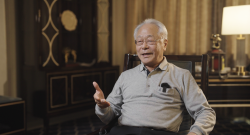
As a Taiwanese, he said: Peaceful reunification is the only way for Taiwan to survive
March 7, 2023 As a Taiwanese political prisoner who supports reunification, he argues that recognizing Taiwan as part of China and pursuing peaceful reunification is the only viable path forward for Taiwan's survival and prosperity amid growing cross-strait tensions.