


Author: CA
Contributors-Eric Li S. M.
Contributors / Advisory Board Eric Li S. M. Eric Li S. M. is chairman of Chengwei Capital. He is founder and chairman of Guancha.cn, and a trustee of Fudan University’s China Institute and chairman of its advisory council. He also serves on the boards of School of SciTech Business at University of Science and Technology of China, Graduate School of Business at Stanford University, Asia Society Hong Kong, and the International Institute for Strategic Studies (IISS). He received his B.A. in economics from University of California, Berkeley, MBA from the Graduate School of Business at Stanford University, and Ph.D. in political science from Fudan University. He is a frequent contributor to leading global publications such as Foreign Affairs, Foreign Policy, The New York Times, Financial Times, and The Economist.
Contributors-Di Dongsheng
Contributors / Advisory Board Di Dongsheng Professor and Associate Dean of the School of International Studies (SIS) at Renmin University of China (RUC). Dr. Di is the vice president of the China Society of Emerging Economies (CSEE) and the founding dean of the School of Global and Area Studies of RUC. He is one of the most influential Chinese political economist. His research interests include The International Political Economy of Monetary and Finance, China’ s Foreign Economic Relations, American Political Economy, Political Economics of Empires. Featured Works Dongsheng, Di; Lun, Wei (2015). Great Power Currencies: International Currencies and Currency Internationalization (in Chinese). Beijing: Peking University Press. ISBN 9787301254813. Dongsheng, Di (2019). Money, Power and People: The Humanistic Political Economy of the Global Monetary and Financial System (in Chinese). Beijing: Chinese Social Sciences Press. ISBN 9787520344029. Dongsheng, Di (2019). Why China has a Future (in Chinese) (3rd ed.). Mechanical Industry Press. ISBN 9787111628330. Dongsheng, Di (2021). Parallel Competition (in Chinese). Beijing: Oriental Publishing House. ISBN 9787520722353. Experiences In 2001, Dr. Di worked as a visiting scholar at Science Po Paris in France, and further expanded his international experience as a visiting scholar at Durham University in the UK in 2003. Additionally, he taught as a part-time teacher at Vrije Universiteit Brussel (VUB) and Boston University Brussels (BU-Brussels-Campus) during 2005-2006. Starting in 2011, Professor Di has been serving as the Deputy Director and Secretary-General of the Center for International Strategy Studies at Renmin University of China. In 2015, he was invited to Georgetown University as a visiting scholar, where he delivered lectures on China’s reform and economy at prestigious institutions including the US Department of State, Wall Street Hedge Fund, University of Chicago, and Chicago Stevenson Center. In 2017, he became the Vice Dean of the School of International Relations at Renmin University of China. Show less Show more
Contributors-Charles Liu
Contributors / Advisory Board Charles Liu Strategic Committee Member of China Academy, Senior fellow at Taihe Institute, Chairman and co-founder of Hao Capital, is the Chairman of Investment Committee of Leading Tech Capital. Experiences From 1975 to 1990, Charles served in the UN Economic and Social Council for 15 years, mainly serving as the negotiation secretary or executive secretary of international conferences and negotiations. From 1991 to 1999, he served as Managing Director of Lazard Asia Investment Bank, a leading investment bank, where he made significant contributions to China’s investment attraction in the telecommunications, finance, automotive and infrastructure industries. He has also provided senior consulting services to a number of Fortune 500 companies. In 2003, he served as Chairman of the Investment Committee of the Board of Directors of Applied Materials, Inc. and became the only Chinese director of a Fortune 300 company at that time. Show less Show more Recent Events 3:19 Who benefits the most from the US banning of TikTok? March 14, 2024
Contributors-Wen Yang
Contributors / Advisory Board Wen Yang Wen Yang is a retired Naval officer, research fellow at the China Institute of Fudan University, the Shanghai Chunqiu Institute for Development and Strategic Studies, and the Chongyang Institute of Chinese People’ s University. Featured Works Co-authored “China’s Strength” (2009) Co-authored “Why China Again?” (2022) Authored “The People’s Republic” (2017) Authored “China As Tianxia: The Huge Nation and Sedentary Civilization” (2019) Authored “The Logic of Civilization: The Interaction and Evolution of Chinese and Western Civilization” (2021) Lecturer of the 40-episode audio course “Wen Yang on Civilization” (2021) Lecturer of 2 episodes of the video course “What The West Gets Wrong About China?” (2023) Lecturer of 2 episodes of the video course “Why China Will Not Collapse?” (2023) Experiences He was the chief editor of Chinese newspapers and websites in New Zealand (2003-2012), columnist for overseas Chinese media(2001-2009). Show less Show more Recent Events 21:02 Why was China never wiped out like all the other ancient civilizations? March 7, 2023
Contributors-Wen Yi
Contributors / Advisory Board Wen Yi Renowned Chinese economist at Shanghai Jiao Tong University. He specializes in the field of macroeconomics. His research interests include Business Cycle theory, savings and investment theory, and monetary policy. Featured Works “Capacity Utilization under Increasing Returns to Scale.” Journal of Economic Theory 81 (1998) 7-36. “Can a Real Business Cycle Model the Watson Test?” Journal of Monetary Economics 42 (1998) 185-230. “Investment Cycles.” Journal of Economic Dynamics and Control 22 (1998) 1139-1165. “Indeterminacy, dynamic adjustment costs, and cycles,” Economics Letters 59 (1998) 213-216. “A simple nonlinear filter for economic time series analysis,” (with Bing Zeng) Economics Letters 64 (1999) 151-160. “A generalized method of impulse identification,” Economics Letters 73 (2001), 367-374. “Understanding self-fulfilling rational expectations equilibria in real-business-cycle models.” Journal of Economic Dynamics and Control 25 (2001) 1221-1240. “Residential Investment and Economic Growth,” Annals of Economics and Finance 2 (November 2001), 437-444. “Joint time-frequency distributions for business cycle analysis,” (with Sharif Raihan and Bing Zeng) Lecture Notes in Computer Science 2252 (2001), 347-358. “The business cycle effects of Christmas.” Journal of Monetary Economics 49 (2002), 1289-1314. “Indeterminacy, aggregate demand, and the real business cycle.” (with Jess Benhabib), Journal of Monetary Economics 51 (2004), 503-530. “What does it take to explain procyclical productivity?” Contributions to Macroeconomics 4 (2004, No.1), Article 5 (in The B.E. Journals in Macroeconomics). “Endogenous money or sticky prices? Comment on monetary non-neutrality and inflation dynamics.” (with Peng-Fei Wang), Journal of Economic Dynamics and Control 29 (2005, No. 8), 1361-83. “Understanding the Inventory Cycle.” Journal of Monetary Economics 52 (2005), 1533-1555. “Demand shocks and economic fluctuations.” Economics Letters 90 (2006), 378-383. “Another look at sticky prices and output persistence,” (with Peng-fei Wang) Journal of Economic Dynamics and Control, December 2006, 30(12), pp. 2533-52. “By force of demand: Explaining international comovements,” Journal of Economic Dynamics and Control 31(1), January 2007, 1-23. “Understanding the large negative impact of oil shocks,” (with Luis Conraria) Journal of Money, Credit, and Banking 39(4), June 2007, 925-44. “Granger causality and equilibrium business cycle theory,” Federal Reserve bank of St. Louis Review 89(3), May/June 2007, 195-205. “Measuring interest rates as determined by thrift and productivity,” (with Woongyu Choi), Annals of Economics and Finance 8(1), May 2007, 159-187. “Production and inventory behavior of capital,” Annals of Economics and Finance 8(1), May 2007, 87-104. “What’s unique about the federal funds rate? Evidence from a spectral perspective,” (with Lucio Sarno and Daniel Thornton) Oxford Bulletin of Economics and Statistics, April 2007, 69(2), 293-319.. “Inflation Dynamics: A Cross-Country Investigation,” (with Peng-fei Wang) Journal of Monetary Economics October 2007, 54(7), 2004-31. “Imperfect competition and composition of aggregate output,” (with Peng-fei Wang), Journal of Economic Theory November 2008, 143(1), 519-40. “A note on oil dependence and economic instability,” (with Luis Conraria), Macroeconomic Dynamics, November 2008, 12(5), 717-23. “Global indeterminacy in locally determinate RBC models (with Tarek coury), International Journal of Economic Theory, March 2009, 5(1), 49-60.[27] “Understanding the Puzzling Effects of Technology Shocks,” (with Peng-fei Wang), Review of Economic Dynamics October 2011, 14(4), pp. 705-24. -“Dynamics of Externalities: A Second-order Approach,” (with Huabin Wu)., Federal Reserve bank of St. Louis Review April/May, 2011. “Can rising housing prices explain China’s high household saving rate?” (with Xin Wang), Federal Reserve Bank of St. Louis Review May/June, 2011. “Input and Output Inventory Dynamics,” American Economic Journal: Macroeconomics, October 2011, 3(4), pp. 1-33. “Volatility, Growth, and Welfare,” (with Peng-fei Wang), Journal of Economic Dynamics and Control 35 (2011) 1696–1709. “OPEC’s Oil Exporting Strategy and Macroeconomic (In)Stability” with Luís Aguiar-Conraria, Energy Economics, January 2012, 34(1), 132-136. “Hayashi Meets Kiyotaki and Moore: A Theory of Capital Adjustment Costs” with Pengfei Wang, Review of Economic Dynamics, September 2012, 15(2), 207-225. “Speculative Bubbles and Financial Crisis” with Pengfei Wang, American Economic Journal: Macroeconomics, July 2012, 4(3), 184-223. “Housing Prices and the High Chinese Saving Rate Puzzle” with Xin Wang China economic review, June 2012, 23(2), pp. 265-283. “Leveraged Borrowing and Boom-Bust Cycles” with Patrick A. Pintus, Review of Economic Dynamics, October 2013, 16(4), 617-633. “What Inventory Tell Us about Business Cycles? A (S,s) Approach,” with Pengfei Wang and Zhiwei Xu, Journal of Economic Dynamics and Control 44, pp. 196-217, July 2014. “Money, Liquidity and Welfare,” European Economic Review 76, pp. 1-24, May 2015. “Sentiments and Aggregate Demand Fluctuations,” with Jess Benhabib and Pengfei Wang, Econometrica 83(2), pp. 549-585, March 2015. “The Great Housing Boom of China,” with Kaiji Chen, American Economic Journal: Macroeconomics April 2017, Vol. 9, No. 2, pp. 73-114 “Self-Fulfilling Credit Cycles,” with Costas Azariadis and Leo Kaas. Review of Economic Studies, October 2016, Vol. 83, No. 4, pp. 1364-1405 “Two-Way Capital Flows and Global Imbalances,” with Pengfei Wang and Zhiwei Xu. Economic Journal, February 2017, Vol. 127, No. 599, pp. 229-269 “Long and Plosser Meet Bewley and Lucas” with Feng Dong, Journal of Monetary Economics, April, Vol. 102, No. April, pp. 70-92 Working Paper https://doi.org/10.1016/j.jmoneco.2019.01.025 “Credit Search and Credit Cycles,” with Feng Dong and Pengfei Wang, Economic Theory Volume 61 (2) – Sep 26, 2015. “Should Capital Be Taxed?” with Yunmin Chen, YiLi Chien, and C.C. Yang, Economics Letters (forthcoming). “Withstanding Great Recession like China” with Jing Wu, Manchester School, 2018-05-28 Working Paper https://doi.org/10.1111/manc.12223 “Financial Development and Long-Run Volatility Trends” with Pengfei Wang, Review of Economic Dynamics, April 2018, Vol. 28, pp. 221-251; Working Paper https://doi.org/10.1016/j.red.2017.08.005 “Are Unconditional Lump-sum Transfers a Good Idea?” with Yunmin Chen, Yili Chien, and C.C. Yang, Economics Letters (forthcoming), Federal Reserve Bank of St. Louis Working Paper 2021-002C, August 2021 “Time-Inconsistent Optimal Quantity of Debt” with Yili Chien, European Economic Review (forthcoming), Federal Reserve Bank of St. Louis Working Paper 2020-037E, September 2021 “Optimal Ramsey Capital Income Taxation under Quasilinear Preferences” with Yili Chien, Review of Economic Dynamics (forthcoming), Federal Reserve Bank of St. Louis Working Paper 2017-024C, February 2018 “China’s Industrial Revolution—A New Perspective,” China Economic Review, Volume 69, October 2021, 101671 “The Determination of Public Debt under both Aggregate and Idiosyncratic Uncertainty” with Yili Chien, Journal of Economic Theory (forthcoming) The Great Chinese Industrial Revolution (in Chinese), Tsinghua University Press, 2016 The Making of an Economic Superpower: Unlocking the Secret of China’s Rapid Industrialization, World Scientific Publishing CO, 2016 The Code of the Scientific Revolution – Guns, War, and the Mystery of the Rise of the West (in Chinese), China Eastern Publishing CO, 2022 Experiences In 1982, he obtained a Bachelor of The West China Medical Center, Sichuan University. In 1991, he earned a Master’s degree in History and Philosophy of Science from the University of Notre Dame. In 1996, he received a Ph.D. in Economics from the University of Iowa. He then served as an Assistant Professor at the Department of Economics at the Hong Kong University of Science and Technology (1996-1999) and at the Department of Economics at Cornell University (1999-2005). He was a visiting professor at Washington University in St. Louis (2005-2008). Starting from 2005, he served as a Senior Researcher at the Federal Reserve Bank of St. Louis, and in 2008, he was promoted to Assistant Vice President. In the same year, he became a professor of Economics at Tsinghua University, holding the CCB Chair Professorship and serving as a doctoral supervisor. He has been awarded lifetime professorships at Indiana University and the University of Warwick [he decided to stay at the Federal Reserve without taking up these positions]. In August 2021, he resigned from the Federal Reserve Bank and joined Antai College of Economics and Management at Shanghai Jiao Tong University as a Distinguished Full Professor in the Department of Economics. Show less Show more
Contributors-Zhang Weiwei
Contributors / Advisory Board Zhang Weiwei Distinguished Professor at Fudan University and Director of the China Institute in Shanghai. Professor Zhang has written extensively on China’s economic and political reform, the China Model, and comparative politics. He is one of the most influential Chinese political scientists. Featured Works Ideology and Economic Reform under Deng Xiaoping (1978-1993), a publication of the Graduate Institute of International Studies, Geneva), Kegan Paul, London and New York, 1996. Transforming China: Economic Reform and its Political Implications, Macmillan Press, London and New York, 2000. The China Wave: Rise of a Civilizational State, World Century, NJ, 2012 The China Horizon: Glory and Dream of a Civilizational State, World Century, NJ, 2015 Experiences In the mid-1980s, Professor Zhang served as an English translator for Deng Xiaoping and other Chinese leaders. In 2011, he debated Francis Fukuyama on the China Model and accurately predicted the turmoil of the “Arab Spring”. His 2014 video “Chinese People, You Should be Confident” was viewed hundreds of millions of times online. His commentary show “China Now” has received acclaim domestically and abroad. In 2022 it won China’s top television award. He has lectured at institutions including Harvard, Oxford, Cambridge and Yale. He has participated in international conferences like the World Economic Forum in Davos and Boao Forum. Major media outlets including CCTV, BBC and The Economist have interview In 2016, he spoke at a national conference hosted by President Xi Jinping. In 2019 he represented ideological circles at the PRC’s 70th anniversary parade. In 2021, he lectured and advised the CPC Political Bureau on strengthening China’s international communications. Show less Show more Recent Events 11:44 Who is Dividing Asia?|Thinkers Forum· Zhang Weiwei & Vijay Prashad March 7, 2023
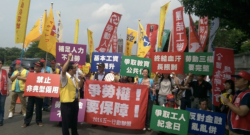
Taiwan’s Workers’ Movement
March 14, 2023 An opportunity to delve into the Taiwan's complex history surrounding workers' rights, labor movements, and cross-strait relations, while also considering the future of its workforce.