



A wall around a nursery
Washington has erected a wall around an industry that is still learning how to manufacture at scale. On July 28, 2026, the Federal Communications Commission placed foreign-produced advanced robotic devices on its Covered List. The practical effect is that qualifying new mobile robots cannot obtain the equipment authorizations needed for legal U.S. marketing unless the Department of War grants conditional approval. The security logic is straightforward: a networked machine with cameras, microphones, mapping data and physical force can be a surveillance node, an attack surface or, in the worst case, a remotely controlled hazard.[1]
But the economic question is harder. The United States is not choosing between an open market and a ready-made domestic supply chain. It is choosing how much friction to add while its robot makers still rely on foreign arms, actuators, reducers, sensors, batteries, electronics and processed magnetic materials. That distinction drives the three-year verdict: protection can reserve demand for U.S. firms, yet a ban on finished products does not automatically create the missing inputs underneath them.
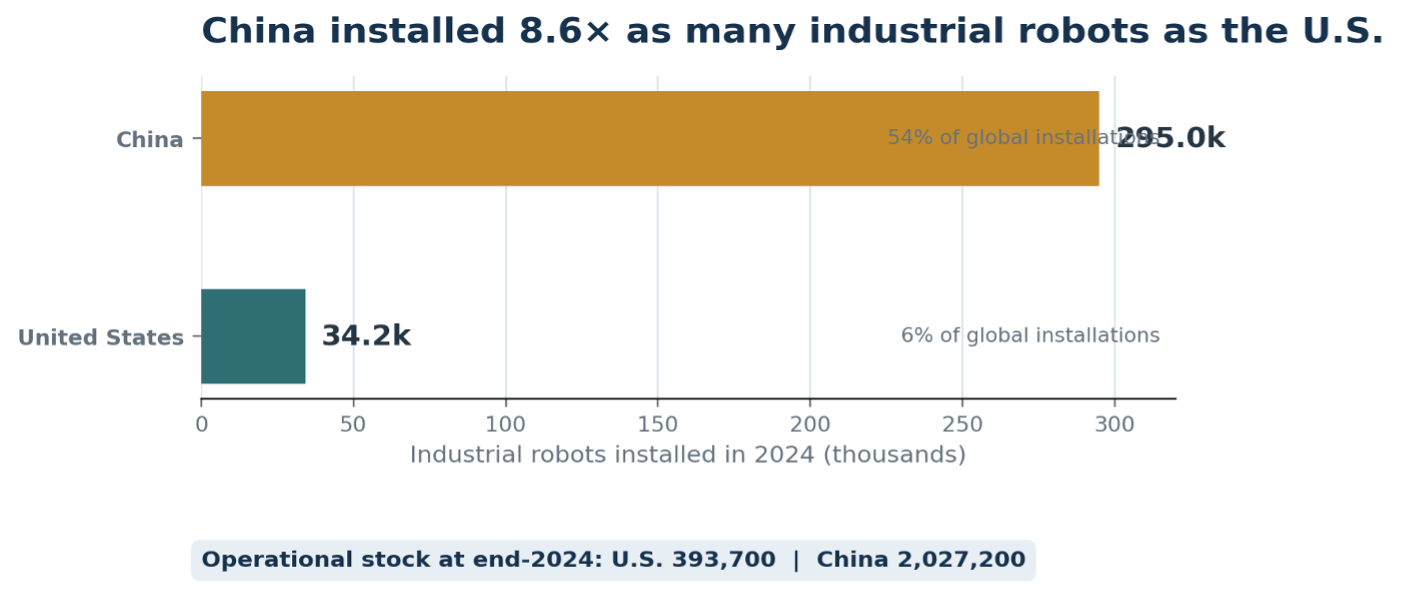
Figure 1. 2024 industrial-robot installations and operational stock. Source: International Federation of Robotics, World Robotics 2025.
The Actual Policy
The headlines call this a China robot ban. The legal mechanism is both broader and narrower. It is broader because the category is based on where a device is produced, not the nationality of a named company; on paper, a Japanese, European or Korean mobile robot can also be caught. It is narrower because it applies to new FCC authorizations. Models already authorized can continue to be marketed for now, and fixed industrial arms—the workhorses of car and electronics plants—are explicitly excluded, along with regulated medical devices, cars, rail systems, drones and underwater vehicles.[1][4]
The component issue is similarly indirect. The FCC did not put every foreign robot motor or gearbox on the Covered List. Instead, a new mobile robot escapes the foreign-produced category only if it is manufactured in the United States and clears the federal Buy American content test: more than 65% domestic component cost through 2028, rising to 75% in 2029. Unknown-origin components are treated as foreign. Separate radios and communications modules still face their own authorization rules. A U.S. startup can therefore design the software, write the control stack and perform final assembly at home—and still fail the test because too much of the bill of materials is foreign.[2][3]
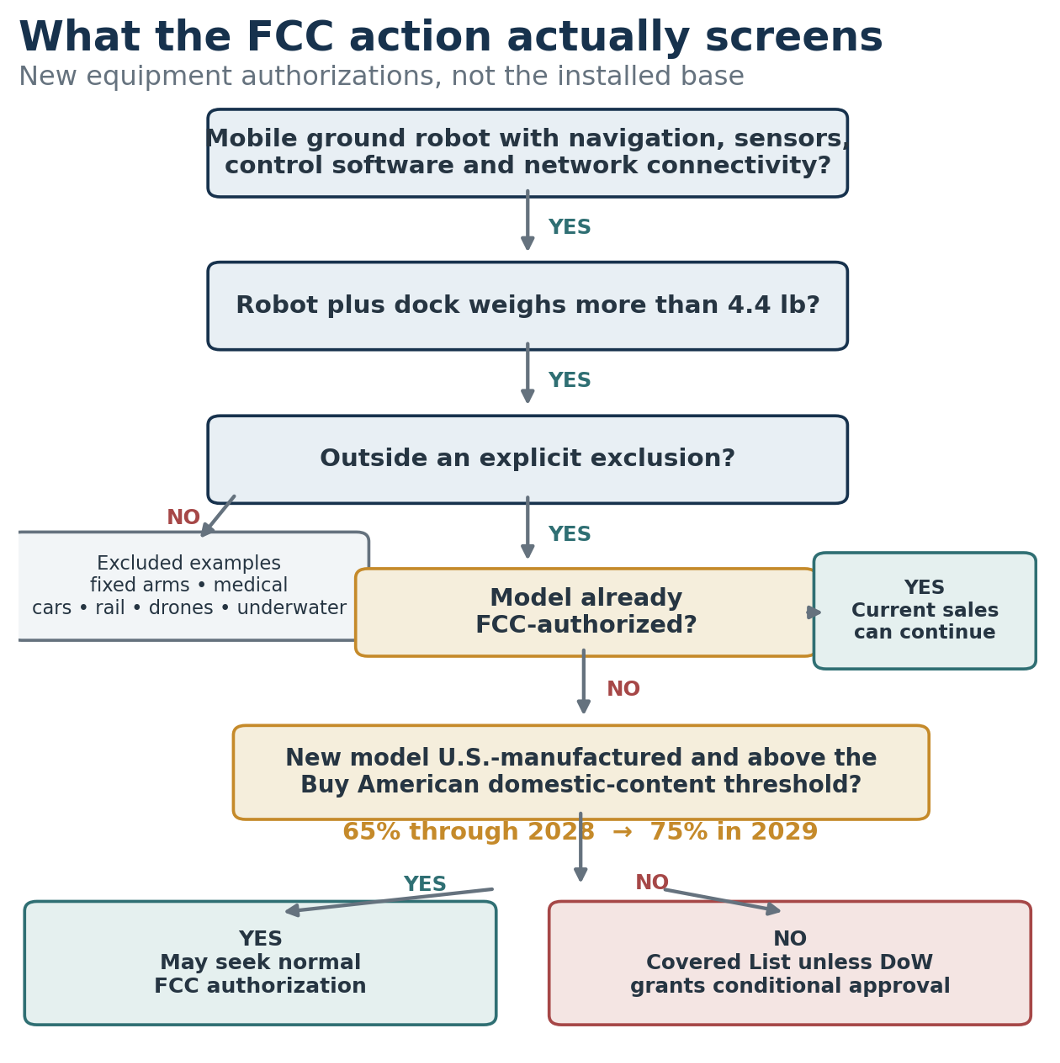
Figure 2. Simplified coverage test. Exact classifications and conditional approvals remain fact-specific. Sources: FCC; Federal Acquisition Regulation.
The American robotics industry is several industries
The mature market is conventional factory automation. Here, U.S. plants buy heavily from FANUC and Yaskawa of Japan, ABB of Switzerland and KUKA of Germany, now owned by China’s Midea. The United States is stronger downstream: more than 1,000 system integrators design cells, add grippers and vision, write software, install safeguards and keep production running. The Association for Advancing Automation estimates that these integrators employ roughly 60,000 people. A robot arm may be only half the cost of an installed system, which is why pressure on imported hardware can cascade into small engineering firms and their manufacturing customers.[7]
The liveliest domestic cluster is mobile logistics. Amazon Robotics has deployed more than one million robots across its network. Symbotic automates the movement of retail cases and pallets. Locus Robotics sells autonomous mobile robots to warehouses; Boston Dynamics sells Stretch for truck and case handling; Zebra owns Fetch Robotics. This is the segment the FCC rule most directly reshapes—and the segment where the United States has the strongest commercial base to protect.[12][13]
At the frontier sit humanoids: Tesla’s Optimus, Figure’s 03, Apptronik’s Apollo, Agility Robotics’ Digit and Boston Dynamics’ Atlas. They have raised large sums and secured serious factory partners, but the numbers remain pilot-scale. Figure says its earlier robot handled 90,000 parts during an 11-month BMW deployment; Agility reports commercial deployments across nine facilities; Apptronik has production and pilot partnerships with Jabil, Mercedes-Benz and GXO. These are meaningful milestones—not proof that general-purpose humanoids have found mass-market economics.[9][10][11]
A segment map
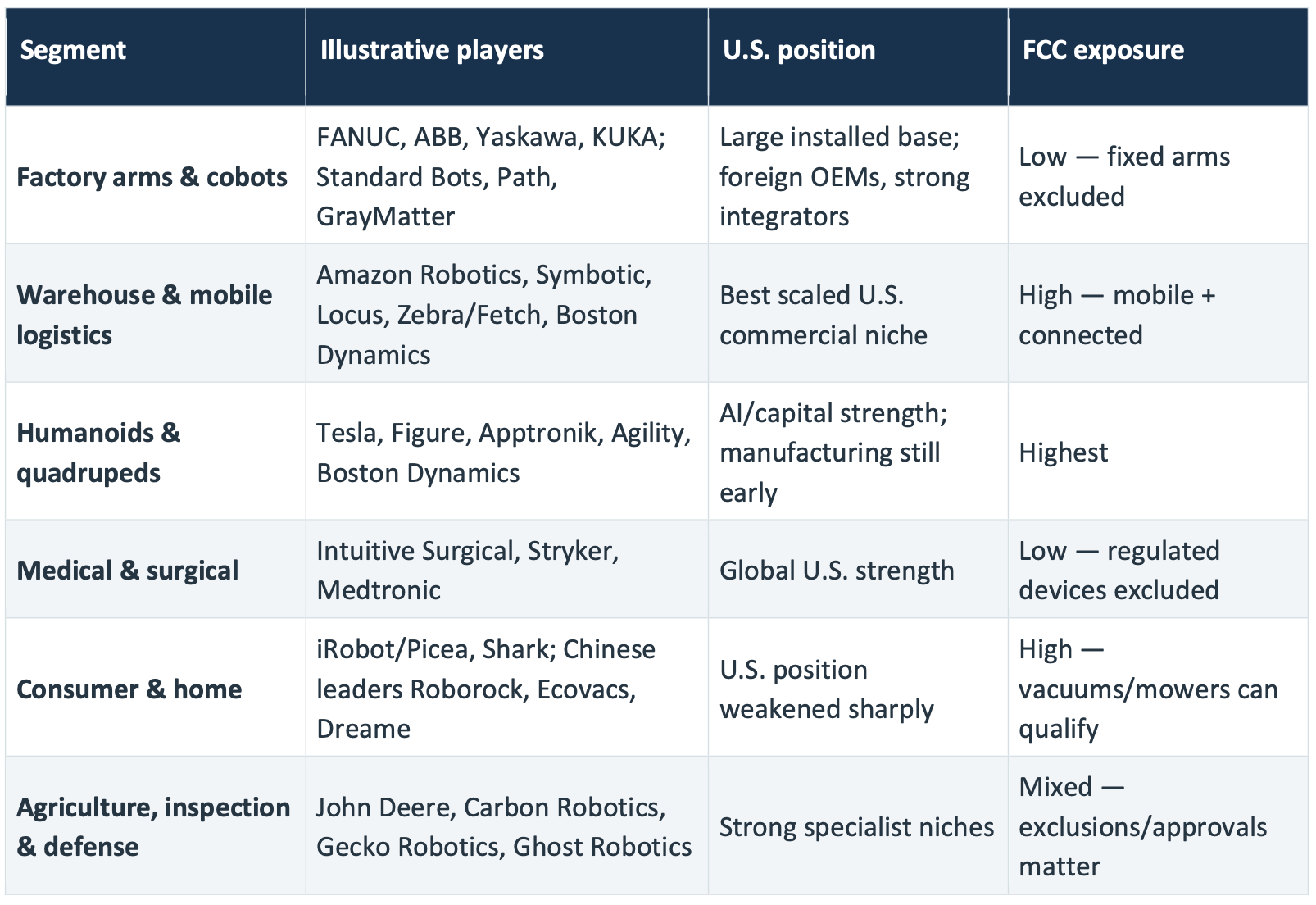
Table 1. Illustrative, not exhaustive. FCC exposure refers to the new advanced-robot-device category, not every other trade or national-security rule.
Scale is the central shortcoming
The United States remains a major robot user, but it is not the global volume engine. It installed 34,200 industrial robots in 2024, versus China’s 295,000. The U.S. operational stock was 393,700, less than one-fifth of China’s 2.03 million. Preliminary data show U.S. installations rose to about 38,000 in 2025, a welcome rebound, but not a change in the global production map. The International Federation of Robotics describes the U.S. market plainly: most robots are imported from Japan and Europe; domestic robot suppliers are few; system integration is the deeper local capability.[5][6]
Within U.S. demand, automotive manufacturing still dominates, accounting for 40% of 2024 installations. Food, metals and electronics are growing opportunities, but they buy in smaller volumes. That matters because component plants need recurring orders. Association for Advancing Automation (“A3”) argues that onshoring a sufficient base of robot hardware, components and trained labor would likely take five to ten years. The three-year forecast ends before that clock runs out.[5][7]
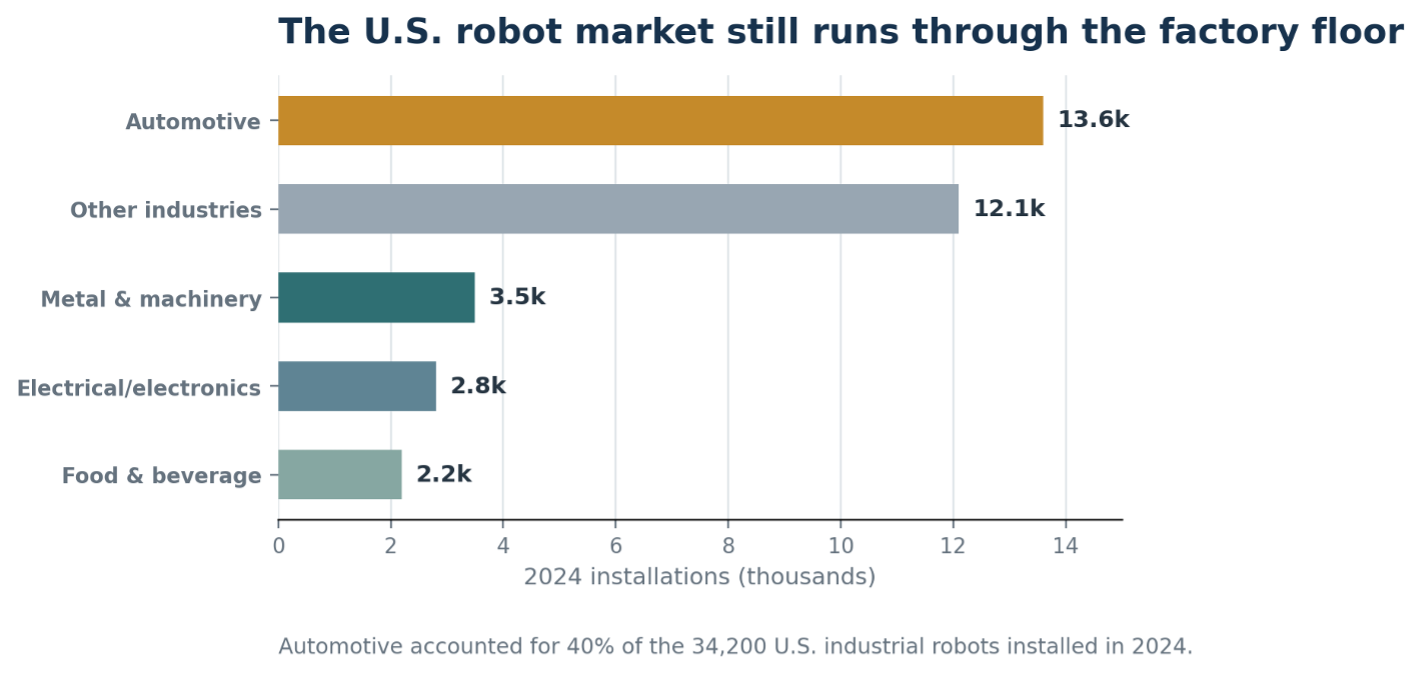
Figure 3. U.S. industrial-robot installations by customer industry, 2024. “Other” is calculated from the IFR total. Source: IFR.
The dependency is real—but it is not simply ‘made in China’
A robot is a stack. At the top, the United States is formidable in AI models, cloud infrastructure, advanced computing and autonomy software. At the bottom, the picture fragments. A3 says the domestic market lacks essential capacity in controllers, motors, drives, castings and gearboxes. High-end precision reducers and servos often come from Japan; conventional robot arms come largely from Japan and Europe. China’s advantage is breadth: dense clusters of suppliers, fast iteration, lower-cost mid-tier components, batteries and electronics, plus proximity between robot designers and factories.[7][15]
At the materials layer the imbalance becomes stark. The International Energy Agency estimates China produced 94% of the world’s sintered permanent magnets in 2024. Those magnets sit inside compact, high-torque motors used across robots. Yet even China is not self-sufficient at the technological frontier: a U.S.-China Economic and Security Review Commission study found Chinese robot makers still import large shares of advanced sensors, high-end actuators and ball screws. The useful industrial-policy conclusion is not that China makes everything. It is that China can assemble a much more complete, geographically concentrated stack at enormous volume.[8][16]
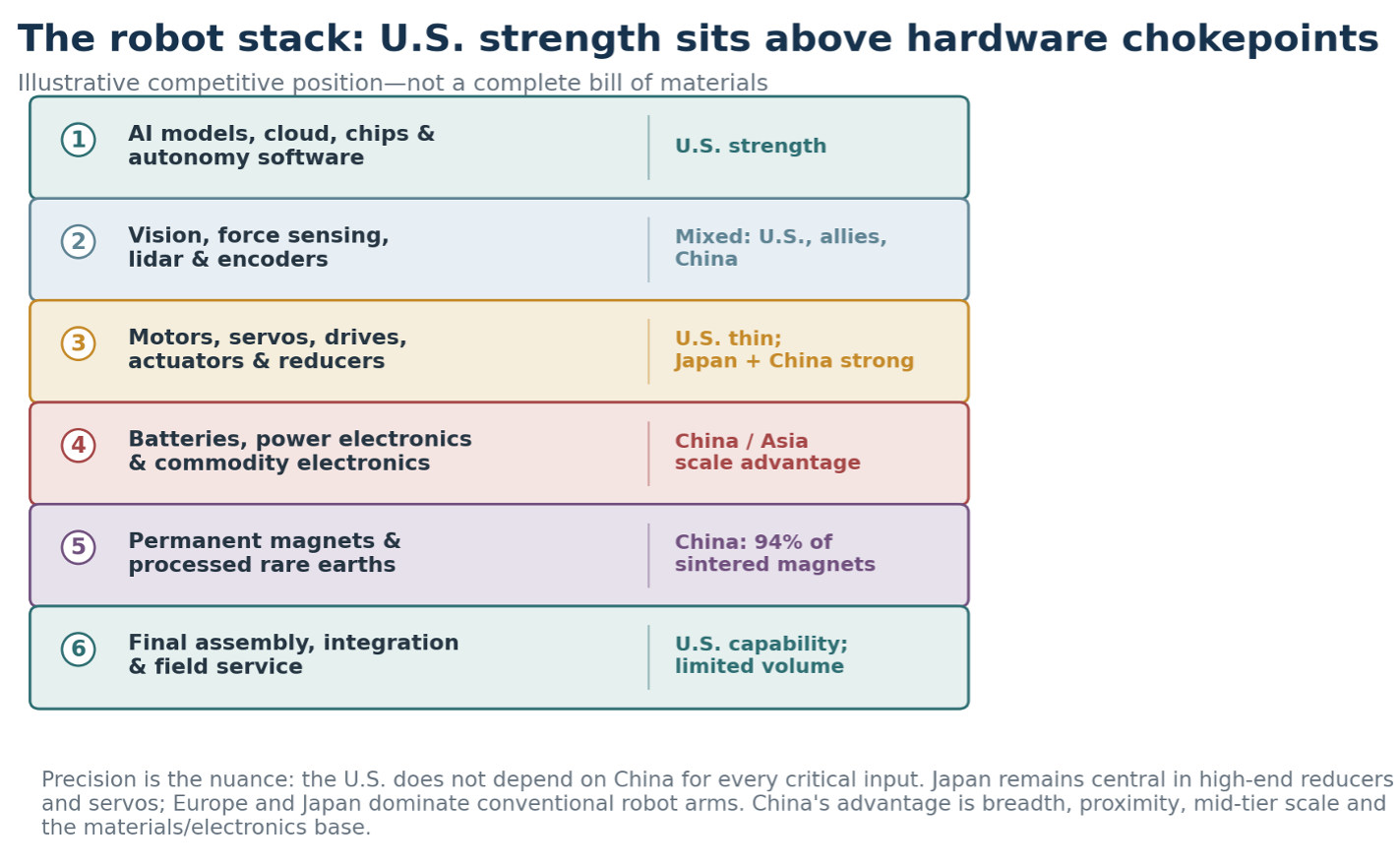 Figure 4. An illustrative robot stack. Sources: A3, IEA, USCC, CSIS and company disclosures.
Humanoids magnify both the promise and the trap
Humanoids are the cleanest case for infant-industry protection because no incumbent has yet locked up the global market. They are also the clearest warning about waiting. Counterpoint estimates roughly 16,000 humanoid installations worldwide in 2025, more than 80% in China. AgiBot and Unitree together accounted for well over half. The market is still tiny, practical autonomy and dexterity remain limited, and many deployments depend on teleoperation or tightly scripted tasks. But manufacturing learning compounds: every additional unit tests actuators, calibrates software, reveals failure modes and trains suppliers.[14][15]
Blocking low-cost Chinese robots protects U.S. firms from a brutal price comparison and prevents an early security-sensitive installed base from forming. It also removes inexpensive research platforms and can slow the collection of real-world data. If U.S. companies respond by sourcing from Japan, Korea or Europe, national resilience may improve, but Buy American compliance may not. If they redesign around immature domestic parts, cost and reliability suffer before scale arrives.
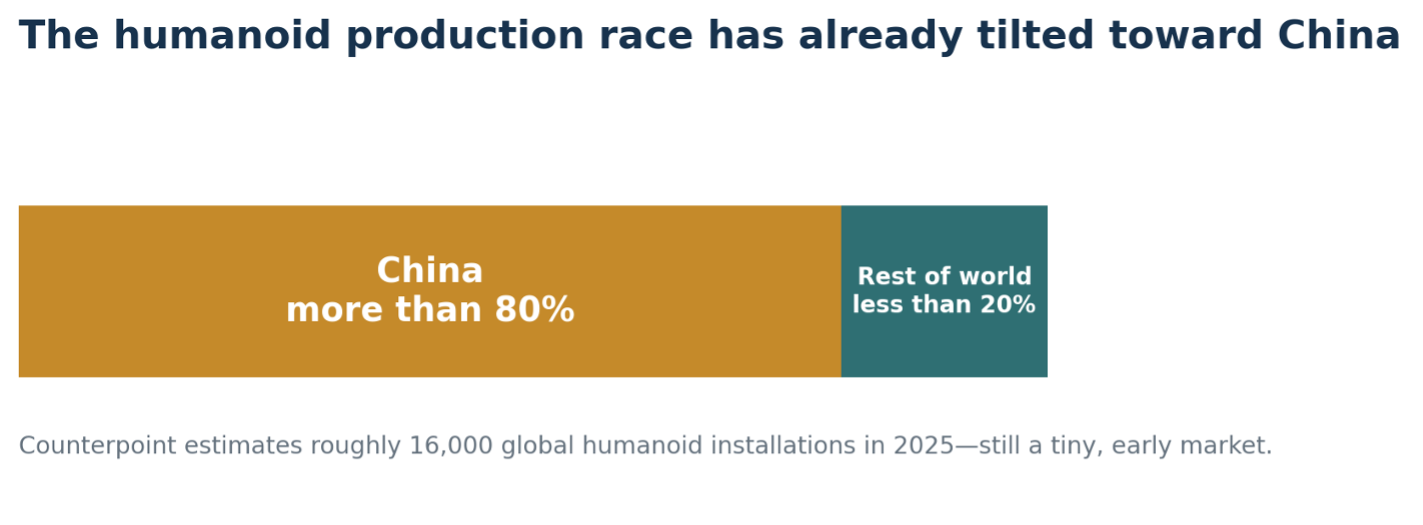 Figure 5. Conservative visualization of Counterpoint’s estimate that China represented more than 80% of 2025 humanoid installations.
What happens over the next three years?
The immediate winners are cybersecurity officials and U.S. mobile-robot vendors. Importers must map bills of material, ownership, data flows and manufacturing plans; government gains leverage through conditional approval. Domestic vendors face less direct competition from Unitree and other Chinese manufacturers in new models, which can improve order books, pricing power and investor confidence. A few component makers may receive credible new demand signals.
The immediate losers are users and intermediaries. Warehouses, universities, small manufacturers and consumers get fewer low-cost choices. Integrators sell fewer projects when hardware prices rise. Startups spend scarce engineering time on content accounting, waivers and redesign. Because existing authorized models can still be sold, the market will initially bifurcate: an aging inventory of approved foreign products beside costlier new compliant designs. The distortion grows in 2029, when the domestic-content threshold rises from 65% to 75%.[1][3][7]
By the end of the period, the United States will probably have more domestic mobile-robot assembly, more transparent supply chains and a handful of stronger national champions than it would without the rule. It will probably not have a self-sufficient component base. Tooling a precision gearbox plant, qualifying a new motor supplier, securing magnet materials, building service networks and training technicians take longer than three years. Meanwhile, Chinese firms retain their domestic market and much of the rest of the world. Their learning curve does not stop at the U.S. border.
That produces a mixed but directionally negative ecosystem result: modestly positive for selected U.S. vendors and national-security risk management; negative for adoption, integrators, research access and cost; roughly neutral for the strategic manufacturing gap by 2029. The rule can change who sells the next robot in America faster than it can change who makes the robot’s joints.
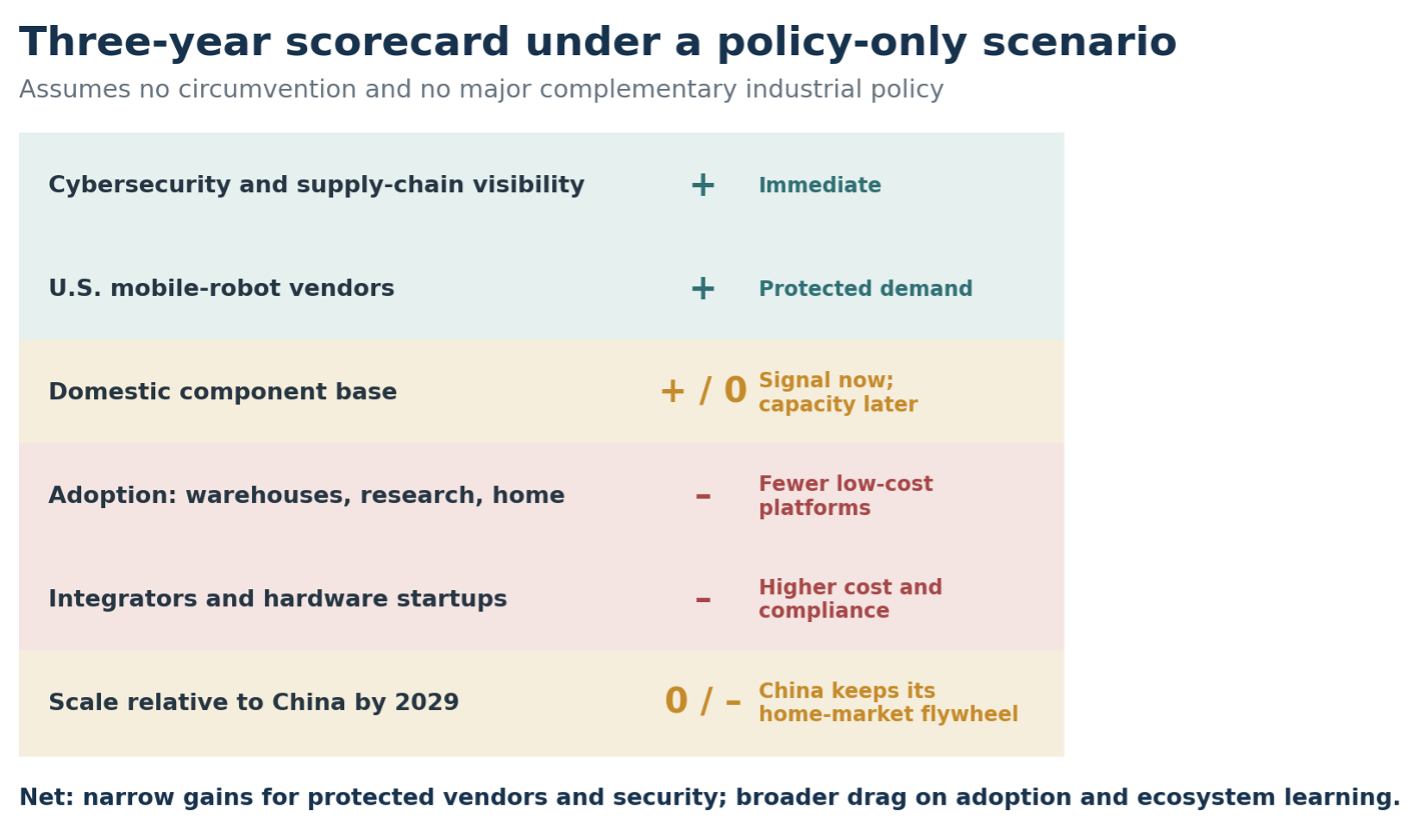 Figure 6. Author’s qualitative assessment under the assumptions stated at the outset.
A ban can buy time; only a package can use it
Protection becomes nurturing only when the protected market is paired with production and demand. From the US perspective, the conditional-approval process should reward verifiable U.S. investment without treating trusted allied supply as equivalent to opaque high-risk sourcing. Public procurement and deployment tax credits can aggregate demand. Grants, loans and purchase commitments can target motors, drives, reducers, sensors and magnet supply rather than subsidizing final assembly alone. Common safety, cybersecurity and interoperability standards can keep a protected market contestable instead of turning it into a club for a few well-financed firms.
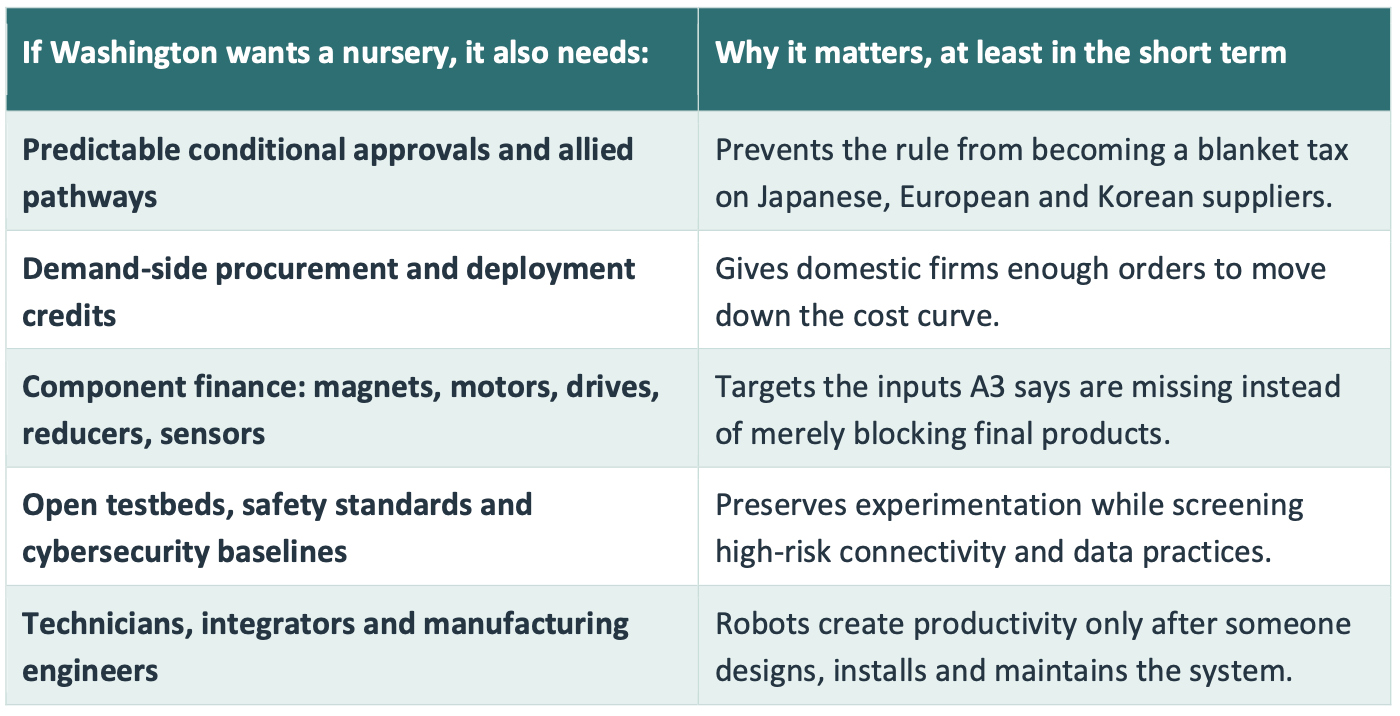 Table 2. Complementary measures that would make the policy more likely to nurture, rather than merely shelter, a domestic ecosystem.
Verdict: a selective nursery wall, not an industrial strategy
Under the assumptions in this article, the FCC’s action is more likely to slow the overall development and diffusion of U.S. robotics over the next three years than to accelerate it—while still helping a narrow set of domestic mobile-robot and humanoid companies. The reason is timing. Demand can be redirected in months; component ecosystems take years. Fixed industrial arms, which dominate present-day factory automation, are outside the rule. The frontier systems inside it are precisely the ones most dependent on rapid iteration, low-cost hardware and international supply chains.
That is not treating the security risk argument as blanket pretense or accepting foreign dependence as permanent. This is an argument for judging the FCC measure by what it is: a filter on market access. If Washington adds investment, procurement, allied coordination, open standards and workforce capacity, the wall can give American suppliers room to grow. If the policy approach truly stays the same, the wall will mostly make the nursery quieter—and more expensive.
Four indicators to watch
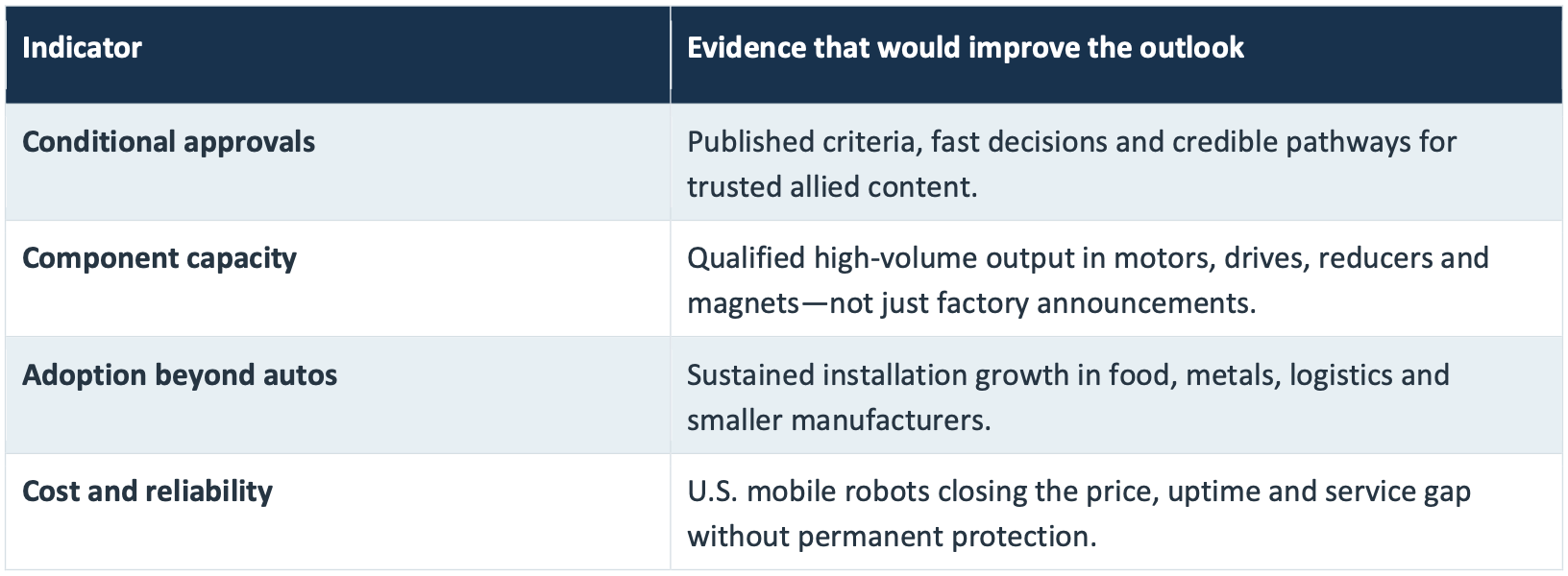 Table 3. Observable evidence that would justify revising the three-year judgment upward.
THE DECISIVE TEST By 2029, has the United States merely changed the passport of the next robot—or lowered the cost of making its joints, electronics and materials at home?
Sources and reporting notes
Data are the latest public figures available as of July 30, 2026. Company deployment and capacity figures are company-reported unless a third-party source is specified. The forecast is an educated judgment, not a prediction of legal outcomes for any individual product.
1. FCC Public Notice DA 26-786, “Covered List—Advanced Robotic Devices and Power Inverters” (July 28, 2026).
2. Federal Acquisition Regulation 25.101, Buy American domestic-content test.
3. Federal Acquisition Regulation 25.105, component-origin rules and examples.
4. Reuters, “Trump administration to ban new Chinese robots, inverters…” (July 28, 2026).
5. International Federation of Robotics, World Robotics 2025 press materials and executive summary.
6. International Federation of Robotics, “Robot Boom in USA – Installations up by 11%” (June 11, 2026).
7. Association for Advancing Automation, Section 232 public comment on robotics and industrial machinery (October 2025).
8. International Energy Agency, Rare Earth Elements: Executive Summary (2025).
9. Figure, “Production at BMW” and BotQ production updates.
10. Agility Robotics, deployment and manufacturing disclosures (June 2026).
11. Reuters, “Humanoid robot startup Apptronik raises $520 million…” (February 11, 2026).
12. Amazon, “Amazon deploys its 1 millionth robot.”
13. Locus Robotics, “Seven Billion Picks” (March 2026).
14. Counterpoint Research, “Global Humanoid Robot Installations Reach 16,000 Units in 2025.”
15. CSIS ChinaPower, “How Is China Shaping the Future of Robotics?” (February 2026).
16. U.S.-China Economic and Security Review Commission, Made in China 2025 performance review.
17. Reuters, “iRobot enters Chapter 11…” (December 15, 2025).
Method note: “U.S. industry” is treated as the domestic innovation, manufacturing, deployment and integration ecosystem—not merely firms headquartered in the United States. That avoids crediting foreign-made hardware as domestic capacity or excluding U.S. factories and workers employed by foreign-owned suppliers.
Editor: Yida