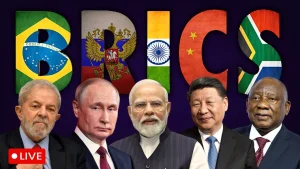


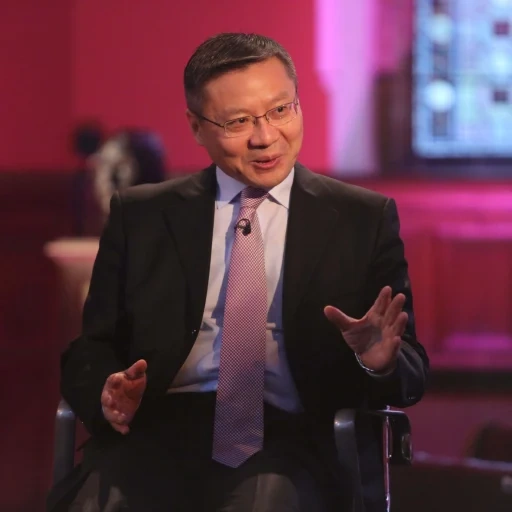
Yusuf Erim: Welcome to Straight Talk. I’m Yusuf Erim. The global order is being reshaped as wars, economic rivalry, and new alliances challenge decades of Western dominance. China is at the center of that transformation as it expands its economic and diplomatic influence across the Global South. Organizations like BRICS and the Shanghai Cooperation Organization are giving emerging powers a greater voice. At the same time, tensions with Washington are playing out far beyond trade. The US capture of Venezuela’s president Nicolás Maduro, the Iran war, and tensions over Taiwan have all tested Beijing’s approach to the international system. China, meanwhile, argues that multipolarity offers an alternative to decades of US dominance, but is there enough room for Washington and Beijing to pursue their competing visions, or is confrontation inevitable if the balance of power continues to shift? What role does Beijing see for itself? I put that question to Zhang Weiwei, a professor of international relations at Fudan University and the director of its China Institute.
Zhang Weiwei: China is a powerful force for peace and for development and for whatever possible future, a better and more just and fairer international order. So China is essentially a constructive builder for the new world order. Unlike the United States, it’s a destroyer.
Yusuf Erim: When we look at the American positioning, they definitely are more offensive as a country. When it comes to conflicts, how long can China stay quiet or stay on the sidelines or just keep its soft power before not only its interests, but the international community demands more of China because there seems to be no counterbalance? Right now, in this current unipolar world, there seems to be a demand for some type of counterbalance.
Zhang Weiwei: On the one hand, this is understandable. More and more countries hope that China will play a more active role in shaping or reshaping the international order. Yet China has done a great deal to which insufficient attention has been given. In fact, China is highly active in promoting a better and more just international order. Take the Iran crisis as an example, which you mentioned, China is the only country today with a railway running effectively from Xi’an to Tehran. China also signed a highly important 25-year cooperation accord covering every aspect of cooperation, economic, political, social, and anti-terrorism, the last of which is partially military. China has honored this 25-year accord to the letter. This is very important.
Yusuf Erim: I want to get into the war in Iran a little with you. But before that, I want to ask about what happened at the beginning of the year in Venezuela — the kidnapping, extraction? I don’t know what you want to call it. Nicolás Maduro, the Venezuelan president, followed by the conflict in Iran — were these two events American interests, or were these American moves against China, to stop the flow of oil from two potential, very important resources?
Zhang Weiwei: Some people say it is, in the end, a move against China. That could be true. But the point is that, from the Chinese point of view, we believe the United States has been making strategic mistakes all along. The kidnapping of Venezuelan leader President Maduro, I would call a tactical victory but a strategic disaster or a huge mistake. And then, if you look at overall US strategy, at the US security report toward the end of last year, I would summarize that report in two sentences. The first is that the report shows due respect for China and Russia; the United States knows, and Donald Trump knows, what a big power means. You cannot treat them dismissively. Yet the United States is ready to bully all other countries except Israel. The second is that the United States wants to maintain the facade of its superpower status and hegemony at the lowest possible cost. So the kidnapping of Venezuela’s president gave Donald Trump a kind of so-called success. Then he made a huge mistake in Iran. Iran has been sanctioned for close to 50 years by the United States, yet however weak it is, the US still cannot beat Iran. This shows that a middle power like Iran, if determined, can corner the United States to such a degree that it cannot do much about it. For the United States, the Iran crisis is a huge strategic disaster, and it marks the watershed of US power going down sharply. So, if you look at the global picture, the United States, NATO plus Ukraine cannot defeat Russia. The United States cannot defeat Iran. The United States has already lost the trade war with China and lost the tech war with China. All this means the world has entered a post-America and post-Western world.
Yusuf Erim: So up till now, China’s had a very soft spoken and very diplomatic position on the war in Iran. Going forward, what would be a red line for China on Iran? What would America or Israel do? Where China would say: No, that’s a red line. Now, I’m not behind the scenes. I’m stepping to the stage?
Zhang Weiwei: China’s red lines are very clear. The first is the issue of Taiwan. You cannot cross that red line. Taiwan is part of China. China will achieve unification, and whether the United States chooses to involve itself or not, China will unify Taiwan in the not-too-distant future. It will come. The second is the South China Sea: no one can make trouble there. And China’s political system, too, is unshakable, whatever Western countries may wish to do about it. China is also a country with the highest threshold for the use of force, this a principle rooted in Chinese philosophy, in the thinking of the military strategist Sun Zi. I told the Americans: read the remarks by your own defense secretary Hegseth. He said that today China’s hypersonic missiles can destroy all US aircraft carriers within 20 minutes. This is true. So I said the Chinese have a culture. We give face to others. We do not humiliate others in public and the same goes for the United States. We still call the United States a superpower. So I would say: you should take care of yourself. Please do not cross the red line China has set. say, over Taiwan or the South China Sea. I said that if you cross that red line, within 24 hours, the whole world will know the United States is no longer a superpower.
Yusuf Erim: So can we say that China’s red lines are within its neighborhood and that outside of its neighborhood in areas like the Middle East or Eastern Europe that there aren’t red lines, but maybe we call them guidelines that China wants to see.
Zhang Weiwei: We have very good partnerships with our strategic partners. We have different degrees and different types of strategic partnership, all-weather strategic partnerships, among others. And we honor all our commitments. For instance, we provide a very strong defense system to Pakistan, and they have done well in their border conflicts with certain power. We also have a very good partnership with Serbia. This is important. But all this is done on a case-by-case basis, not with every country and every region, you cannot do that way. You must know your power and how to use it in a rational way.
Yusuf Erim: You mentioned Pakistan, we’re in Turkey at the moment in Istanbul, if we bring another country into the mixed Saudi Arabia, we have something called the Mecca defense alliance. In a post Iran war, Middle East, do you see the Mecca lines playing an important role in regional security architecture? Will a post Iran war Middle East become a post American Middle East.
Zhang Weiwei: With the US failure in the Iran crisis up to now, I have said that this is a strategic blunder, which means the United States will quicken the pace of its decline. The Middle East is a typical case. This new pact between the three countries is, very importantly, a change in the security order in the region, which used to be dominated by the United States. Now, middle powers play a major role, this is great. We should leave the Middle East to the Middle East people and Middle East countries. The same applies to the economic order that is changing. As I mentioned, the petrodollar is gradually being replaced by the petro-yuan in this region. So, all these are signs of a changing global picture and a post-US world order. It is already happening.
Editor: Zhiyu Wang