


China’s real estate sector reached two moments in August 2026 that could go down in the country’s economic history.
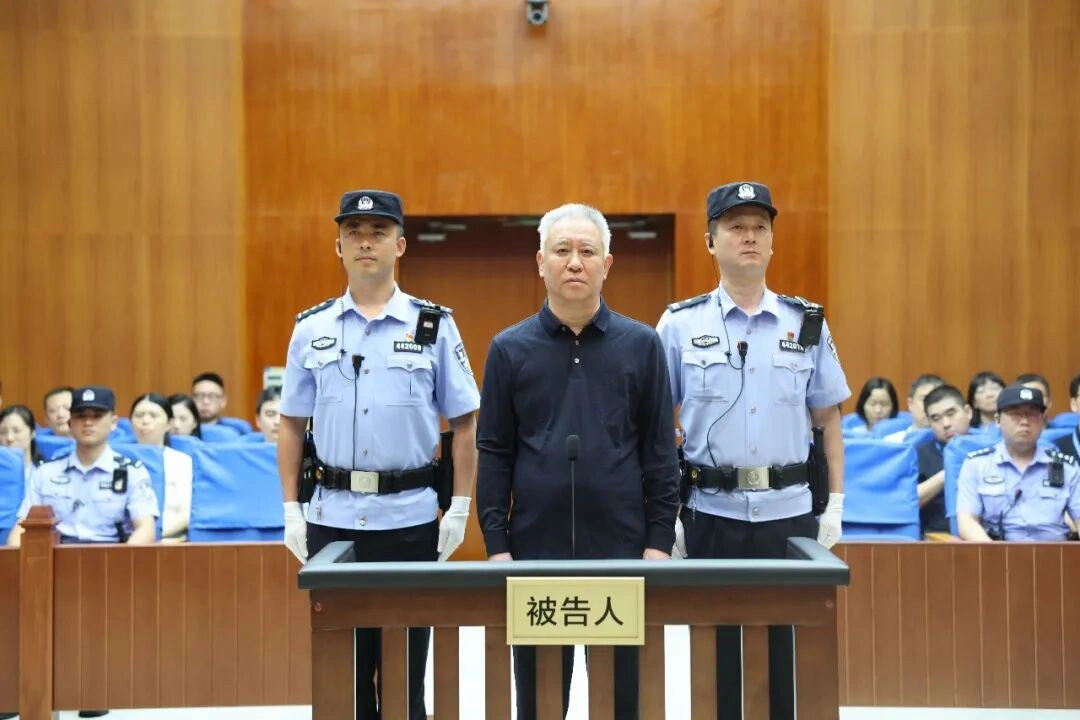
On Aug. 20, the Shenzhen Intermediate People’s Court publicly handed down a first-instance verdict in the case of Evergrande Group and its founder and controlling shareholder, Xu Jiayin. Xu was sentenced to life imprisonment after being convicted of multiple offenses, including illegally absorbing public deposits, fundraising fraud, fraudulent issuance of securities, corporate bribery and embezzlement. He was also deprived of political rights for life and ordered to forfeit all personal assets. The debt crisis at Evergrande and other real estate companies affected millions of homebuyers across China. Xu’s fall from being China’s richest man to a prisoner has triggered a strong reaction in Chinese society.
Eight days later, on Aug. 28, China’s housing ministry, central bank and financial regulator, among other government agencies, jointly unveiled a package of policies. At the core of the measures was the gradual phasing out of presold homes in favor of sales of completed properties, along with full, closed-loop supervision of developers’ use of funds. The fact that the two developments came just one week apart has been widely seen as more than a coincidence. It is widely believed that Beijing has made the decision to regulate the real estate giants, the wealthiest class in China over the past 20 years.
The severity of the action is particularly striking from an international perspective. After the U.S. subprime mortgage crisis erupted in 2008, more than 10 million households across the United States lost their homes to foreclosure, while average home prices fell 30%. The U.S. government responded by injecting more than $400 billion in public funds into the banking system through the Troubled Asset Relief Program, or TARP. Most of the money flowed into the balance sheets of financial institutions rather than to ordinary families who had lost their homes.
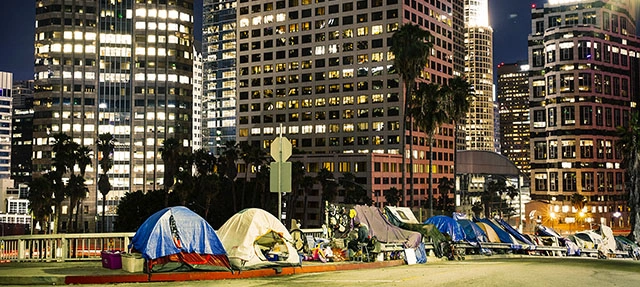 A homeless encampment near downtown skyscrapers in Los Angeles.
U.S. financial institutions that received government support continued to pay huge bonuses to senior executives that year. Merrill Lynch paid $3.6 billion in bonuses to executives on the day it was acquired by Bank of America, while American International Group, paid $165 million in bonuses to executives in its financial-products division after receiving more than $170 billion in government assistance.
In terms of criminal accountability, no chief executive of a major Wall Street financial institution was sent to prison for fraud related to the subprime crisis. Angelo Mozilo, chief executive of Countrywide Financial, the largest U.S. mortgage lender at the time, was accused by the Securities and Exchange Commission of securities fraud and insider trading. He eventually settled the case by paying $67.5 million without admitting wrongdoing and faced no criminal charges. In In 2013, then-U.S. Attorney General Eric Holder told Congress that some financial institutions were so large that “if we do bring a criminal charge, it will have a negative impact on the national economy, perhaps even the world economy.” The remarks were summarized by the media as meaning that some institutions were “too big to jail.”
Faced with the aftermath of real estate bubbles, the two countries followed markedly different paths in the allocation of public funds and the pursuit of criminal accountability.
Presales are the starting point for understanding China’s real estate debt crisis. In China, developers have traditionally sold apartments before construction has begun, or after only the foundation has been completed. Buyers’ down payments and mortgage loans from banks flow directly into developers’ accounts, providing capital for their next projects. Known internationally as “off-the-plan sales,” the model also exists in countries such as Australia and Britain. But no major economy has taken the model to the same extreme as China. With relatively little of their own capital, developers could use buyers’ money to build homes, acquire land, launch new projects and acquire more land, repeating the cycle. One of the most extreme examples was Country Garden, which internally adopted a project-management rule known as “456.” Under the system, developers were expected to begin presales 4 months after acquiring land, collect the sale proceeds within 5 months and recycle the funds into new projects within 6 months.
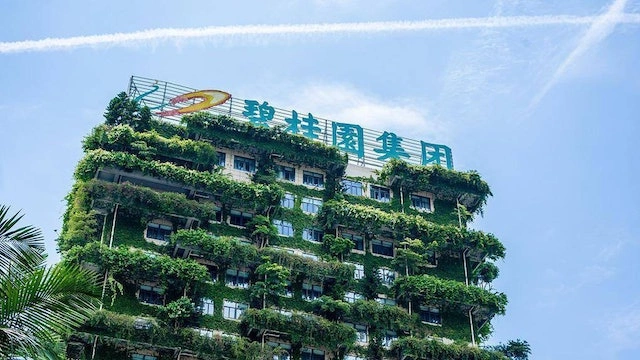 Country Garden’s Headquarter in Shunde, a medium-size city in Southern China
When the system was introduced in the 1990s, China’s urban per-capita living space was less than 7 square meters and nearly half of urban households lacked adequate housing. The country needed to expand its housing supply rapidly. Presales dramatically lowered the barriers to entry for real estate developers. Over the following three decades, China’s urban per-capita housing floor space rose to about 40 square meters, while the urbanization rate jumped from less than 20% to 67%. Hundreds of millions of people moved into homes equipped with separate kitchens and bathrooms. It was one of the largest improvements in living conditions in human history.
The problem was that this mechanism did not stop after the shortage of housing had been resolved. The pace of home-price increases far outstripped the growth of household incomes. A 2019 report by the National Academy of Economic Strategy under the Chinese Academy of Social Sciences further calculated that a price-to-income ratio of nine was the critical point at which the negative impact of real estate on economic growth exceeded its positive effect.
Once that figure was exceeded, the report said, the squeeze that high housing prices placed on consumption and innovation would outweigh their contribution to economic growth. China’s price-to-income ratio had already reached 9.3 times in 2018. At the peak of the bubble in 2021, the ratio reached 39 times in Shenzhen, 28 times in Beijing and 27 times in Shanghai.
For comparison, Ren Zeping, a former chief economist at Evergrande Group, and his team calculated in a study titled “A Comparison of Housing Prices in Global First-Tier Cities” that, after taking holding costs into account and calculating on the basis of usable floor area, the ratio was about 18 times in central London, 12 times in New York and 12 times in Tokyo.
The biggest beneficiaries of soaring home prices were the owners of real estate companies. In 2017, Xu Jiayin topped the Hurun Rich List with a fortune of 290 billion yuan (about $42.92 billion). His wealth increased by 200 billion yuan in that year alone(about $29.60 billion). Three of China’s five richest people that year came from the real estate sector: Xu ranked first, Yang Huiyan of Country Garden ranked fourth, and Wang Jianlin of Wanda ranked fifth. Wang Jianlin’s wealth peaked at 220 billion yuan (about $35.02 billion) in 2015, when he topped the ranking three times. In 2018, Xu’s fortune reached about 300 billion yuan (about $45.39 billion) at one point, making him China’s richest man. Shareholders’ internal rates of return in the real estate industry remained above 20% for an extended period. When the 2025 Hurun China Rich List was released, Rupert Hoogewerf, chairman and chief researcher at Hurun, said: “As little as seven years ago, a third of the Hurun Top 100 was made up of real estate developers.” The figure offered a clear illustration of the industry’s wealth-creating power.
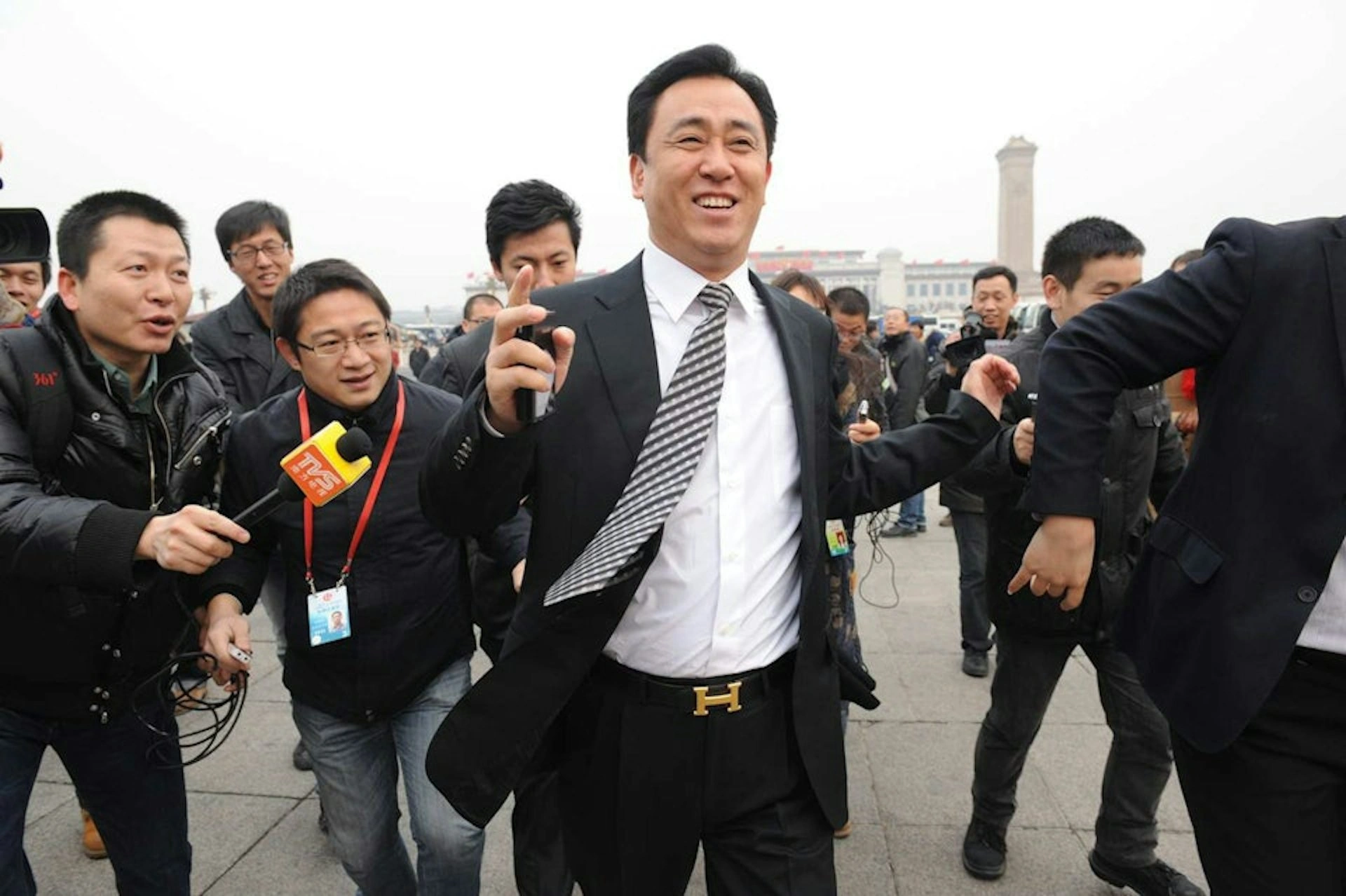 In March 2012, Xu Jiayin, who was also a member of the Chinese People’s Political Consultative Conference (CPPCC), China’s top political advisory body, trotted all the way to attend the opening ceremony of the CPPCC. The Hermès belt worth thousands of yuan around his waist earned him the nickname “Belt Brother” that year.
When Evergrande defaulted on its debt in 2021, its total liabilities had exceeded 2.4 trillion yuan, or about $330 billion, involving more than 200 cities and roughly 6 million units of unfinished commercial housing nationwide. According to project data compiled by the China Index Academy, Evergrande had 1,322 projects, more than 1,300 of which had been suspended. About 1.62 million homes remained undelivered, affecting roughly 6 million homeowners. Most of these families had spent savings accumulated by several generations to make their down payments. They continued to make their monthly mortgage payments, even though the homes they had purchased might never be completed.
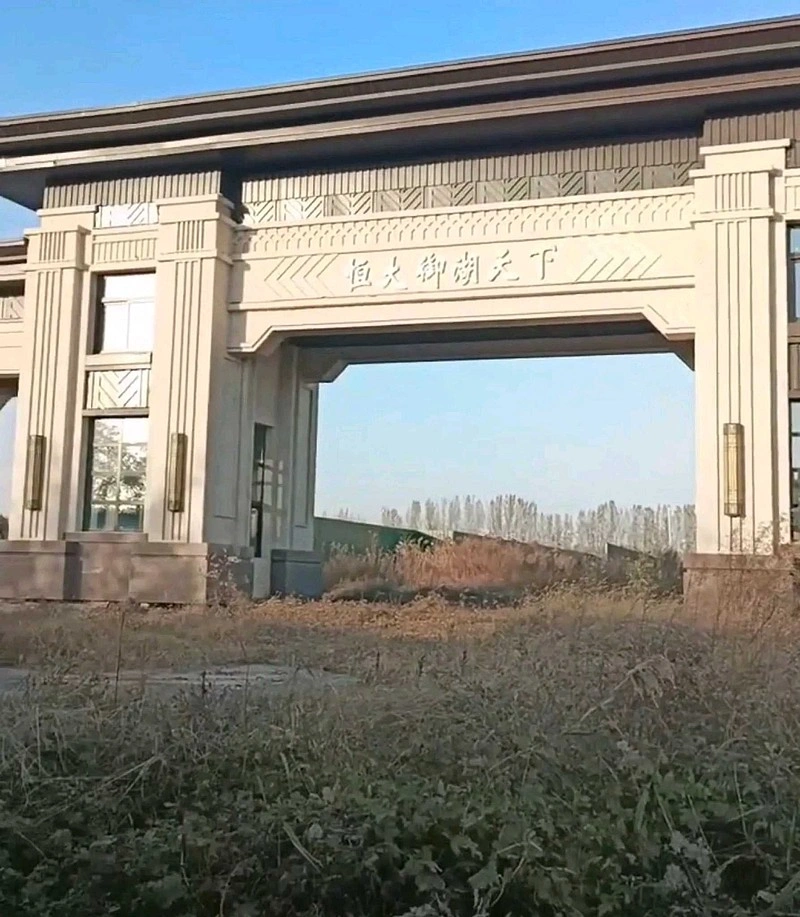 Located in Xinxiang, a medium size city in central China, Evergrande’s “Yuhu Tianxia” is one of the most extreme unfinished housing projects amid the company’s debt crisis, where only a luxurious entrance gate was built, leaving over 2,000 homeowners trapped in the nightmare of paying mortgages for non-existent homes.
More than 720 billion yuan in presale payments (about $111.61 billion) had been collected, equivalent to an average of 450,000 yuan (about $69,759) per homebuyer. In return were swathes of barren construction sites consisting only of foundations and steel reinforcement. In some cities, homeowners organized collective mortgage-payment stoppages, refusing to continue repaying loans for homes that had not been built. It was the largest consumer-rights campaign of its kind since China’s real estate market was commercialized.
To address the problems caused by the real estate bubble, the central government has gradually implemented series of policies. In 2022, it launched a special campaign known as “guaranteeing housing delivery”, using public funds to finance the resumption of construction at stalled projects. So far, it has allocated more than 1.4 trillion yuan in special funds for the campaign (about $204.78 billion), delivering more than 3.2 million stalled Evergrande projects. In July 2025, China’s Supreme People’s Court issued a judicial interpretation making clear that owners of homes for their own use have priority in debt repayment. Their claims rank ahead of bank loans and construction payments. That means that when a developer enters bankruptcy liquidation, ordinary homebuyers have priority over financial institutions in securing the homes they purchased.
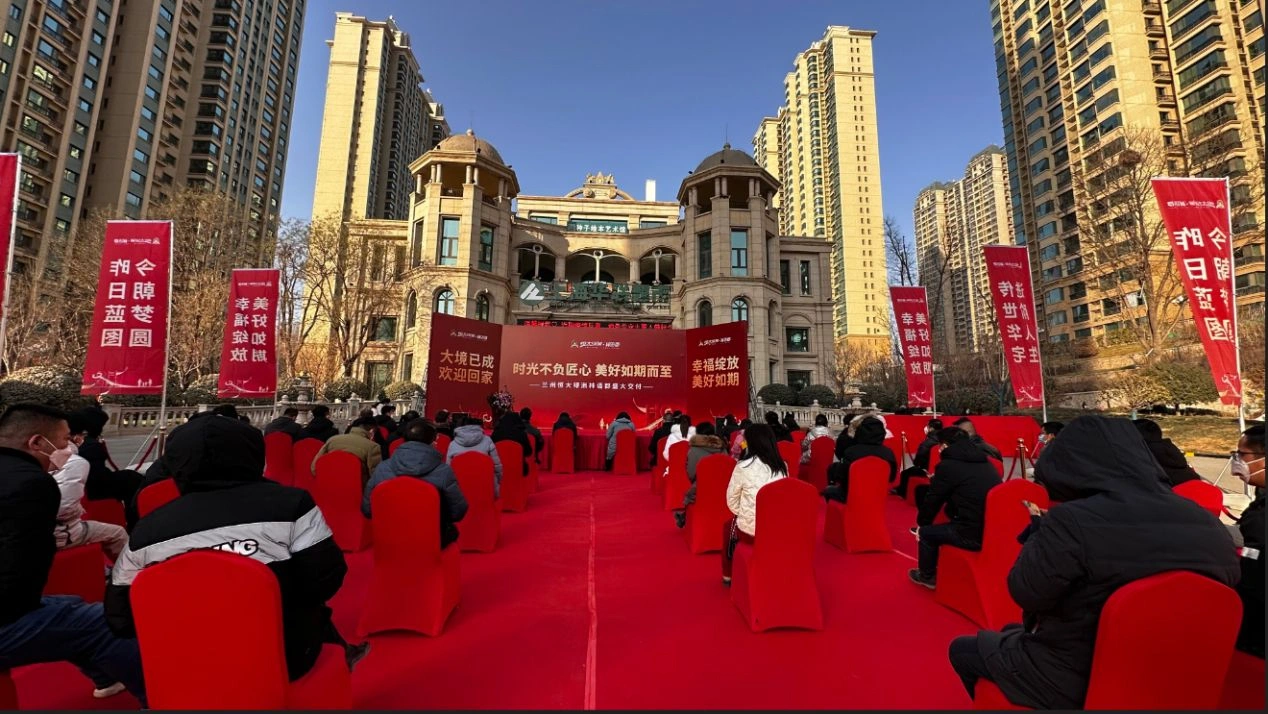 Delivery ceremony of one of the stalled Evergrande housing projects.
The new policy package announced on Aug. 28 goes further. For newly auctioned residential land, developers are encouraged to prioritize sales of completed homes, meaning properties can be sold only after construction and inspections have been completed. For projects that continue to use presales, developers must wait until the main structure has been topped out before starting sales. All payments made by buyers must be deposited into supervised bank accounts and cannot be accessed by developers before the project is completed. Developers must also use their own funds to acquire land and are prohibited from diverting buyers’ advance payments.
When Chinese stock markets opened on Monday, Aug. 31, real estate shares opened briefly higher but soon plummeted. Four leading real estate developers — China Merchants Shekou Industrial Zone Holdings, Poly Developments and Holdings, China Vanke and Gemdale — fell 8.8%, 4.82%, 0.63% and 2.16%, respectively.
In a quantitative report published on Sept. 2, Morgan Stanley China real estate analyst Zhang Yongtian estimated that if completed-home sales were strictly enforced, developers’ internal rates of return on projects would fall from about 22% to between 4% and 5%. Commercial housing sales could fall 35% year-on-year in 2028, the report estimated. Citigroup, in a report issued around the same time, estimated that developers would need to put up 70% to 120% more of their own capital to maintain similar sales volumes.
The disappearance of presale financing means developers can no longer rely on effectively zero-cost customer funds. Construction cycles could lengthen from the previous 6 to 9 months to 2 to 3 years. A number of highly leveraged developers are therefore likely to be forced out of the market, while those that survive will have to return to the fundamentals of construction and make money through product quality and cost control.
What comes next for Chinese real estate giants
The court found that between 2016 and 2021, Xu directed Evergrande to inflate assets and conceal liabilities through persistent financial fraud. The company illegally absorbed public deposits and engaged in fundraising fraud, used bribery to obtain control over financial institutions and illegally obtain credit, and misappropriated corporate assets under the guise of paying dividends.
Evergrande Group was fined 8.82 billion yuan (about $1.29 billion), Evergrande Real Estate Group was fined 7 billion yuan (about $1.02 billion), and another 56 people involved in the case were sentenced to prison terms ranging from 18 years to one year and 10 months.
Economist Ma Guangyuan wrote on the day of the verdict that saying the case marked the end of an era in Chinese real estate would itself underestimate the warning and significance of the case. At a sensitive moment when China’s real estate sector is shifting from its old model to a new one, the extremely severe punishment imposed on a former Chinese richest man has been widely interpreted as a warning whose target clearly extends beyond Xu Jiayin alone.
Despite this, China’s real estate-sector transformation is far from complete. There are still 300,000 to 400,000 Evergrande homes yet to be delivered, while a number of real estate developers remain struggling with debt restructuring. The land-sale revenues on which local governments have long relied are also continuing to decline.
But presales are now leaving the stage, completed-home sales are becoming the mainstream, developers are returning from being financial players to their role as builders, and housing is returning from an object of speculation to its function as a place to live. The image of Xu Jiayin standing in the dock wearing prison clothes, placed alongside the thick policy document released on Aug. 28, is perhaps the most accurate footnote to China’s real estate industry over the past 20 years.
Editor: Chang Zhangjin
https://www.court.gov.cn/zixun/xiangqing/509281.html
http://www.cass.cn/xueshuchengguo/jingjixuebu/201906/t20190624_4922568.shtml
https://k.sina.cn/article_1909698584_71d3b01801901aq5o.html
https://stcn.com/article/detail/4161508.html
https://www.stcn.com/article/detail/4155726.html
http://www3.xinhuanet.com/fortune/20260903/ff4401587f2c4fc1bc691ec9c7824ab6/c.html
https://www.mohurd.gov.cn/xinwen/gzdt/art/2025/art_c1719472587343089cd5f676addfaf75.html
https://companies.caixin.com/2018-04-13/101234053.html
https://www.hurun.net/en-us/info/detail?num=4IUOJSIJ87JN
https://finance.sina.cn/2026-08-20/detail-ininyncn1940690.d.html
https://xueqiu.com/1248169152/199392092
https://m.yicai.com/news/101588039.html
https://www.163.com/dy/article/L4U652QE0518SA4C.html
https://finance.sina.com.cn/roll/2026-04-14/doc-inhumwqc9125938.shtml
https://news.qq.com/rain/a/20260519A02GK000
https://www.sup.org/books/sociology/foreclosed-america/excerpt/excerpt-chapter-1
https://home.treasury.gov/data/troubled-assets-relief-program/about-tarp
https://www.nbcnews.com/id/wbna29137662
https://finance.sina.com.cn/zl/china/2022-08-05/zl-imizmscv4889983.shtml
https://www.chnfund.com/article/AR2022071417545548947031
https://finance.sina.com.cn/wm/2026-04-14/doc-inhunxzn4541306.shtml
https://www.afr.com/world/why-bank-bosses-are-too-big-to-jail-20140930-jl5lq