


One of the important challenges China will face going forward is learning from its competitors. What exactly should it learn? It needs to study the hegemony of the U.S. dollar and understand what actually underpins it—why the dollar is able to exert such enormous influence around the world. Only by understanding the foundations of our rival’s power can we determine our own path forward.
There is a major misconception here. Many people assume that the financial theories promoted by mainstream Western media and academia reflect the realities of the financial world. Actually, there is a strong element of utopian thinking in these theories. The financial hegemony exercised by the United States in practice has almost nothing in common with the financial theories taught in textbooks. Textbooks portray financial markets as a perfect system of rational pricing, risk diversification and free competition. But the actual exercise of financial power follows a very different, and much more naked logic.
Take one example. One major mistake we made in the past was accumulating a huge amount of U.S. Treasury securities. Why did this happen? Because at the time, China’s financial authorities, like central banks around the world, were familiar with a concept taught in financial textbooks: the “risk-free rate.”
All financial assets carry some degree of risk. So what kind of asset can preserve and increase its value indefinitely? The textbooks told us that U.S. Treasuries were risk-free. Why? Because they assumed that the U.S. financial system was so powerful that, after World War II, the United States would never default on its dollar-denominated debt or go bankrupt.
Was that assumption correct? It no longer holds up — US Treasuries can default too, and the risk is far greater than people imagined.
China’s large holdings of U.S. Treasuries therefore carry real risks. According to data from the U.S. Treasury’s Treasury International Capital (TIC) system, China held about $618 billion in U.S. Treasuries as of July 2026. That was more than 50% below the historical peak of about $1.32 trillion in 2013, but the amount still remains substantial.
If the United States were to wage a financial war against China, it could use domestic law to override the norms governing international relations, declare China, as it has Russia, an enemy of the United States, and then freeze the Treasury securities held by China.
After the outbreak of the Russia-Ukraine conflict in 2022, Western countries moved to freeze roughly $300 billion in Russia’s gold and foreign-exchange reserves—nearly half of its total reserves. That is the lesson from Russia.
When that happens, the U.S. Treasury securities held by China could become nothing more than worthless pieces of paper.
This is extremely dangerous. What textbooks teach and what actually happens in practice are two entirely different things. There is no truly risk-free financial asset anywhere in the world. The only question is whose risks are greater and whose are smaller. Treating the sovereign debt of a rival country as a “risk-free asset” is itself the greatest risk.
There are many similar examples. Remember the repeated claims in Western media that China was on the verge of a financial crisis, or that the Chinese government itself might go bankrupt. But what happened in the end?
Whether during the 1997 Southeast Asian financial crisis or the 2008 global financial crisis, China’s economy demonstrated a greater ability to withstand shocks than the United States, the dollar area and the euro area.
In 1997, currencies across several Asian economies collapsed and capital fled the region. China insisted on keeping the renminbi from depreciating, providing an anchor for regional stability. In 2008, the global financial crisis originated in the U.S. subprime mortgage crisis, while China’s economy was among the first to stabilize and recover.
Time and again, the facts showed that Western predictions had failed to materialize.
This reveals a fundamental contradiction. By the standards of Western mainstream media and financial textbooks, China’s financial system is supposedly backward and fragile. In practice, however, the reality is almost the opposite: the dollar may look powerful, but it is far more vulnerable than it appears; China’s financial system may seem insufficiently “market-oriented,” yet it has demonstrated greater resilience through successive crises.
So why is that?
Western textbooks and mainstream media either fail to explain this or deliberately conceal it. And I am not the only one who has noticed. Many countries have figured it out as well.
Russian analysts, for example, have a clear understanding of the weaknesses of dollar hegemony. Oil-producing countries in the Middle East understand them perfectly well too. The weaknesses of U.S. hegemony have become increasingly visible in the latest Middle Eastern wars.
In the 1970s, after the dollar was decoupled from gold, many people assumed that the dollar’s position would be shaken. But why was the dollar able to maintain its hegemony even after that break with gold?
This was rooted in what I would call a major “invention” by Henry Kissinger. I use the word “invention” because it was an artificially constructed international political arrangement.
On August 15, 1971, President Richard Nixon announced the suspension of the dollar’s convertibility into gold, causing the core pillar of the Bretton Woods system to collapse. Kissinger subsequently approached the oil-producing countries of the Middle East.
These countries were extremely wealthy, but also extremely vulnerable. Their continued existence depended on America’s military hegemony. The two sides therefore reached an arrangement: gold was no longer what mattered. What is the lifeblood of an industrial economy? Energy—oil and natural gas.
They established what was, in effect, a political rule: all energy transactions conducted by Middle Eastern oil producers, whether involving oil or natural gas, would be settled in U.S. dollars. After selling their oil, these countries accumulated huge amounts of dollars. How could those dollars be recycled? The United States required Middle Eastern oil producers to use that money to purchase American weapons and military equipment. That is how the dollar maintained its position after breaking away from gold: through the petrodollar trade, reinforced by the arms trade.Today, roughly 80% of global oil trade is still denominated and settled in U.S. dollars.
Once you understand this, you can see how a challenger to dollar hegemony might actually challenge it. There are two possible approaches.
One is what the Organization of the Petroleum Exporting Countries is doing: oil-exporting countries joining forces to compete with the United States.
The United States was once an oil importer. It has now become the world’s largest energy exporter. According to the U.S. Energy Information Administration, the United States became a net annual energy exporter in 2019, while its total energy exports reached a record high in 2024. Its crude oil exports averaged more than 4.1 million barrels per day.
Who is the United States competing with as an exporter? Russia, as well as its former allies—the oil-producing countries of the Middle East.
When sellers shift from cooperation to competition, the entire landscape changes.
And this is where China’s opportunity emerges.
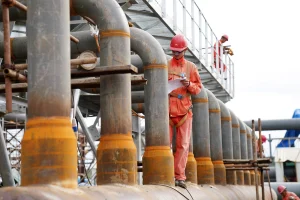
Why? Who are the buyers of the oil exported by these producer countries? China is the world’s largest importer. According to data from China’s National Bureau of Statistics and General Administration of Customs, China imported 577.73 million metric tons of crude oil in 2025, an increase of 4.4% year on year.
But China’s position as an oil importer is different from that of other importing countries. India is also an oil importer. So are Japan and South Korea, as well as China’s Taiwan region and the countries of Southeast Asia, with the exception of Indonesia. What is their weakness compared with China? Precisely that they do not possess the same level of military power as China.
So when the United States seeks to control oil pricing power, what does it do? In practice, it wages war. What is the United States doing by supporting Israel in its confrontation with Iran in the latest Middle Eastern war? At bottom, it is about competing for control over oil pricing.
Importing countries without the military capacity to defend themselves have little choice but to be pushed around. China, by contrast, has the ability to say no.
Why does China have this leverage?
One extremely important reason is that China’s military power is greater than Iran’s, while its economic power is greater than that of Russia.
In this sense, you can understand where the strength of America’s petrodollar hegemony lies. Its strength comes from the combination of economic and military power: using military force to safeguard its control over oil pricing, using that control to reinforce the dollar’s position, and then using the dollar’s position to sustain military spending.
So where does its weakness lie?
If it loses a war, the hegemony of the petrodollar can also be shaken. Military defeat can directly translate into a collapse in financial credibility.
This is why the renminbi may have the potential to compete with the United States in the future.
One important reason, apart from China’s formidable competitiveness in manufacturing and industry and its advantages across industrial supply chains, is that China is now rapidly narrowing the military gap between itself and the United States and Russia.
On paper, at least, China’s military capabilities have made substantial progress.
In 2026, China’s national general public budget allocated RMB 1.94 trillion (about $272 billion) to defense spending, up 6.9% from the previous year. In November 2025, China’s first aircraft carrier equipped with electromagnetic catapults, the Fujian, formally entered service, ushering the People’s Liberation Army Navy into the “three-aircraft-carrier era.”
At the 2025 National Day parade, five types of active-duty stealth combat aircraft, including the J-35 and J-20, appeared together, indicating that China’s air force has begun to establish the foundations of its transition toward stealth capabilities.
But there is still something missing.
China’s military power remains, at this point, largely potential and theoretical. It has yet to be tested in war.
If, in the next war, China were to engage directly with the United States, or Japan—or if the strength of China’s defense industry were indirectly put to the test, as happened in the India-Pakistan conflict—the picture could change.
On May 7, 2025, India launched airstrikes against Pakistan. The Pakistani Air Force immediately mounted a counterattack. Pakistan’s defense minister said that Pakistani forces had shot down five Indian Air Force aircraft during the retaliation, including three French-made Rafale fighter jets, as well as one Su-30 and one MiG-29. In this most serious military confrontation between India and Pakistan in decades, many analysts said that Pakistan had used Chinese-made combat aircraft in the fighting, viewing the conflict as an indirect test of China’s defense industry. Only after such capabilities have been validated in actual combat can potential military strength be transformed into greater financial power for China.
At this point, we need to recognize an objective truth.
America’s financial hegemony did not come from the free trade and liberal democratic system that it claims to represent. Where did it actually come from?
It began with Britain. British financial hegemony was closely intertwined with its military hegemony. At the time, Britain’s military dominance was fundamentally naval supremacy.
After Britain’s national power was exhausted by the First and Second World Wars, its financial hegemony disappeared as well.
The same logic applies to the United States. When America reached its postwar peak after World War II, its financial hegemony was virtually unrivaled around the world.
Then came the Korean War, the Vietnam War, and now the failures and predicament of the United States in the Middle East. Looking at this trajectory, you can see that as American military hegemony declines, the decline of American financial hegemony is likewise unavoidable.
But how quickly that decline occurs will depend on the speed and scale of China’s development in both finance and military power.
The renminbi’s emergence onto the world stage may look, on the surface, like a question of currency. Underneath it all, however, it is really a question of comprehensive national power.
The basic logic is fairly simple.
Editor: Chang Zhangjin