


On August 5, Beijing answered new U.S. restrictions with a five-part package: drone export controls, a certification-inspection suspension, two countermeasure orders and a national-security investigation. The point was not only that China retaliated. It was that no single “Chinese OFAC” did the retaliating. Different agencies activated different laws against different pressure points.
That package captures the central tension in China’s sanctions regime. China has so far used formal sanctions predominantly in response to China-directed conduct. But “retaliation” is defined broadly enough to include perceived interference with core interests—not merely retaliation against an earlier economic sanction. Reactive practice is real; a narrow legal no-first-use rule is not.
To test that claim, I compiled 76 public actions from the first disclosed use of the Anti-Foreign Sanctions Law (AFSL) in July 2021 through August 5, 2026 (please refer to the link). Sixty-five are “core” deployments, six are broad product controls and five are later suspensions, cancellations or easing actions. Here, “core” means the core analytical series—not a judgment that Beijing’s “core national interests” were implicated.
How this dataset works
An action enters the core series when an official authority publicly makes an operative measure country, region, entity or conduct specific—for example, an AFSL designation, UEL listing, country-specific tariff or export restriction, or formal investigation. A “broad product control” applies by item, names no country or entity, and invokes national security, export control or nonproliferation. Timing cannot carry the coding. Thus the July 2023 gallium and germanium controls sit outside the headline series.1
The same rule excludes the seven globally worded rare-earth controls announced on April 4, 2025, despite their timing alongside Beijing’s response to U.S. tariffs.2
“China-directed: Yes” requires a public link to a foreign restriction on China or Chinese parties, or to conduct Beijing calls interference with sovereignty, security or development. “Core-interest conduct” is an author coding—not official magic words—used when the stated rationale concerns Taiwan, Xinjiang, Tibet, Hong Kong, territorial claims or closely related political-security interests. “Ambiguous” means the measure is specific but no discrete prior China-directed act is identified. The January 2026 military end-use control on Japan is core because it names Japan, but its trigger is Ambiguous because the order cites security and nonproliferation, not a preceding Japanese measure.3
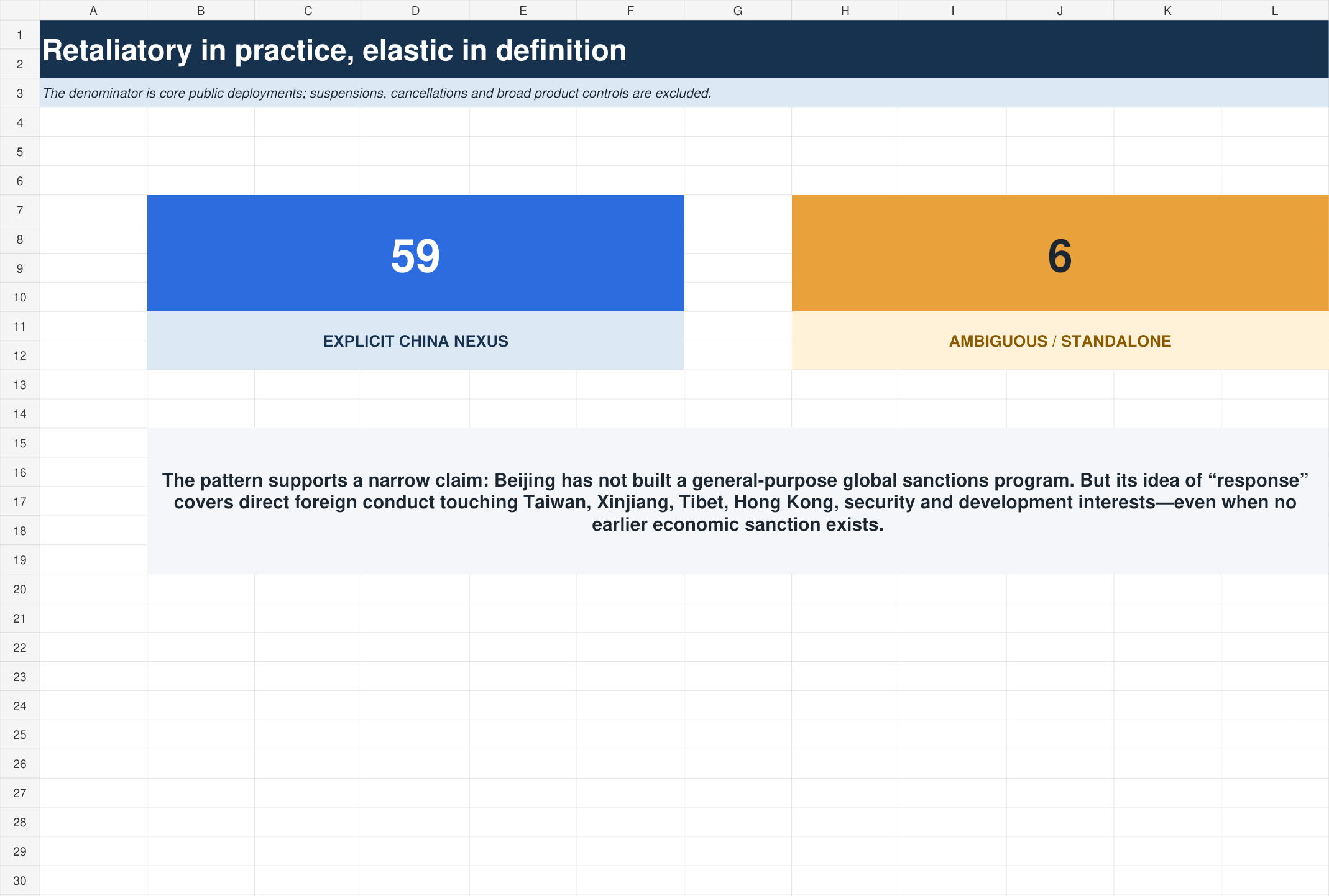 Figure 1. The thesis test. Author dataset. “Core deployments” exclude broad non-country product controls and later status changes.
Available resources are useful, but incomplete
Bloomberg’s August 7 newsletter appeared two days after Beijing’s five-part response and ahead of a possible leaders’ meeting. Its Morgan Lewis-sourced chart captures six important authorities and the direction of travel: more procedures and more cross-border compliance conflicts. But it is a capability table, not a record of deployment.
The surrounding literature falls into three camps. Legal alerts, including Morgan Lewis’s work on supply-chain security, map powers and corporate exposure. Studies such as IISS’s critical-materials analysis emphasize export chokepoints. Coercion studies combine formal orders with opaque restrictions and selective enforcement; a 2025 brief by Viking Bohman, Audrye Wong and Victor Ferguson shows how they worked together in the second trade war.
MERICS came closest to the present exercise, assembling 39 sanctions cases through early 2023. Its denominator combined six UN Security Council cases, five trade-war cases and 28 unilateral cases, and predates the 2024–26 deployment boom. Other work counts targets rather than announcements. These are valid but different questions. What they do not isolate is this one: among formal, public, post-AFSL deployments, how often did Beijing identify China-directed conduct—and what did that mean? Separating core actions, global product rules and reversals makes the answer auditable.
The Bloomberg snapshot is also incomplete on its own terms. Most importantly, it leaves out the Export Control Law, the 2024 dual-use regulations, Article 17 of the Tariff Law, Article 33 of the Foreign Relations Law, the revised Foreign Trade Law and the machinery for anti-discrimination and trade-barrier investigations.
One date also needs qualification. The Unreliable Entity List rules were issued in September 2020, but the first public designations did not arrive until February 2023. That gap matters. Beijing spent several years building legal option value before using the tools routinely.
The expanded chart shows why “China’s sanctions law” is the wrong singular noun. The AFSL freezes assets and prohibits transactions; the UEL cuts firms off from trade and investment; export-control law denies dual-use inputs; tariff law hits import categories; blocking rules resist foreign measures; and the new supply-chain rules reach goods, services, investment and data.
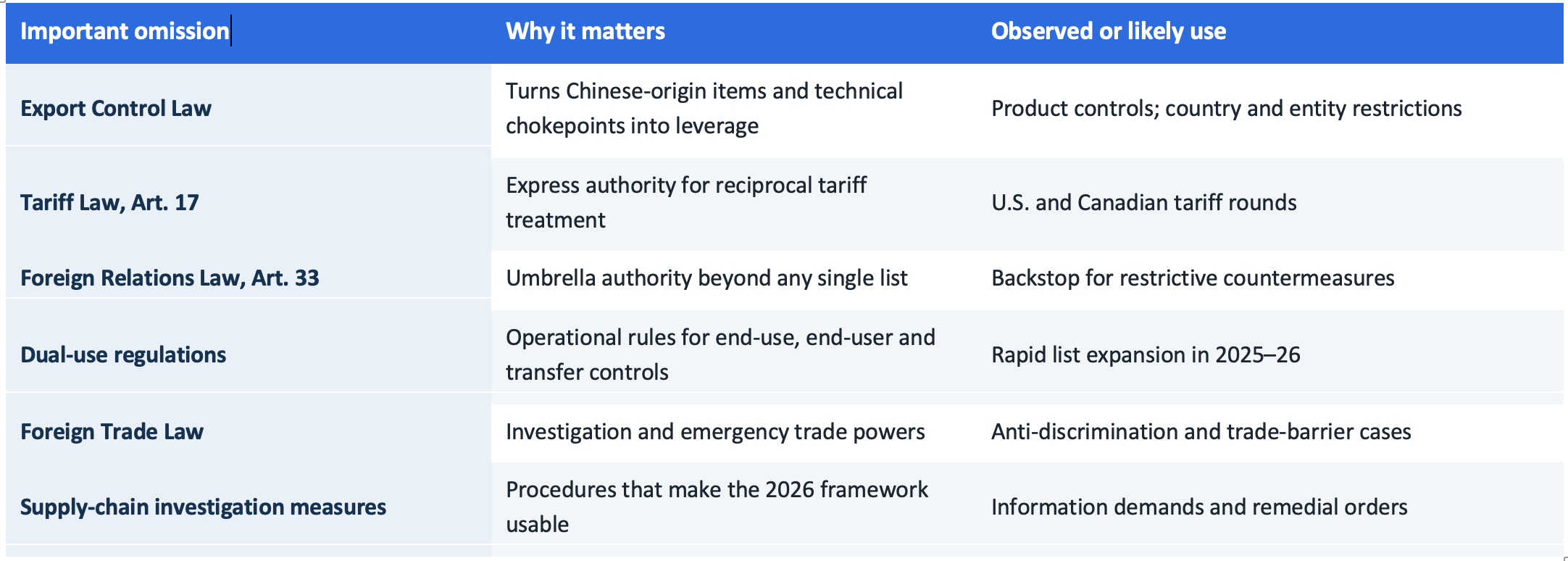 Table 1. The most consequential omissions from the Bloomberg snapshot. Official legal texts; details consolidated in the expanded chart and workbook.
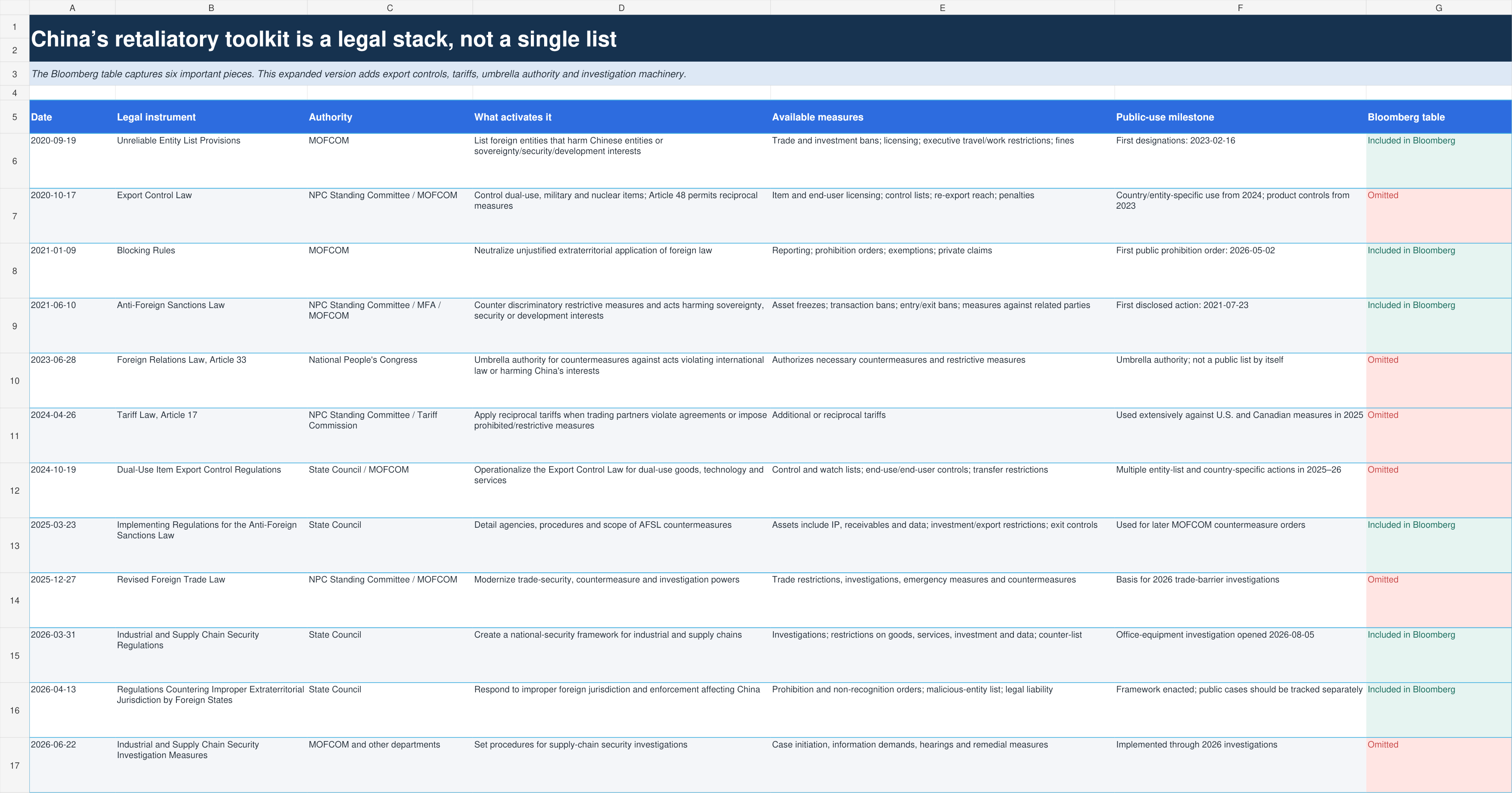 Figure 2. An expanded map of China’s formal retaliatory architecture. Author compilation from official legal texts.
The public record is reactive—but not narrowly reciprocal
The dataset supports the restrained version of Beijing’s claim. Fifty-nine of 65 core deployments, or 90.8%, cited a China nexus: a restriction on China, a Taiwan arms sale or visit, or conduct described as interference in Xinjiang, Tibet, Hong Kong or sovereignty. The six ambiguous cases were specific export controls justified in security terms without a discrete prior China-directed act.
The largest trigger category was not economic counter-sanctions. Thirty-six actions answered “core-interest conduct,” versus 12 reciprocal economic measures and six tariff steps. Taiwan arms sales generated repeated AFSL, UEL and export-control actions. Beijing also sanctioned legislators, advocacy groups and Japanese politicians over visits, statements or exchanges touching Taiwan, Xinjiang, Tibet and other sovereignty claims.
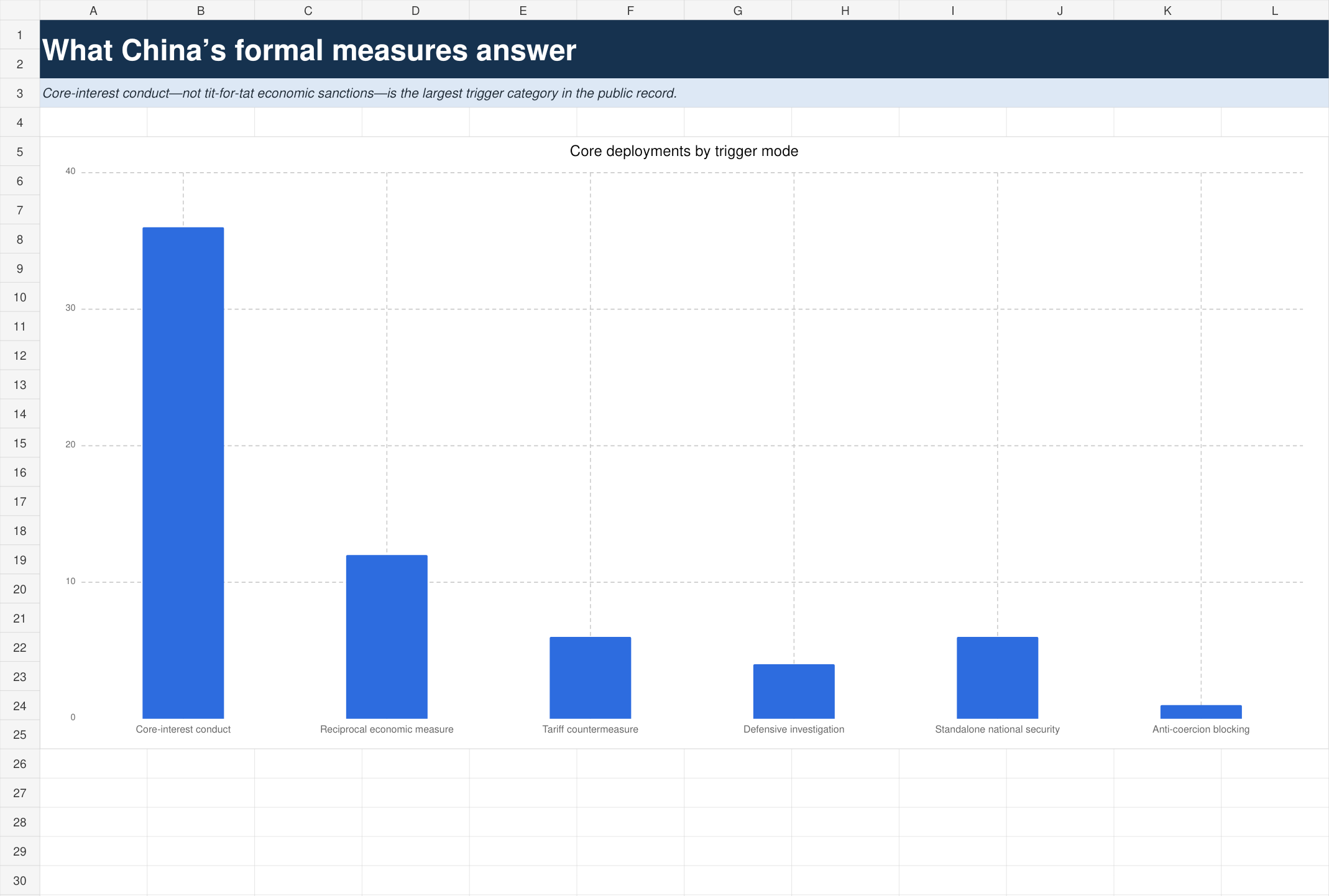 Figure 3. What China’s formal measures answer. Author dataset; core public deployments through Aug. 5, 2026.
These are retaliatory in Beijing’s vocabulary because the underlying conduct is treated as the first hostile act. No earlier asset freeze, tariff or export ban is necessary. AFSL Article 3 addresses discriminatory restrictions and interference; Article 15 reaches foreign actors involved in acts endangering China’s sovereignty, security or development interests. China’s official description of “core interests” includes sovereignty, territorial integrity and reunification, but also the political system, social stability and safeguards of development.
In other words, “retaliation” is a causal story, not a tight legal predicate. The state identifies foreign conduct as the first move; the conduct can be economic, military, diplomatic, regulatory or expressive. This is why saying “China only retaliates” can be simultaneously accurate about observed practice and misleading about the boundaries of future use.
Why the restraint still matters
Three limits remain visible. First, 50 of 65 core deployments targeted the United States and eight targeted Japan—not a global thematic portfolio. Second, deployment became regular only in 2024: nine core actions in 2021–23, 15 in 2024, 25 in 2025 and 16 through August 5, 2026. Third, measures proved reversible: tariffs were lowered after a truce, Hanwha Ocean subsidiary measures were suspended, and two EU bank sanctions were cancelled after reciprocal relief.
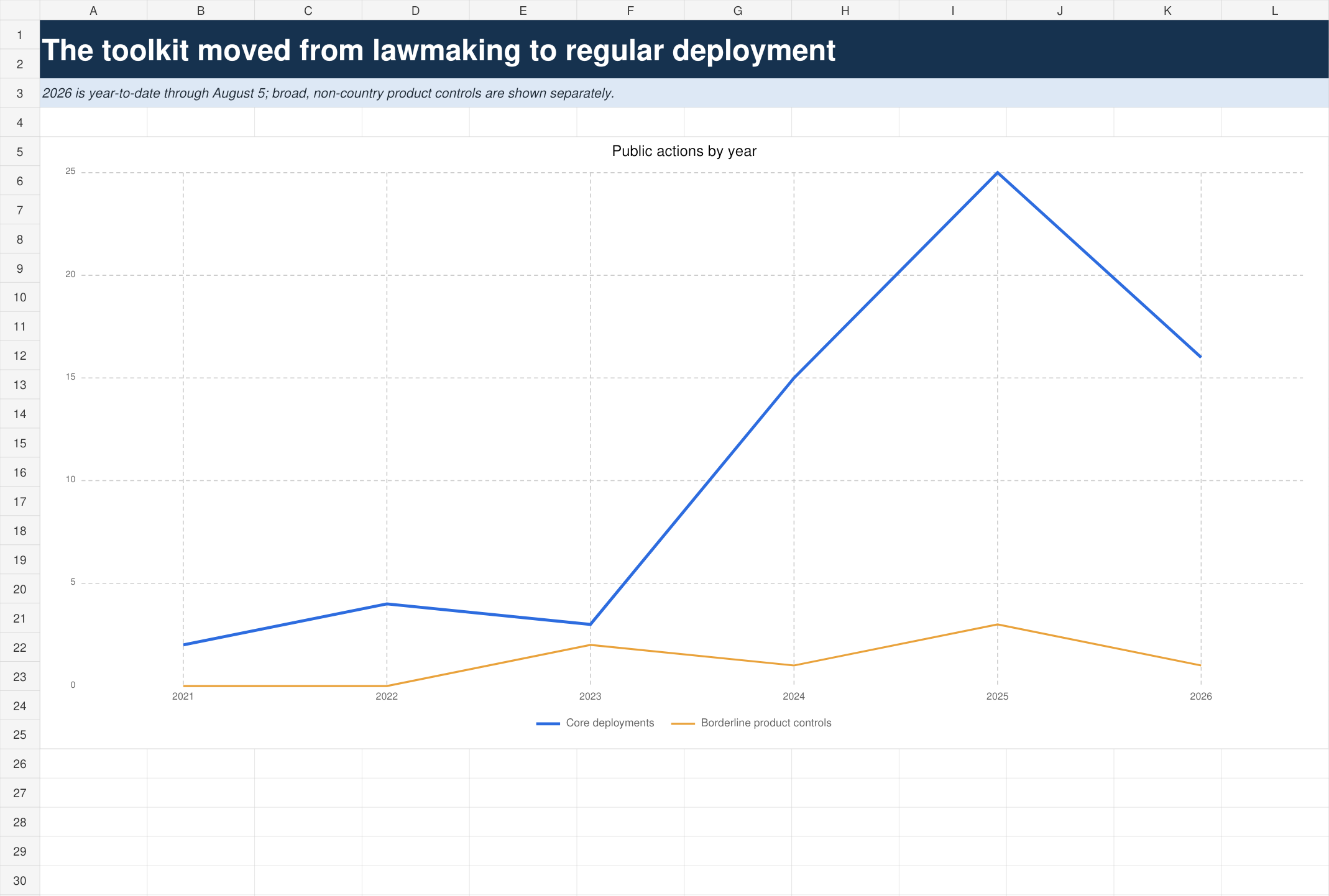 Figure 4. From lawmaking to regular deployment. Author dataset. 2026 is year-to-date through Aug. 5; broad product controls shown separately.
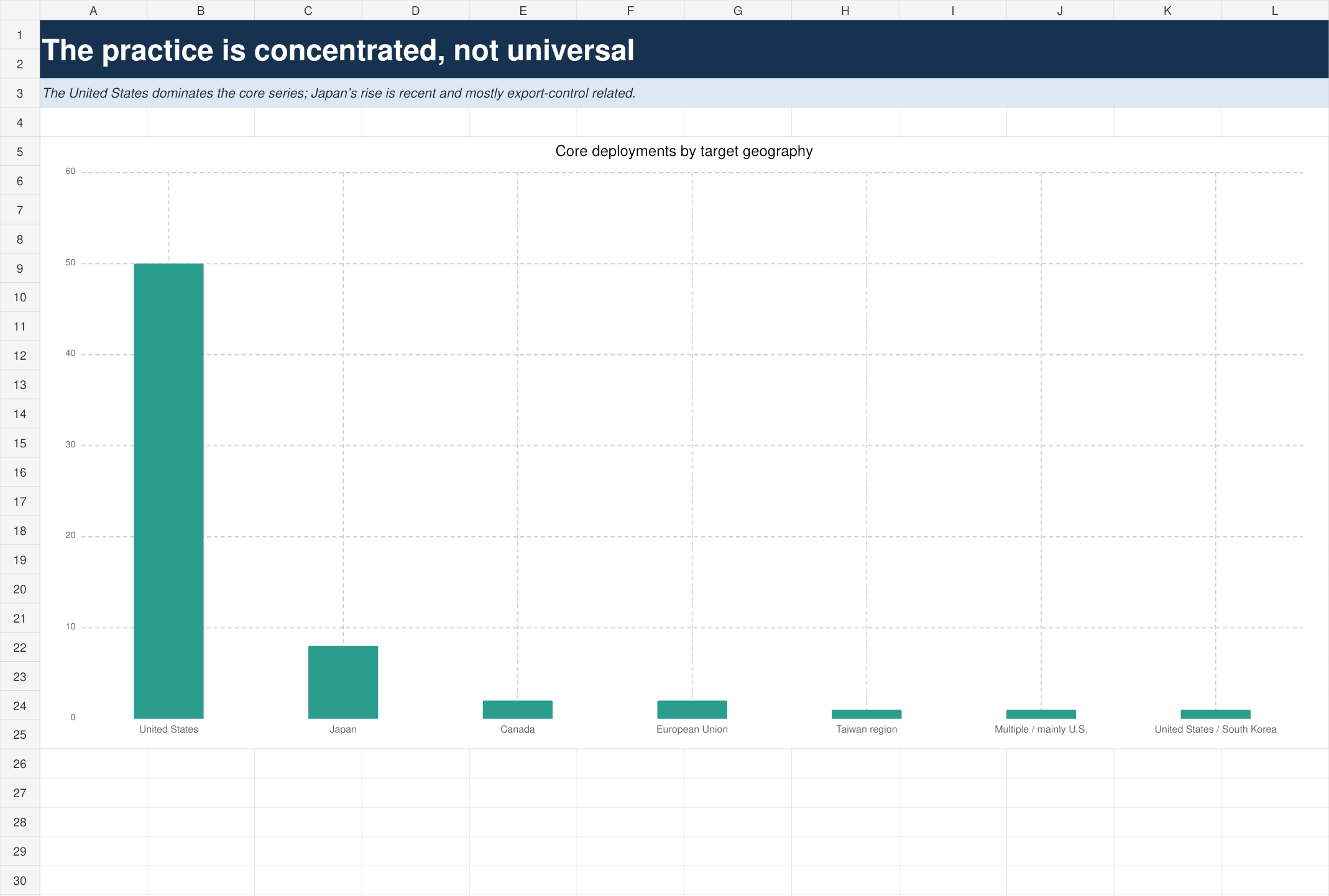 Figure 5. The practice remains geographically concentrated. Author dataset; core public deployments only.
That pattern looks more like bargaining and deterrence than a mission-driven sanctions bureaucracy. It also explains the otherwise odd coexistence of sweeping legal authorities and modest disclosed use. China wants credible escalation options without automatically paying the economic cost of using them.
The dataset covers formal, public action—not customs delays, tourism restrictions, consumer boycotts or unannounced licensing slowdowns. Those can matter economically, but mixing them with legal orders would prevent a clean test of the formal regime.
China is not building a copy of OFAC
The systems share a vocabulary—lists, asset freezes, transaction bans, export controls and licensing—but rest on different leverage. The U.S. system centers on OFAC financial sanctions and BIS export controls. Under IEEPA, the president declares an emergency tied to an unusual and extraordinary foreign threat; orders and statutes define conduct, and Treasury builds programs, regulations, licenses and designations. China disperses authority across ministries, the State Council, customs and the tariff commission, layering “countermeasure” statutes onto trade and security law.
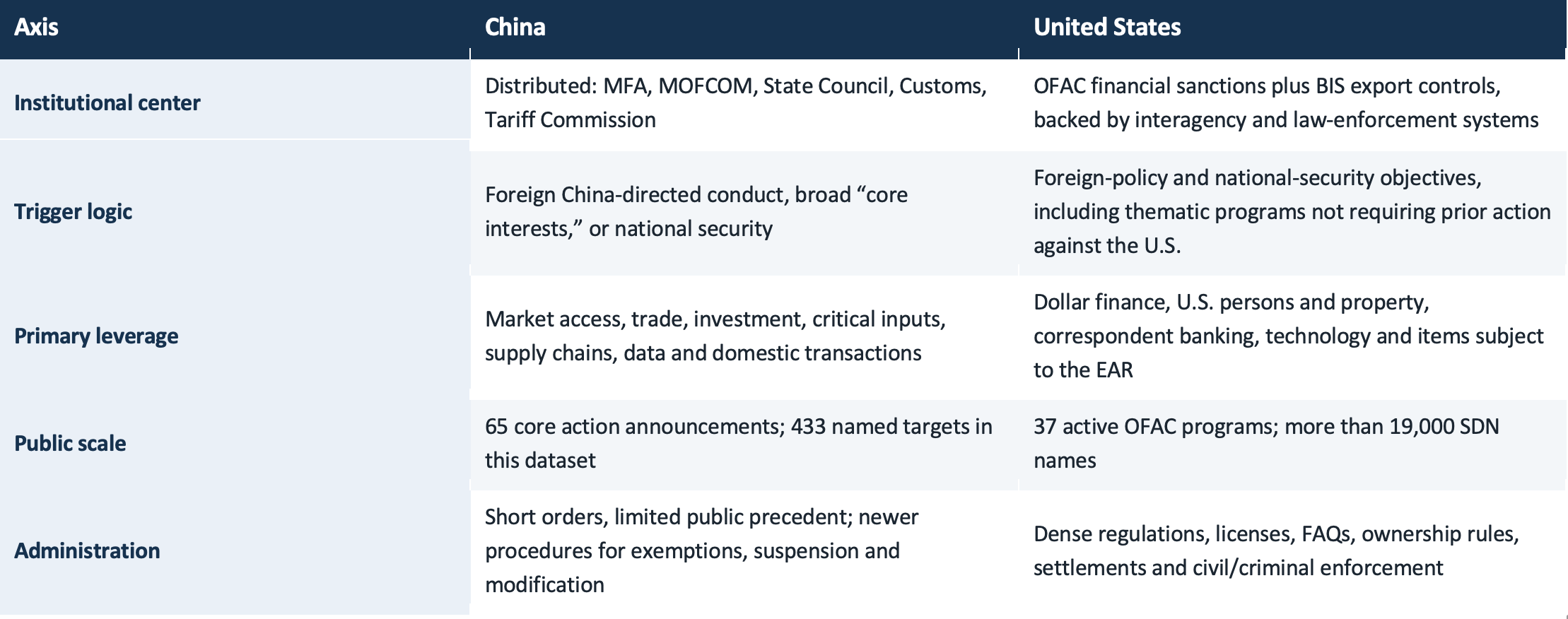 Table 2. Two sanctions systems, two centers of gravity. U.S. figures from OFAC pages current Aug. 9, 2026; China figures from the accompanying dataset. Units are not directly comparable.
OFAC was not born proactive. Treasury traces its formal creation to December 1950, when President Truman answered China’s entry into the Korean War by blocking Chinese and North Korean assets. Iran’s 1979 asset freeze likewise followed the embassy seizure and hostage crisis. In that temporal sense, much U.S. sanctions history is also retaliatory: a war, coup, terrorist attack, invasion or proliferation episode supplies the emergency.
The difference is what happened next. Crisis blocks became durable programs, and after September 11 sanctions became, in Treasury’s phrase, a “tool of first resort”. OFAC was used to coerce policy change, constrain money and technology, disrupt networks, deter conduct and signal rules. Iran sanctions grew from a hostage-crisis block into pressure on oil revenue, nuclear and missile activity and terrorism. Counterterrorism authorities targeted financing networks. The 2017 Global Magnitsky program made serious human-rights abuse and corruption sanctionable worldwide, with no prior economic measure against the United States.
Russia shows the mature system. Since 2022, OFAC measures have immobilized assets, reduced revenue, degraded the war machine and policed evasion, reaching suppliers in third countries. This is proactive in the relevant sense: the objective is an autonomous U.S. policy goal, not defense against Russia first sanctioning America. Yet it responds to an invasion. “Reactive” and “proactive” are not opposites; the useful variable is the required nexus.
China’s observed nexus is tighter. Fifty-nine of 65 core deployments identify an act against China, a Chinese party or claimed sovereignty and security. There is no Chinese Global Magnitsky: no standing worldwide campaign against corruption, narcotics or human-rights abuse unconnected to China. Nor is there routine formal secondary sanctioning of third parties. The analogue is pressure through market access and inputs, not a global financial perimeter.
This is practice, not a clean legal limit. AFSL Article 15 and security clauses leave room to widen the nexus; OFAC’s history shows how emergency architecture accretes missions. China already uses designations for signaling, licenses for constraint and reversals for bargaining. It has not built the same thematic, third-party-facing machine.
The scale gap fits that distinction, though the units differ. OFAC lists 37 active programs spanning thematic and country conflicts. Its SDN list contains more than 19,000 names. BIS reported more than 340 Entity List additions in 2024. China’s 433 named targets are not an equivalent universe, and many likely hold few Chinese assets.
Enforcement also differs. U.S. rules follow persons, property and financial transactions, apply a 50-percent ownership rule, and carry subpoenas, settlements and criminal cases; export rules attach abroad. Chinese orders are shorter, precedent and enforcement data sparse. But China’s leverage is market access, industrial capacity and hard-to-replace inputs. An export denial can be less legally global than an OFAC designation and still commercially acute.
The right conclusion is conditional, not comforting
So far, China has not used its formal regime as a general tool for remaking third-country behavior. The clearest falsification would be a thematic campaign—with no plausible China nexus—or secondary sanctions forcing third parties to advance an autonomous policy goal. That would look more like U.S.-style proactive sanctioning.
Until then, China is building an anti-coercion fortress with offensive ports: a system designed mainly to answer pressure on China, but with “pressure on China” defined by Beijing. That captures the restraint in the record without mistaking practice for a binding limit on power.
Methodology and source note
Coverage runs July 23, 2021–August 5, 2026. Routine trade-remedy cases, informal coercion and pre-AFSL announcements without a transparent legal mechanism are excluded. Official sources are preferred; two 2022 actions rely on Reuters and are marked Medium confidence. All coding is editable.
Editor: Yida
1. Borderline case—gallium and germanium. MOFCOM Announcement No. 23 (July 3, 2023) imposed licensing on specified items for all destinations, cited national security and interests, and did not name the United States. Its timing in the chip-controls dispute supports a retaliatory interpretation, but the coding rule does not infer motive from timing. It remains in the workbook as Borderline and is excluded from the 65-action denominator.
2. Borderline case—seven medium and heavy rare earths. MOFCOM/Customs Announcement No. 18 (April 4, 2025) landed the same day as a broader retaliation package. Yet the operative text applied globally and cited national security plus nonproliferation obligations. The dataset records it as Borderline rather than reciprocal economic action. By contrast, the December 2024 ban on specified dual-use exports to the United States names a destination and is Core.
3. Borderline trigger—Japan. MOFCOM Announcement No. 1 (January 6, 2026) barred dual-use exports for Japanese military users, uses and capability enhancement, including retransfers. Because Japan is named and legal consequences are immediate, the action is Core. Because the order identifies no earlier Japanese sanction, restriction or interference, its China-directed field is Ambiguous rather than Yes. Inclusion and trigger attribution are separate judgments.