


Global nuclear power generation hits historic high, with China emerging as the key driver.
According to a report published by Forbes on August 2, global nuclear power generation reached a historic peak in 2025, with almost all of the growth driven by China. Over the past decade, China’s nuclear power output has nearly tripled, not only filling the gap in global nuclear power growth but also rapidly narrowing the gap with the United States, the traditional leader in the nuclear power sector.
Citing data from the latest Statistical Review of World Energy, Forbes reported that global nuclear power plants generated 2,845 terawatt-hours (TWh) of electricity in 2025, an increase of approximately 30 TWh from 2024, representing year-on-year growth of 1.3% and setting a new historical record.
However, this record does not necessarily indicate a broad-based revival of the global nuclear power industry.
Data shows that while global nuclear power generation has surpassed the previous record set in 2006, it has increased by only around 1.5% over the past 19 years. Over the past decade, global nuclear power generation rose from 2,576 TWh in 2015 to 2,845 TWh in 2025, an increase of approximately 10.5%.
During this period, China became the primary source of global growth.
From 2015 to 2025, China’s nuclear power generation increased from 171 TWh to 485 TWh, an increase of approximately 314 TWh. During the same period, global nuclear power generation grew by only about 270 TWh in net terms.
This means that China’s newly added nuclear capacity not only accounted for the entirety of global growth but also effectively offset the decline in nuclear output in other regions.
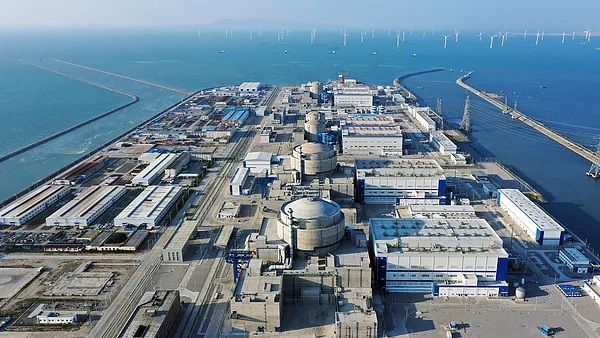 Panoramic view of Fuqing Nuclear Power Plant Units 1-6 (Fuqing Nuclear Power, Guo Donghai) Visual China
The United States remains the world’s largest nuclear power producer. In 2025, U.S. nuclear power generation reached 826 TWh, accounting for approximately 29% of the global total. China ranked second with 485 TWh, representing 17.1% of global nuclear power generation, while France ranked third with 390 TWh, accounting for 13.7%.
However, the United States’ lead is narrowing.
Data shows that U.S. nuclear power generation has remained largely unchanged over the past decade. In 2015, the United States generated 839 TWh of nuclear power, slightly higher than its 2025 output. By contrast, China’s nuclear power generation nearly tripled over the same period, with an average annual growth rate close to 11%.
Forbes stated that if both countries maintain their recent growth rates, China could surpass the United States in approximately five years to become the world’s largest nuclear power producer.
Besides China, France and Japan also contributed to global nuclear power growth in 2025. France’s nuclear power generation increased by 9.6 TWh to reach 390 TWh. Previously, France’s nuclear output declined due to factors including the shutdown of some reactors. It is now gradually recovering, although it remains below its 2015 level.
Japan’s nuclear power generation increased by 9.2 TWh in 2025, up 11.1% year-on-year, reaching 94 TWh. Japan’s nuclear output has recovered from the low point following the Fukushima nuclear accident, but it remains far below pre-accident levels. In 2010, Japan generated approximately 292 TWh of nuclear power, more than three times its 2025 level.
From a regional perspective, the center of global nuclear power growth is gradually shifting toward Asia. Between 2015 and 2025, nuclear power generation in the Asia-Pacific region increased from approximately 420 TWh to nearly 845 TWh, doubling over the decade and accounting for around 30% of global nuclear power generation today.
By contrast, nuclear power generation in Europe declined significantly, falling from 968 TWh in 2015 to 759 TWh in 2025, a decrease of nearly 22%. North America generated 921 TWh of nuclear power in 2025, slightly below the 952 TWh recorded in 2015.
The article points out that trends in nuclear power growth also reveal a divergence between developed and emerging economies. Over the past decade, nuclear power generation among members of the Organisation for Economic Co-operation and Development (OECD) declined by approximately 96 TWh, while non-OECD countries increased their output by nearly 366 TWh. Although developed economies still account for the majority of global nuclear power generation, an increasing share of new growth is coming from regions such as Asia.
According to data from China’s National Energy Administration, mainland China currently has 120 nuclear power units either in operation or approved and under construction, with a total installed capacity of 135 million kilowatts, ranking first in the world in terms of overall scale. Among them, 62 units are currently in operation, with an installed capacity of 66.14 million kilowatts, ranking second globally and accounting for 1.6% of China’s total installed power capacity. Another 58 units have been approved and are under construction, with an installed capacity of 69.51 million kilowatts, ranking first worldwide.
Forbes concluded that the global nuclear power record set in 2025 was less the result of a worldwide nuclear construction boom than a reflection of China’s rapid expansion in nuclear power. The United States continues to hold the top position in nuclear power generation, but its output has remained largely stable for years. China, through sustained construction and expansion, is gradually reshaping the global nuclear power landscape.
However, China’s nuclear energy ambitions extend beyond conventional nuclear fission technology. At the same time, the country is advancing research into controlled nuclear fusion, widely regarded as one of the ultimate frontiers of future energy development.
In 2026, China’s “artificial sun” project achieved a major milestone, with researchers aiming to enable a controlled nuclear fusion device to generate its first electricity by 2030. As a technology that seeks to replicate the energy-generation mechanism of the Sun, controlled nuclear fusion is considered to have potential advantages including abundant fuel resources, low carbon emissions, and enhanced safety. It is widely viewed as a key pathway toward meeting future global energy demands.
If the global nuclear power competition of the past several decades has largely focused on the construction and expansion of nuclear fission reactors, the next phase of the energy race may increasingly depend on who can achieve the first commercial breakthrough in controlled nuclear fusion. China is now building a comprehensive nuclear energy strategy that spans both large-scale deployment of conventional nuclear power and research into next-generation nuclear technologies.
Editor: LQQ