



In December 2023, the Prince William County Board of Supervisors approved one of the largest proposed data-center developments on Earth. The public hearing lasted 27 hours. The vote was 4–3. One decisive vote came from a board chair who had already lost a primary to a data-center opponent. A judge later voided the rezoning over defective public notice. In July 2026, the developer walked away.1
Now travel 7,000 miles to Wuhu, a city west of Shanghai that most Americans could not place on a map. In May 2025, the local environmental bureau posted China Mobile’s Yangtze River Delta data-center paperwork. The document was an environmental-impact report form. The posting ran for five working days. The line for a public-participation statement in that form was blank.2
Same infrastructure. Radically different political object.
The tempting explanation is that China is authoritarian and can build whatever it wants. That explanation contains a kernel of truth; it is just badly incomplete. China has formal environmental-participation rules, public-comment windows, complaint hotlines and administrative litigation. Chinese residents have stopped or altered other unwanted facilities. “Dictatorship” does not explain why data-center siting so rarely appears to reach the escalation stage.
But before explaining the difference, we need to prove there is one.
First, establish the mystery
I went back through the 24 Chinese projects in the dataset and searched every exact project name with six families of terms: opposition, complaint, petition, hearing, lawsuit and cancellation—反对、投诉、信访、听证、诉讼、取消. I also ran broader Chinese searches for data-center protests and nuisance complaints.
The defensible finding is narrow: I located no project-specific siting protest, resident lawsuit, opposition-led delay or cancellation among those 24 projects. That is not the same as finding no resistance. Search engines miss things; local archives disappear; censorship changes what becomes legible; private grumbling leaves no URL. The China sample is also not a random census. A cynic might say China simply erased every trace of resistance. But the wider record makes that explanation too simple.
The exact-name search produced permits, procurement notices and construction updates. The wider search did find residents complaining after equipment began operating—about cooling fans and air-conditioning—not coalitions trying to stop the campus before construction. A month-long consultation on a Zhongwei data-center cluster plan reported receiving zero comments.3
Meanwhile, America’s conflict is impossible to miss even with imperfect measurement. Data Center Watch, an opposition-focused tracker, counted hundreds of local groups across 42 states and at least $156 billion in projects blocked or delayed amid opposition in 2025. That is not a national rejection rate; the tracker deliberately looks for fights. It does establish that American resistance is organized, geographically broad and capable of changing project outcomes.4
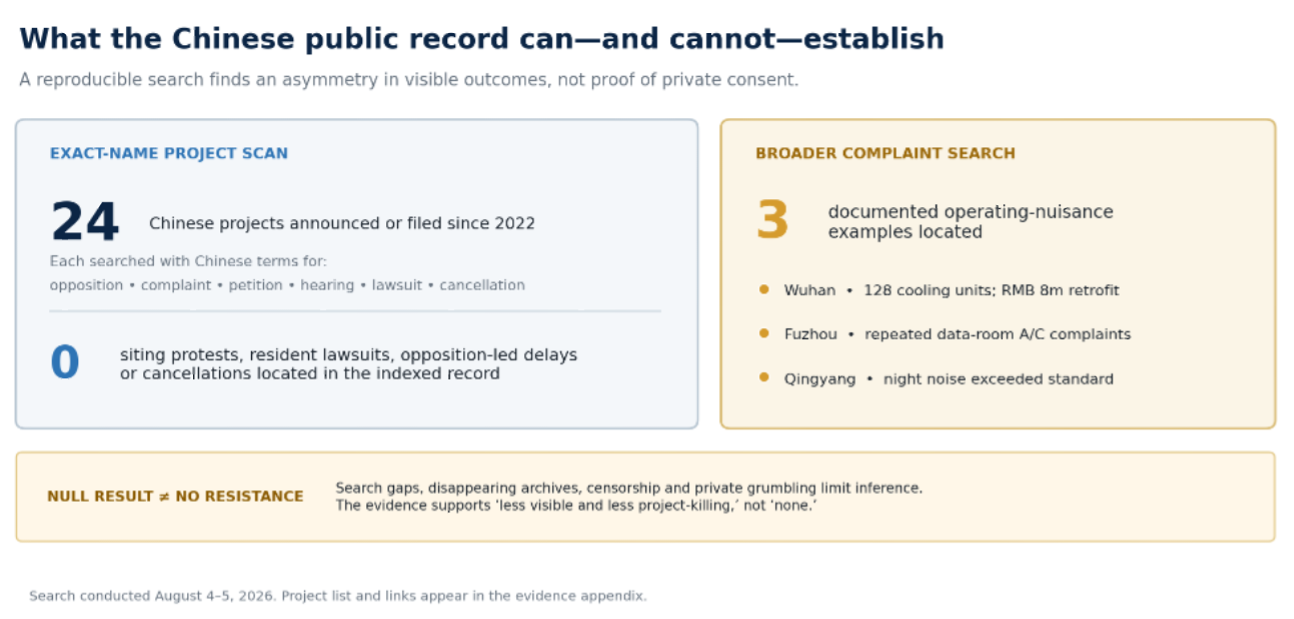
Figure 1. The public record supports a narrow claim: no project-killing resistance was located in the 24-project exact-name scan, while broader searches found operating-nuisance complaints. A null result is not proof of consent.
So the mystery survives, with a more honest formulation: why is visible, project-killing resistance so much rarer in China’s data-center buildout?
China chooses the map before the parcel
The most important fact about Chinese data centers is not inside any data center. It is the map.
In 2022, Beijing launched East Data, West Computing—东数西算—and designated eight national computing hubs containing ten initial data-center clusters. Four sit near coastal demand: Beijing–Tianjin–Hebei, the Yangtze River Delta, the Greater Bay Area and Chengdu–Chongqing. Four are resource-side hubs farther west: Inner Mongolia, Guizhou, Gansu and Ningxia.5
The logic is gloriously literal. Eastern China has most of the users and digital businesses, but land and energy are tight. Western China has more space and abundant power, including renewables. So batch processing, backup and offline analysis can move west. Latency-sensitive work—financial transactions, video calls, industrial control, AI inference—stays closer to eastern users.
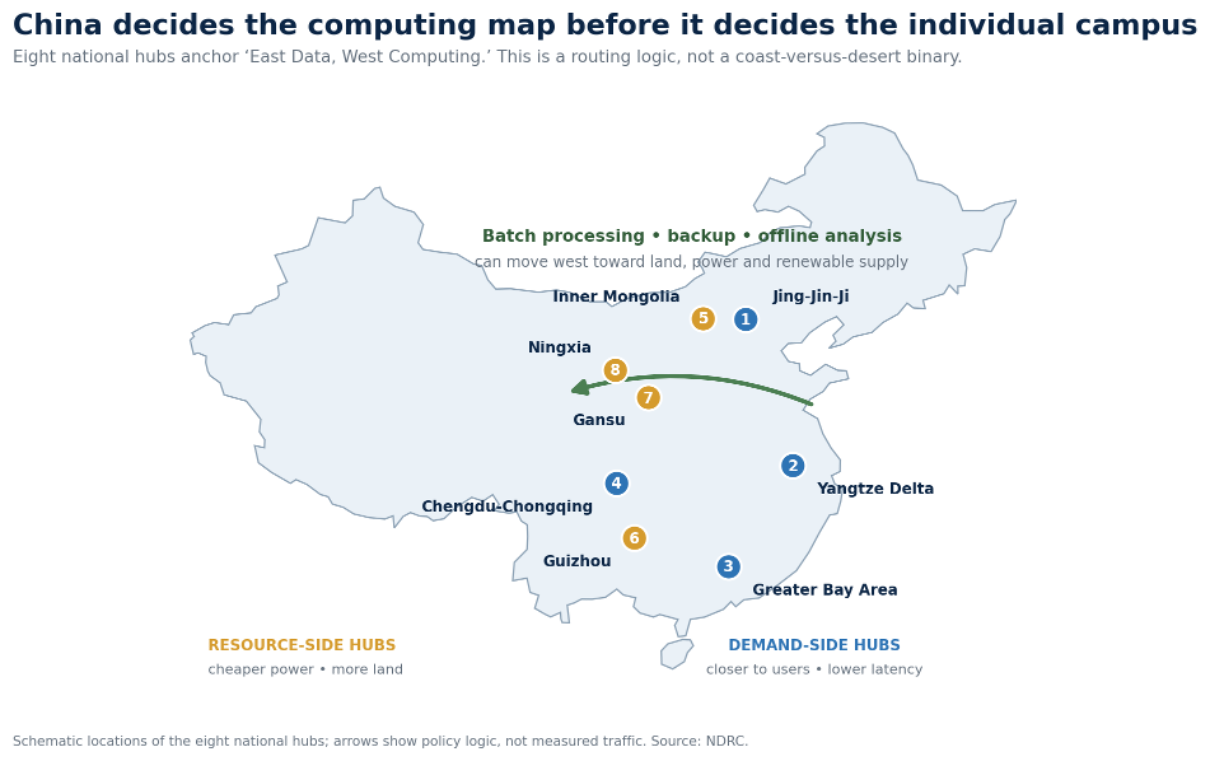
Figure 2. The eight national computing hubs behind East Data, West Computing. Demand-side hubs stay near eastern users; suitable batch, storage and offline work can move toward western land and energy resources.
This changes politics before a building appears. By the time a company files in Wuhu, Qingyang or Zhongwei, the state has often already selected the region, industrial park, power strategy and growth model. The campus arrives less as a fresh philosophical question—Should our town become a data-center town?—than as an implementation question: Does this building comply with the plan?
The quieter American projects in the dataset in fact follow a similar logic. Microsoft took over Wisconsin’s former Foxconn site. Meta entered Indiana’s preplanned LEAP district and a 2,250-acre tract in rural Louisiana. Amazon’s Mississippi and Louisiana projects landed with large prepared sites and state backing.6 Pre-siting is not Chinese magic. China simply does it nationally and earlier.
The legal hinge hidden in a form
China’s participation rules are real. For projects requiring a full environmental-impact report book, the 2018 measures require web, newspaper and on-site notices, at least ten working days for comments, a public-participation statement and meetings or hearings when major doubts persist.7
The hinge is classification. Projects expected to have more limited impacts may instead prepare a shorter report form, to which that full machinery does not automatically attach. Local bureaus may still post the document and accept feedback, but the process can look like Wuhu’s: five working days and a blank participation field.
Of the 24 Chinese projects, I located an identifiable environmental-review trace for 13. Every trace was a report form or a component-level form. I located zero full project report books. At least four forms showed participation as blank or “none.”8
The national classification catalog does not contain an obvious standalone category for “data center.” Depending on the impact, the campus may be handled under other categories while a substation, transmission line, wind farm or marine cable receives a separate review.9 That may be perfectly sensible engineering. Politically, that fragments the whole. Noise appears in one file, the grid connection in another, and cumulative electricity demand somewhere upstream.
American neighbors often see the opposite: one red boundary around hundreds of acres, one rezoning request, one hearing and one vote. That is a machine for turning a server campus into a political object.
China also has public input at the planning level. But plan consultation is much earlier, more abstract and less naturally connected to a homeowner imagining cooling fans behind the fence. Participation exists, but the moment at which it becomes concrete is different.
The presumption of usefulness
Institutions are only half the story. People bring priors.
Here is one plausible prior. An American hearing about a new industrial facility often begins with: prove this will not hurt us. A Chinese resident who has watched subways, airports, power lines and high-speed rail materialize within one adult lifetime may begin closer to: this may be disruptive for a while, but infrastructure has delivered before. That is not obedience, and it is certainly not universal within China. It is a different presumption of usefulness.
There is no good survey asking Chinese residents whether they welcome a data center next door, so this remains a mechanism, not a measured fact. But it fits the surrounding evidence. A long-running Harvard Ash Center survey of more than 31,000 people found satisfaction rising at every level of government from 2003 to 2016. Central-government satisfaction rose from 86.1 to 93.1 percent; township satisfaction rose from 43.6 to 70.2 percent. The authors linked the gains largely to material well-being and improved public services.10
High-speed rail is the obvious mental model. By 2019 it was carrying more than 1.7 billion passengers a year. A World Bank study estimated an 8 percent economic return as of 2015, with benefits from time savings, safety, labor mobility and tourism.11 Ordinary people can ride the result. That experience can buy the state some benefit of the doubt for the next piece of infrastructure.
It should not buy a blank check. Research has found high-speed rail can drain capital and skilled workers from peripheral cities, and China’s current computing boom has produced underused facilities. Developmental trust is earned, uneven and reversible.12 The point is simply that “another big infrastructure project” carries a different historical charge in a country where many such projects visibly changed daily life.
The bargain travels with the building
China also does not merely stuff server farms into cheap western land. A package travels with them.
National hub status aligns ministries, state-owned telecom firms, grid companies and local industrial parks. The central plan promises network links and energy coordination. Local governments add land, financing vehicles, procurement, tax support and subsidies. Then they try to pull suppliers and customers into the same cluster. The host is not asked to accept a warehouse full of computers in isolation; it is offered a theory of local development.5
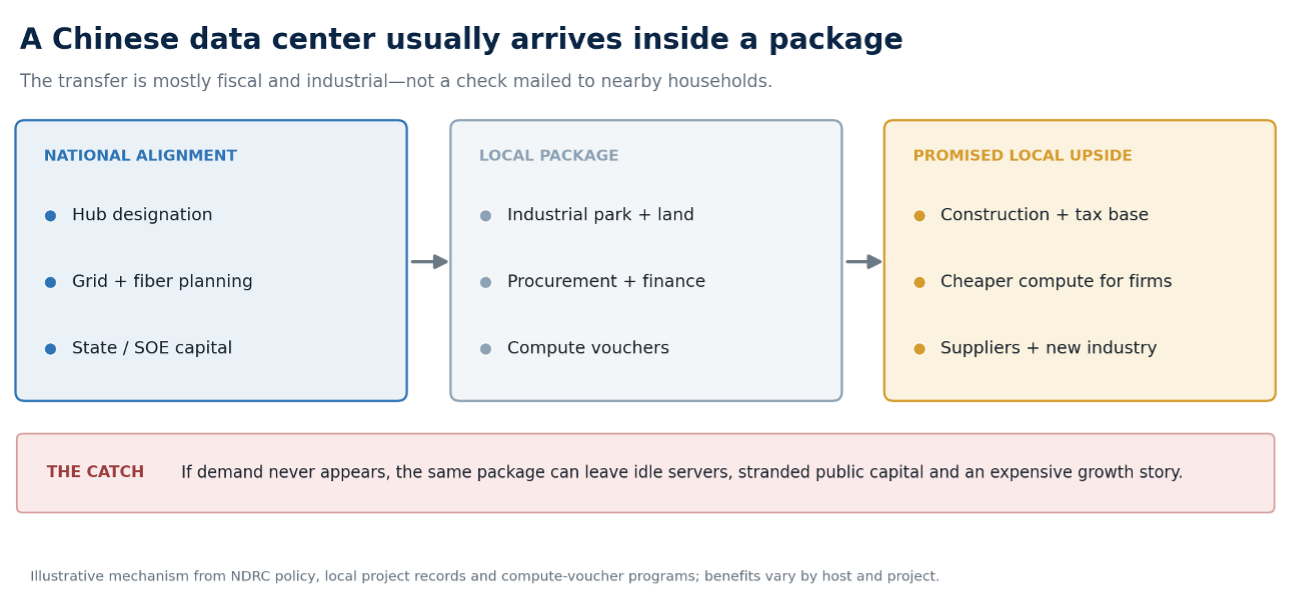
Figure 3. The hosting bargain is mostly fiscal and industrial. National alignment feeds a local package intended to create tax, procurement and supplier benefits; households benefit only if that development chain works.
In Wuhu, the city set aside RMB 100 million in 2025 for “compute vouchers,” covering 25 percent of eligible computing-service contracts up to RMB 20 million per user. The point is not charity. It is to turn newly built capacity into cheaper input for local companies, hospitals, universities and labs.13 Wuhan’s Wuchang district distributed RMB 6 million in vouchers and bought tens of millions of yuan of discounted computing services for local firms.14
The hoped-for prize is an ecosystem. Wuhu says it wants data-center and related output above RMB 100 billion by 2027. Hohhot reported 46 data-center projects and aims for a green-computing and AI industry above RMB 100 billion. Karamay’s cloud park says more than 180 enterprises or projects have arrived, while core digital-industry output rose from RMB 598 million in 2021 to RMB 930 million in 2024.15
This is a real local bargain, but not quite the “cash transfers to residents” version. The transfers mostly run through infrastructure, state capital, industrial policy, procurement and subsidized compute. Construction firms get work; the locality gets taxable assets and a new growth narrative; nearby companies get a cheaper digital input. Whether households benefit depends on whether that ecosystem actually forms.
Sometimes it does not. A 2025 government-affiliated investigation estimated average utilization of Chinese intelligent-computing centers at roughly 30 percent and described local subsidies attracting poorly planned projects. It cited Kunming support worth 15 percent of platform investment, up to RMB 50 million, and an Anhui cost-sharing subsidy for large centers—then warned about facilities that were obsolete or idle almost upon completion.16
That caveat matters. The Chinese model may suppress opposition partly because it socializes the promise of upside. It can also socialize the cost of a bad bet. Still, the basic political advantage remains: local officials and residents can expect meaningful upside from being included in a national industrial policy, which makes the project easier to sell.
America’s backlash is bigger than data centers
The American data-center fight is usually told as NIMBYism: homeowners dislike a large ugly thing nearby. That is true in the way “the Civil War was about a disagreement” is true. It deletes the political economy.
For forty years, American local development has often followed a familiar script. Government offers tax relief and infrastructure to attract mobile private capital. The company promises investment, construction jobs and a larger tax base. The diffuse regional benefits are forecast; the concentrated local costs arrive as land conversion, transmission lines, water demand and noise. Call it neoliberalism if you like. Residents increasingly call it a bad deal.
Virginia’s own legislative watchdog captured both sides. Data centers generate enormous construction activity and local tax revenue. Yet a typical 250,000-square-foot facility supports only about 50 full-time jobs once operating, roughly half of them contractors. Under high-growth scenarios, generation and transmission expansion could add $14 to $37 per month to a typical Dominion residential bill by 2040.17
Now layer that bargain onto a public already suspicious of who wins. In a 2024 Pew survey, 74 percent of Americans said the economic system unfairly favors powerful interests. That included 85 percent of Biden supporters and 62 percent of Trump supporters; majorities in both camps said big corporations have too much power.18
Then layer on the collapse of Silicon Valley’s halo. In another 2024 Pew survey, 78 percent said social-media companies wield too much political power. In a 2025 survey, 51 percent of the public was more concerned than excited about AI, versus 11 percent more excited; 64 percent expected AI to produce fewer jobs.19
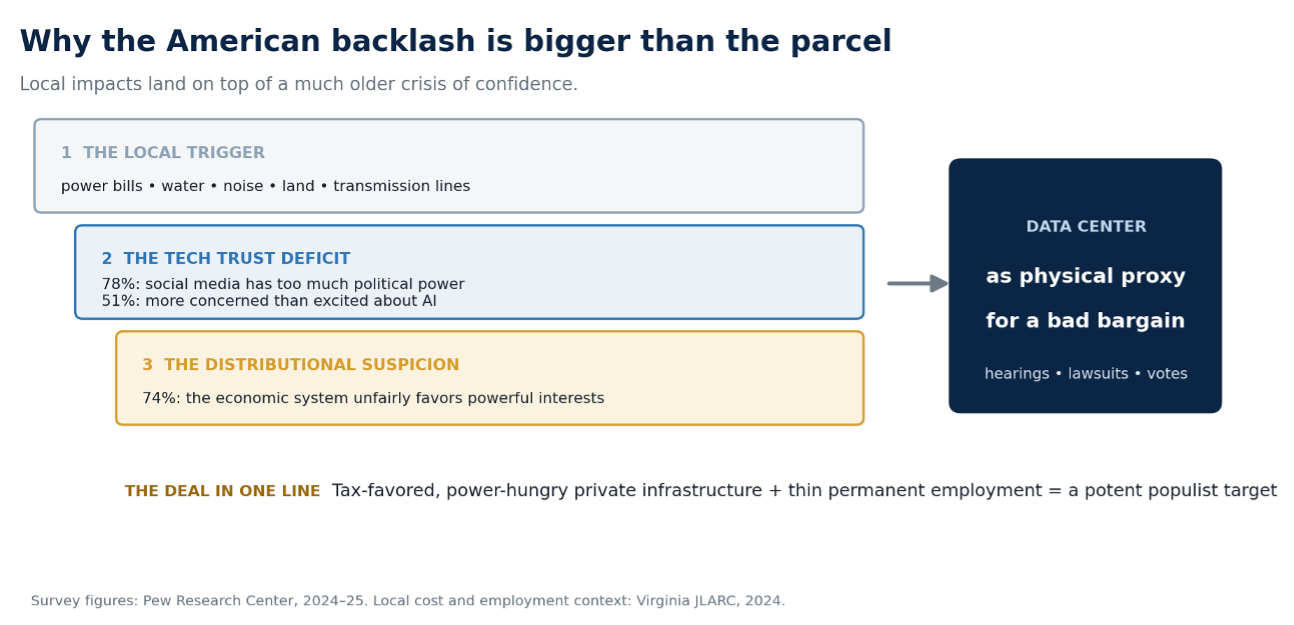
Figure 4. A zoning fight becomes a political faultline when local costs land on top of distrust in Big Tech and a wider belief that the economic system favors powerful interests.
This is why the backlash scrambles party lines. A progressive sees carbon emissions, water consumption and corporate subsidies. A conservative sees eminent-domain-adjacent grid expansion, opaque deals and a distant company changing the character of town. Both see the same basic transaction: local people are asked to absorb the physical costs of an industry whose profits and technological upside may accrue somewhere else.
The data center is therefore more than a building. It is the concrete-and-cooling-tower embodiment of a larger post-neoliberal suspicion: privatized upside, socialized infrastructure, thin permanent employment, trust us about the future. And it is the physical footprint of a technology many Americans now expect to eliminate jobs.
The American reaction, then, runs much deeper than anti-infrastructure sentiment.
American localities can manufacture a fight
Set the grand narrative about techno-feudalism aside for a moment. How do data centers actually get blocked—or approved—in the United States? Virginia offers the clearest laboratory. A data center can be allowed by right, allowed by special permit, or require rezoning. By-right projects follow rules already written into the zoning code and need no special approval. Special permits and rezonings usually trigger public hearings and votes by elected officials. Officials can reject the project or demand conditions such as larger setbacks and lower buildings.17
That sounds like boring land-use law. It is actually a machine for manufacturing political objects. I do not mean “manufacturing” dismissively. Political objects are made: a boundary is drawn, a vote is scheduled and a diffuse worry becomes a concrete target.
Once a developer needs discretionary approval, every concern acquires a target. Noise becomes a permit condition. A transmission line becomes a reason to delay. Water use becomes a demand for disclosure. A supervisor’s vote becomes campaign material. A defective notice becomes a lawsuit. The campus gains a name, a boundary and a scheduled night at city hall.
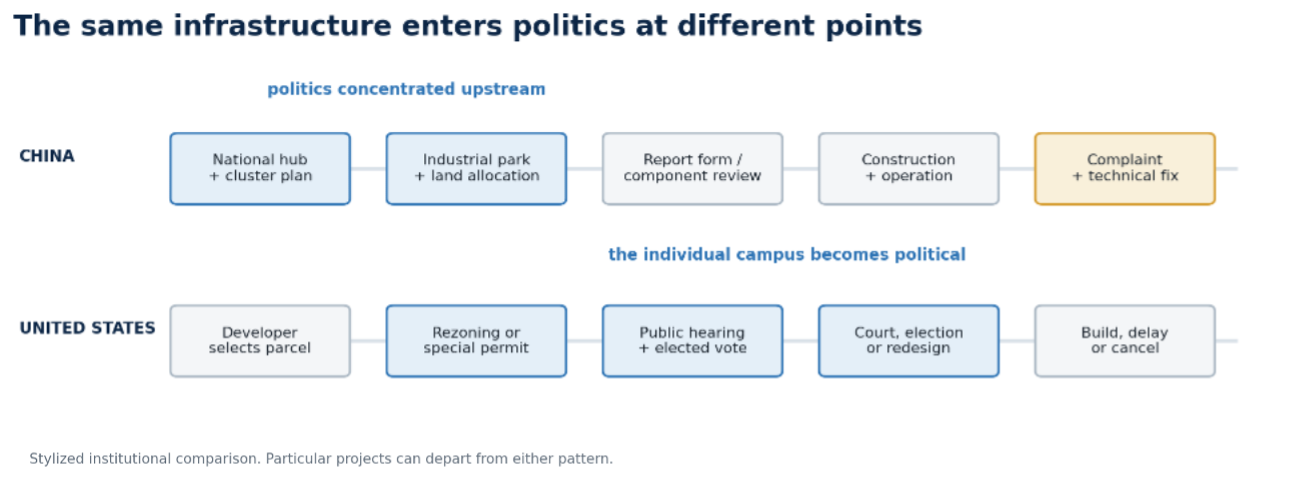
Figure 5. A stylized comparison of where a data center becomes political. Particular projects can depart from either pathway.
The 24 American projects show the consequences. Peculiar, Missouri, removed data centers from its zoning code after opposition to a proposed $1.5 billion project. A 195,000-square-foot, 50-megawatt proposal in Henrico County, Virginia, was withdrawn and replaced by a 65,000-square-foot facility on the part of the site where construction was allowed by right. In Warrenton, Virginia, more than 500 people attended the hearing for an Amazon facility; the project passed 4–3, lawsuits followed, and all four council members who voted yes were soon either out of office or had lost reelection.20
The Digital Gateway fight scaled that logic up to a new level: 27 hours of testimony, a 4–3 vote, a court ruling, an election consequence and, eventually, a dead project. In Monterey Park, California, voters skipped the parcel fight and prohibited data centers citywide by 88.33 percent.21
That $156 billion figure from Data Center Watch matters here because it captures the repertoire available to American opponents: permit denial, redesign, court order, election, ballot measure and cancellation. It is not a national base rate—the organization intentionally tracks conflict—but it shows what American opponents can do.4
American democracy is not an all-purpose stop button. By-right projects can remain remarkably quiet, especially on preassembled industrial land. Nor does a loud hearing guarantee victory. The Digital Gateway initially passed; a Saline Township, Michigan, board denied a 575-acre Stargate rezoning, then settled the developer’s lawsuit through a consent judgment.22
But discretionary zoning gives residents leverage before concrete is poured. China’s process more often concentrates choice at the national plan and industrial-park level, then handles the individual building as administration.
Where Chinese objections go
Chinese residents do object. And the archive shows where those objections land: on operating nuisances, after construction commences.
In Wuhan, people roughly 50 meters from a China Telecom building complained about 128 outdoor cooling units. The company spent about RMB 8 million converting the system to water cooling; later testing found noise within the limits.23 In Fuzhou, a resident said neighbors had complained dozens of times about air-conditioning units serving a government data room; inspectors recorded a retrofit and compliant testing.24 In Qingyang in 2025, a resident reported two years of round-the-clock cooling-tower noise from an East Data, West Computing facility. Night measurements exceeded the local standard, and the environmental bureau issued a correction order.25
That is not silence. It is voice after siting. The typical remedy is inspection and engineering, not reversal of land use.
This is not to deny the sliver of truth in the authoritarian thesis. Organizing across neighborhoods is harder in China, where community organizing does not have the same standing or reach. Courts and elections do not offer the same escalation ladder. But repression does not do all the explanatory work.
Planning reduces exposure before siting; legal classification narrows the project-level forum; developmental experience supplies some benefit of the doubt; and subsidies give local officials and firms a stake in the package.
America, by contrast, makes the parcel contestable just as confidence in corporate-led progress is collapsing.
So do Chinese people love data centers? We do not have evidence for that. The stronger conclusion is much more interesting: China makes data centers look like infrastructure inside a development bargain. America makes them look like Big Tech’s private factory with a public utility bill.
People are not reacting to the same political object. That, more than any national personality trait, is why one country gets complaint tickets—and the other gets 27-hour hearings.
Sources and notes
Links are placed here to keep the article body readable. All online sources were last checked August 5, 2026. Chinese-language titles are translated or summarized in English.
1. The 2023 hearing, vote, scale and election consequence are reported by Associated Press. The July 2026 termination was reported by Reuters.
2. Wuhu Municipal Ecology and Environment Bureau, China Mobile Yangtze River Delta (Wuhu) data-center report-form acceptance posting, May 8, 2025.
3. Author’s exact-name search protocol is described in the dataset appendix. Zhongwei Municipal Data Bureau, feedback on the consultation for the Xuanhe data-center cluster detailed plan, January 12, 2026, reported that the month-long consultation received no public comments.
4. Data Center Watch, Q3–Q4 2025 update. The tracker is conflict-enriched and should not be treated as a census of all U.S. projects.
5. National Development and Reform Commission, Q&A on implementation of East Data, West Computing, February 17, 2022.
6. Comparison projects: AWS Mississippi; Microsoft Wisconsin; Meta Indiana; and Meta Louisiana.
7. China Ministry of Ecology and Environment, Measures for Public Participation in Environmental Impact Assessment, especially Articles 2 and 9–25.
8. Author’s 24-project China sample; see the dataset appendix. Thirteen identifiable project or related review traces were classified from the linked records as report forms or component-level report forms. No full project report book was located in this search.
9. China Ministry of Ecology and Environment, Classified Management Catalog for Environmental Impact Assessment of Construction Projects (2021 edition). A text search of the catalog did not find a standalone data-center category.
10. Edward Cunningham, Tony Saich and Jessie Turiel, Understanding CCP Resilience: Surveying Chinese Public Opinion Through Time, Harvard Kennedy School, July 2020. The survey covered eight waves and more than 31,000 face-to-face interviews from 2003 to 2016.
11. World Bank, China’s Experience with High Speed Rail Offers Lessons for Other Countries, July 8, 2019.
12. Feng Yu et al., High-speed railway to success? The effects of high-speed rail connection on regional economic development in China, Journal of Regional Science 59 (2019); and Digital China Summit / Science and Technology Daily, How to activate ‘sleeping’ computing power, July 17, 2025.
13. Wuhu Municipal Data Resources Administration, Wuhu compute-voucher applications and redemption begin, June 17, 2025.
14. People’s Daily, Wuchang releases computing power through government purchase and vouchers, March 28, 2024.
15. Local development targets and results: Wuhu Municipal Government; China News Service on Hohhot; and Karamay Municipal Government. Targets are official aspirations, not guaranteed outcomes.
16. Digital China Summit / Science and Technology Daily, How to activate ‘sleeping’ computing power, July 17, 2025. The average-utilization figure is attributed there to Inspur’s Artificial Intelligence Research Institute.
17. Virginia Joint Legislative Audit and Review Commission, Data Centers in Virginia, 2024, especially pp. 73–84 for local planning and zoning. The report also documents substantial construction activity, statewide economic output and local tax revenue.
18. Pew Research Center, Biden and Trump supporters both say the U.S. economic system unfairly favors powerful interests, June 24, 2024.
19. Pew Research Center, Americans’ Views of Technology Companies, April 29, 2024; and How the U.S. Public and AI Experts View Artificial Intelligence, April 3, 2025.
20. Project details compiled by Data Center Watch; Warrenton hearing and zoning details are also summarized in JLARC’s 2024 Virginia report.
21. Los Angeles County Registrar-Recorder/County Clerk, March 3, 2026 election results, Monterey Park Measure NDC.
22. Saline Township, Data Center Project Information and Frequently Asked Questions, updated January 28, 2026.
23. Wuhan Municipal Ecology and Environment Bureau, 128 outdoor cooling units prompted resident complaints; cooling-system retrofit brought noise into compliance.
24. Fuzhou Gulou District Government, August 2022 environmental complaint-handling record.
25. Qingyang Xifeng District Government, public petition response on noise from the China Telecom Qingyang computing center, August 4, 2025.
Dataset and method
Scope:Projects announced, environmentally filed, permitted or publicly contested from January 1, 2022 through August 5, 2026. The China list emphasizes government project and environmental records; the U.S. list deliberately includes 16 conflict cases plus eight quieter comparison cases. It is not a representative sample and cannot establish national opposition rates. On August 4–5, 2026, every exact Chinese project name was searched in Chinese with 反对, 投诉, 信访, 听证, 诉讼 and 取消, plus English equivalents where relevant. No project-specific siting protest, resident lawsuit, opposition-led delay or cancellation was located. This is a bounded null result: search gaps, missing archives, censorship and private sentiment make “none exists” an invalid inference. Reported investment, capacity and acreage are nominal figures from the linked sources and may change. Environmental-review labels describe the publicly visible trace, which may cover the campus or a related power or marine component.
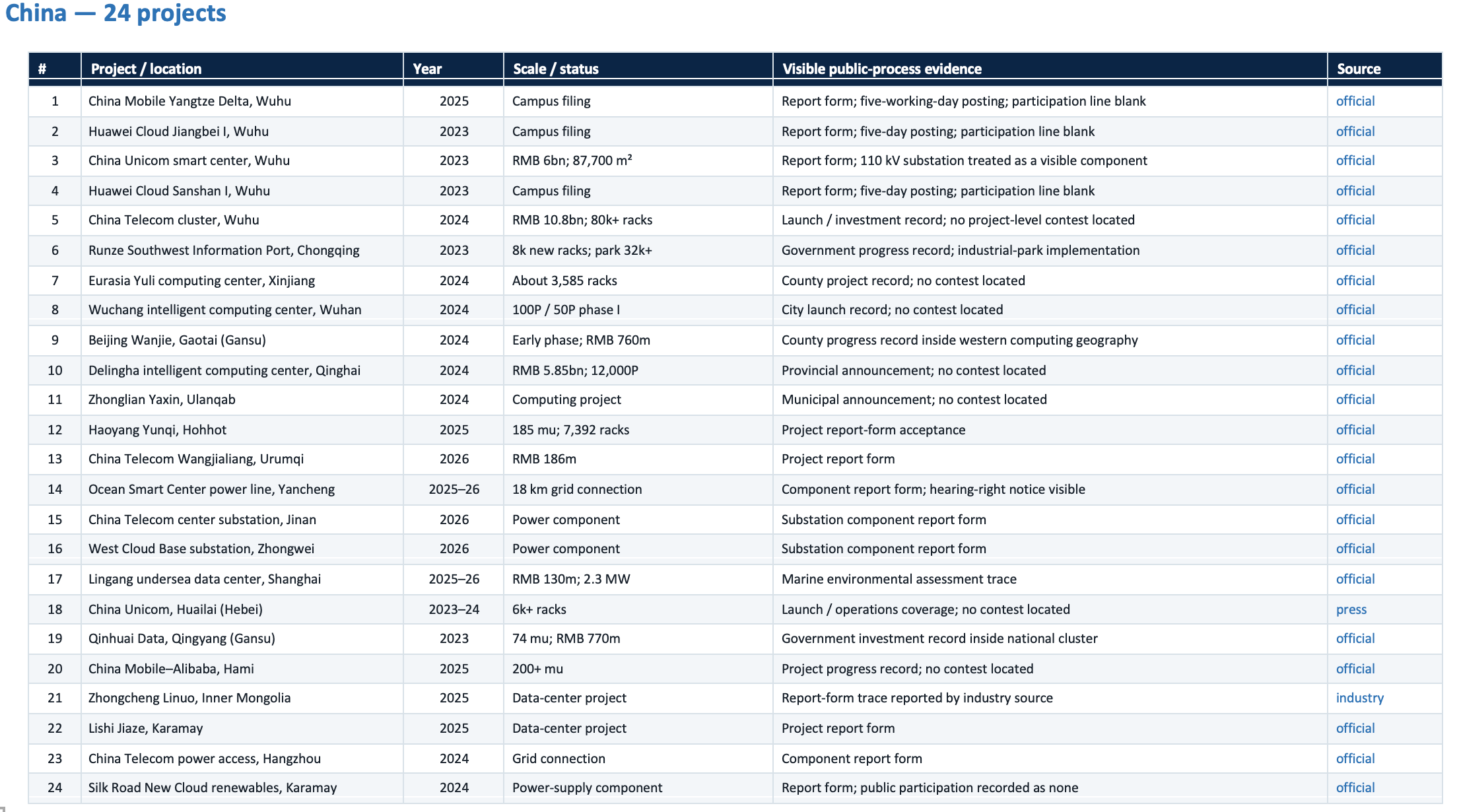
Resistance-search result for all 24 rows: no project-specific siting protest, resident lawsuit, opposition-led delay or cancellation was located. Thirteen entries had an identifiable report-form or component-form trace in the linked material; zero full project report books were located. Neither null result proves that no resistance or other environmental review existed.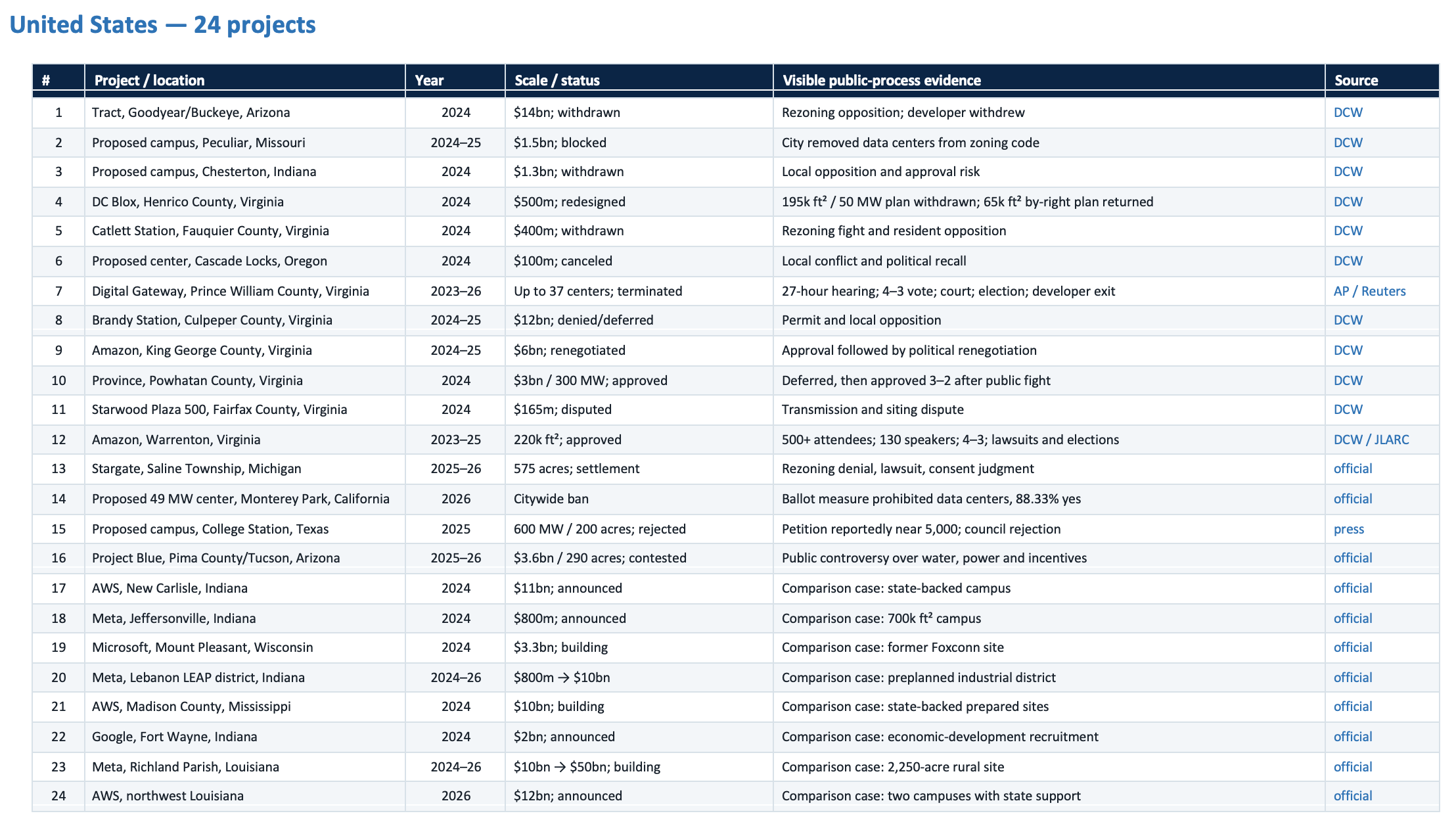 Reading note: rows 1–16 are conflict-enriched by design; rows 17–24 are comparison cases where prepared sites and state or local economic-development support were prominent. Data Center Watch is an opposition tracker, not a denominator of all projects.
Editor: Yunpeng Zhang

Chris24
The Essay argues: “But before we can explain the differences, we need to prove that they actually exist.” This academic analyzis on comparative political economy relies on publicly available records, yet fails to reveal any differences; moreover, there is indeed a vast disparity in the scale of the political systems between the United States and China.
Recommending Chris Hedges geopolitical podcast featuring Whitney Webb. In this episode, they discuss and analyze the political and technocratic ideologies behind US data centers, as well as the authoritarian system planned to be established to build a surveillance state, a system in which everyone is monitored and evaluated around the clock. The podcast is titled “How the Epstein Network Privatizes the State and Builds a Surveillance State.” Chris Hedge’s Podcast https://m.youtube.com/watch?v=2qbs91ivQmg Additional, Trump now ordered to locate Data Centers on US militaire campounds. So all of this makes clear why US Citizen hate Data Centers.