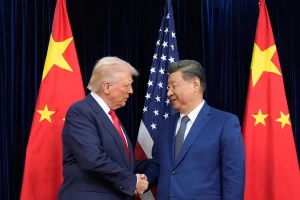



The mine is only the beginning. The real power lies in turning mixed ore into materials that make modern machines move.
1. Japan feels the squeeze; America tries to escape it
Japan’s rare-earth alarm is no longer hypothetical. In June 2026, China exported almost none of several controlled heavy rare earths to Japan. The concern was also spreading beyond defence contractors and materials companies: of nearly 200 Japanese listed-company filings that mentioned rare earths in May and June, more than two-thirds said China’s controls were affecting, or could affect, business.[1]
The squeeze grew out of a political fight. After Japanese Prime Minister Sanae Takaichi said a Chinese attack on Taiwan could threaten Japan’s security, Beijing barred dual-use exports to Japanese military users and any end use that could strengthen Japan’s military. In February, it prohibited sales to 20 Japanese entities, including divisions of Mitsubishi Heavy Industries, and placed 20 more, including Subaru, under tighter review. China said normal civilian trade would continue and described the measures as a check on Japanese “remilitarisation”; Tokyo called them unacceptable. But Japan gets about 60% of its rare-earth imports from China and relies on it for nearly all supplies of some heavy elements. A diplomatic dispute can therefore travel quickly into factory planning.[2]
Across the Pacific, the United States is trying to make that dependence less dangerous by rebuilding the whole chain at home. The White House ordered agencies to accelerate domestic mining, separation, refining and production of finished components. The Pentagon then became an investor, lender, price guarantor and future customer for MP Materials: it committed $400 million in equity, backed a new heavy-rare-earth separation line and guaranteed a market for a planned magnet factory. By February 2026, MP said it had produced its first neodymium-iron-boron magnets on commercial equipment in Texas.[3]
Yet in late July, while Washington was financing domestic capacity, US officials were still pressing Beijing over access to rare earths.[3] That apparent contradiction is the hook: replacing China is not simply a matter of opening a mine. So when people say China “dominates rare earths,” what exactly does China dominate?
2. It is not one mineral, and it is not just mining
“Rare earths” are a family of 17 metallic elements: the 15 lanthanides, plus scandium and yttrium. They are not especially scarce in the Earth’s crust. They are called rare because deposits rich enough to mine economically are uncommon, the elements usually occur mixed together, and their similar chemistry makes them difficult to separate.[4]
The most important current argument is about four “magnet rare earths”: neodymium, praseodymium, dysprosium and terbium. Neodymium and praseodymium form the base of high-performance neodymium-iron-boron magnets; small additions of dysprosium or terbium help those magnets keep working at high temperatures. Permanent magnets now account for roughly 95% of rare-earth consumption by value.[5]
That does not mean the other elements are useless. Cerium is used in catalytic converters and glass polishing. Lanthanum goes into petroleum-refining catalysts and some batteries. Europium, yttrium and terbium appear in phosphors and displays. Gadolinium is used in medical imaging, while erbium is important in fibre optics. “Rare earths” therefore describes a basket of small, specialised markets, not one interchangeable commodity.
It is also misleading to stop at the mine. A rare-earth supply chain has several distinct stages. Ore is mined, crushed and concentrated. The concentrate is chemically treated, then separated into individual oxides. Those oxides are converted into metals and alloys. Magnet makers turn the alloy into powder, align it, press it, sinter it, machine it and coat it. Only then does it become the compact, high-strength magnet that a manufacturer can place inside a motor.
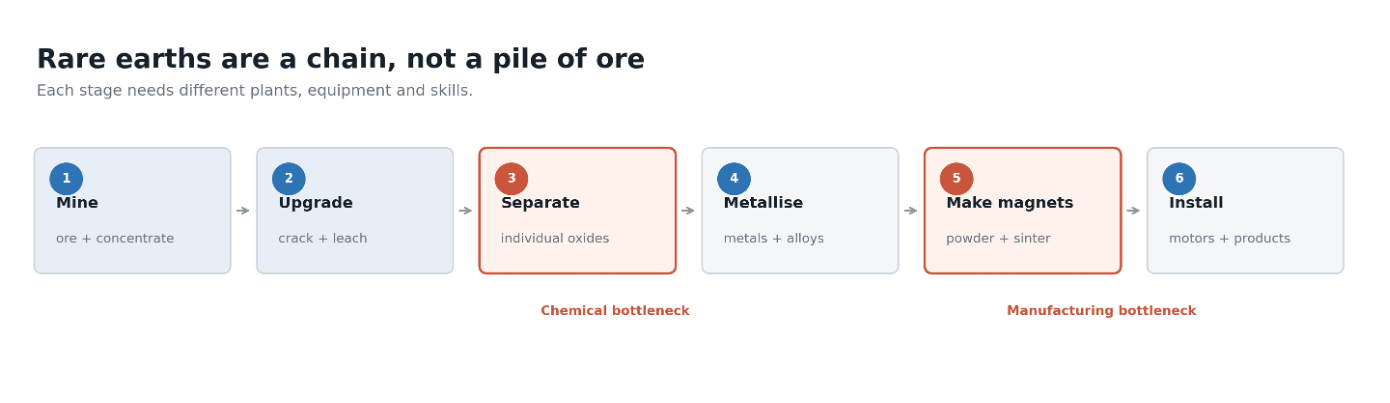
Figure 1. The mine-to-magnet chain.
Source: Adapted from the International Energy Agency, Rare Earth Elements (2026).
China’s position becomes stronger as the material moves down that chain. For the four magnet rare earths, the IEA estimates that China supplied 60% of global mine output in 2024, 91% of refined output and 94% of sintered permanent magnets. The broader USGS measure, covering all rare earths, puts China at roughly 69% of world mine production in 2025. The exact percentage changes with the definition. The pattern does not: mining is concentrated, but separation and magnet manufacturing are much more concentrated.[6]
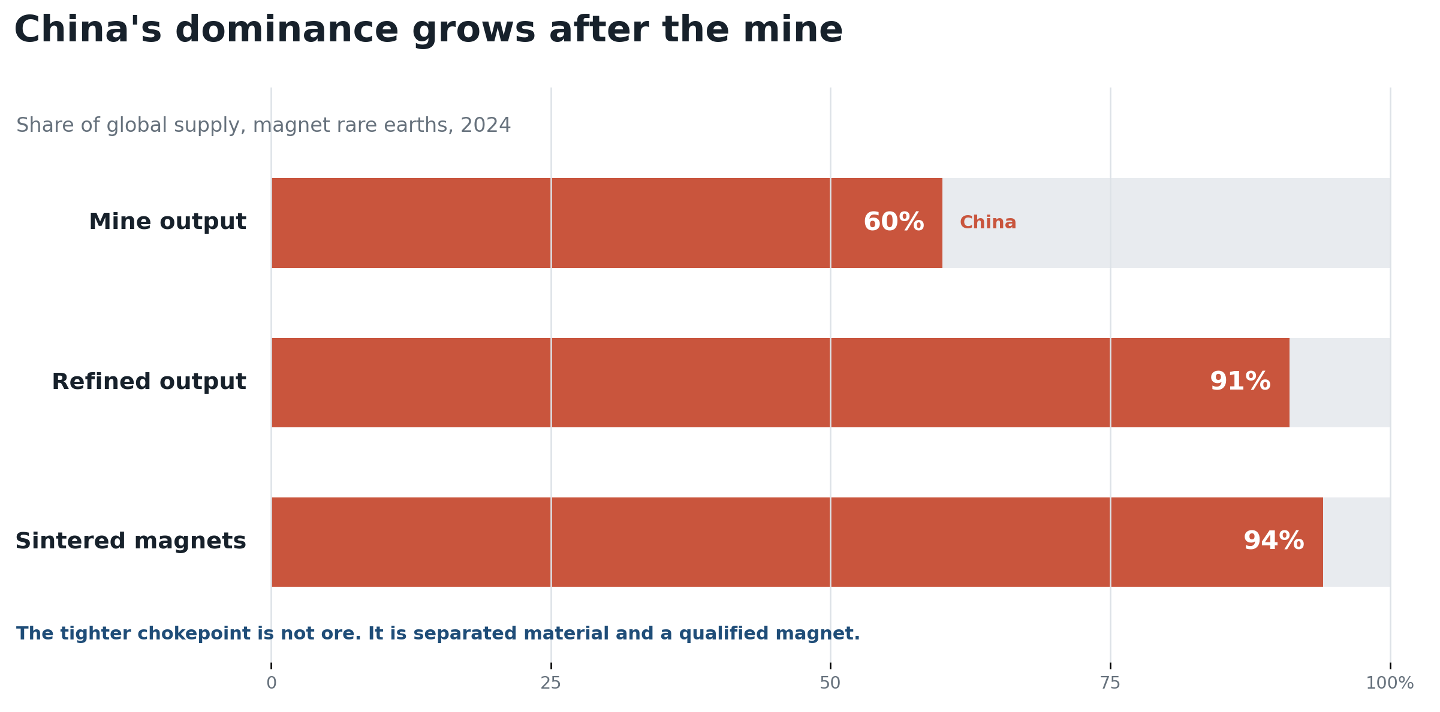
Figure 2. China’s share of the magnet rare-earth supply chain, 2024.
Source: International Energy Agency. Figures cover neodymium, praseodymium, dysprosium and terbium.
This is the distinction hidden by the vague word “processing.” A country can own a mine and still ship concentrate abroad for separation. It can produce oxide but lack the metallisation and alloy-making capacity needed for magnets. It can make an alloy yet struggle to produce thousands of magnets with the same grain structure, coating, heat resistance and failure rate demanded by automakers.
The finished magnets are physically small compared with the products around them, but they provide a great deal of force for their weight. They are used in many electric-vehicle traction motors, wind-turbine generators, robot servos, aircraft actuators, missile-guidance systems, hard-disk drives, speakers and other compact motors. Data centres depend on them in disk drives and cooling equipment. Not every EV or turbine uses a rare-earth magnet; engineers can choose induction motors, wound rotors or ferrite magnets, but those alternatives can involve trade-offs in weight, size, efficiency or cost.[7]
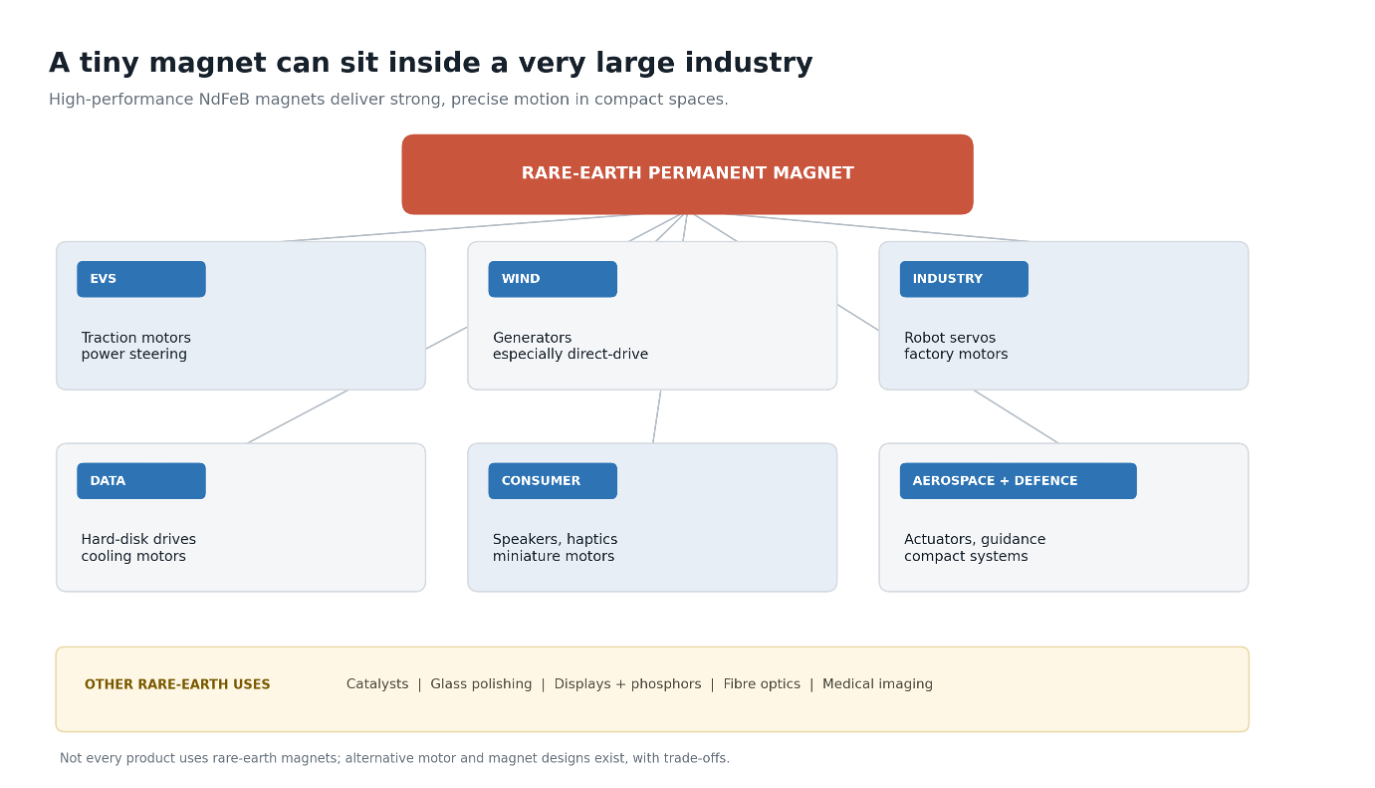
Figure 3. Where high-performance rare-earth magnets show up.
Source: International Energy Agency; U.S. Department of Energy; U.S. Geological Survey.
This explains the unusual leverage. A car factory may have almost every part it needs and still be unable to finish a vehicle because it lacks a magnet worth a tiny fraction of the final product. China’s dominance does not mean that every rare-earth deposit sits inside China. It means that a customer seeking large volumes of separated oxides, specialised alloys and reliable high-performance magnets is still most likely to depend on the Chinese industrial system.
The ore matters. The greater choke point is the system that turns it into a qualified magnet.
3. Why self-sufficiency is so difficult
Opening a mine is the obvious answer, but it solves only the first problem. Each deposit contains a different mix of elements. A producer cannot simply extract more neodymium without also finding buyers for the cerium, lanthanum and other materials that come out with it. This “balance problem” can ruin the economics of an otherwise promising project.
Separation is harder still. Because rare-earth elements behave so similarly, a plant may have to run material through long sequences of solvent-extraction steps. The chemistry is tailored to each ore body. It consumes acids, alkalis, water and energy, while generating waste that may contain toxic chemicals and naturally occurring thorium or uranium. Building a safe plant therefore requires specialised engineers, lengthy permitting and a credible plan for waste.[8]
Then comes manufacturing know-how. Metallisation, alloy casting, powder preparation, sintering, machining and coating each require equipment, skilled workers and repeated production experience. The IEA estimates that, even after announced projects are built, non-Chinese capacity in 2035 would cover only about half of outside-China demand at the mining stage, one-quarter at refining, and well below one-fifth for magnets. Closing those gaps would require capacity increases of roughly two times in mining, four times in refining and six times in magnets, on top of existing plans.[9]
The final obstacle is commercial. A new refinery must compete with an established Chinese ecosystem that has scale, suppliers, trained labour and large domestic buyers. Yet customers hesitate to sign long contracts until a plant proves it can meet specifications, while lenders hesitate to finance a plant without those contracts. Volatile prices make that loop even harder to break.
This is why national self-sufficiency is usually the wrong target. Few countries possess the right deposits, chemical expertise, equipment makers, magnet factories and downstream customers at once. A more realistic goal might be a diversified network: mines in several countries; separation and magnet plants in more than one region; long-term purchase agreements; strategic stockpiles; more recycling; and product designs that use less of the most constrained elements. However, diversification also compounds the difficulties to coordinate across jurisdictions, geographic areas, and, of course, national interests.
China does not merely supply rare-earth ore. It dominates the difficult conversion of geology into standardised industrial components. That is what makes its position so hard to replace and so useful as leverage.
Sources
[1] Reuters, China’s heavy rare earth tap stays closed for Japan in June (July 20, 2026); Reuters, Corporate Japan’s rare-earth warnings get louder as China keeps the spigot closed (July 7, 2026).
[2] Ministry of Commerce of China, Announcement No. 1 (January 6, 2026); Reuters, Japan condemns China’s dual-use export ban as rare earths in crosshairs (January 7, 2026); Reuters, China imposes export controls on 20 Japanese entities to curb ‘remilitarisation’ (February 24, 2026).
[3] White House, Executive Order 14241 (March 20, 2025); MP Materials, US Department of Defense partnership announcement (July 10, 2025); MP Materials, 2025 full-year results (February 26, 2026); Reuters, US officials pressed China on rare earths, farm goods commitments, Bessent says (July 30, 2026).
[4] U.S. Geological Survey, Rare Earths Statistics and Information; International Energy Agency, Rare Earth Elements.
[5] International Energy Agency, Rare Earth Elements, executive summary.
[6] International Energy Agency, Rare Earth Elements; U.S. Geological Survey, Mineral Commodity Summaries 2026.
[7] International Energy Agency, Rare Earth Elements; U.S. Department of Energy, Rare Earth Permanent Magnets Supply Chain Deep Dive Assessment.
[8] International Energy Agency, Rare Earth Elements, environmental and financing discussion.
[9] International Energy Agency, Rare Earth Elements, diversified-capacity outlook to 2035.
Editor: Yunpeng Zhang