



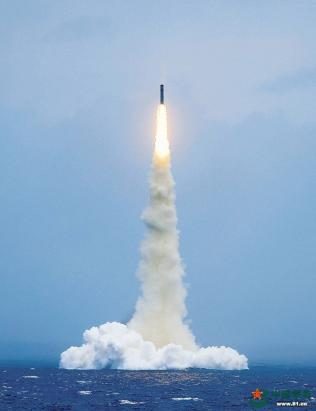
On July 6, China’s Navy test-fired a submarine-launched strategic missile into the Pacific Ocean. The US and its allies, including Japan, Australia, and New Zealand, immediately issued condemnations. The official English-language news website of the Chinese People’s Liberation Army (PLA) described the launch as a “routine arrangement as part of annual military training” and stated that it was “not targeting any specific country or target.” Was it though? While we may never obtain a definitive answer from China’s official voices, analyses by leading Chinese experts offer valuable insights into the thinking of China’s decision-makers.
Military commentator Song Zhongping explicitly denied speculation that the test was aimed at Japan or the Philippines. He argued that one should not overestimate the strategic significance of Japan and the Philippines. This missile test, he said, is a game between major power players. The only real players are China, Russia, and the United States.
Military expert Zhang Junshe pointed out that the test fully validated the entire operational chain of China’s nuclear submarines—including underwater maneuvering, underwater launch, and long-range guidance—proving that China’s strategic nuclear submarines can carry out stable and reliable strategic deterrence and nuclear counterstrikes from any point in the vast high seas of the Pacific. He noted that in more than 40 years, China has conducted ICBM launch tests in the Pacific high seas only twice, “which sufficiently demonstrates China’s self-defensive nuclear strategy, characterized by high transparency and restraint.” He cited the U.S. Ohio-class ballistic missile submarine’s test launch of four Trident II D5 ballistic missiles last September, emphasizing that the frequency and number of China’s missile tests are far lower than those of the United States and Russia. Zhang stressed that China is the only nuclear-armed state to have made a no-first-use nuclear commitment.
U.S.-based scholar Weng Lyuzhong said that the test sent three political signals. First, an internal signal: the PLA has undergone personnel reshuffles within the Rocket Force and at senior levels of the military in recent years, and this test proved that the strategic nuclear force has not lost its operational capability. Second, it sends a signal to the United States and its Indo-Pacific allies that “the cost of intervening in Indo-Pacific conflicts will become increasingly high.” Third, a signal to Taiwan: Weng argued that, strictly speaking, Taiwan is not the primary military target for this type of long-range missile. However, the tests serve as a warning to those in Taiwan who wish that the U.S. would come to their defense in the event of a cross-strait conflict.
Editor: Zhao Yiwen
Wood dragon Myke
This test was to test no choice as it needs a live test to see if it works. Just like any other nations who are making missiles.