


Amid intense global geopolitical turbulence, China–EU economic and trade relations have arrived at an unprecedented historical crossroads. Since 2026, the EU has successively rolled out new regulations, such as the Industrial Accelerator Act, erecting high walls around technical standards, while some European think tanks have even revived the illusion of forcing the appreciation of the renminbi through a “new Plaza Accord” to redress the trade deficit. Yet is the essence of this seemingly fierce “trade imbalance dispute” really, as Europe claims, nothing more than a market distortion brought about by China’s unilateral subsidies or “overcapacity”? Jian Junbo, Director of the Center for China–EU Relations at the Institute of International Studies, Fudan University, sharply points out that behind the China–EU economic and trade frictions lie four underlying and inescapable chasms between the two sides—in interests, perceptions, strategic choices, and institutions. This is not merely a “defensive struggle” by Europe to contain China’s industrial upgrading and preserve the old Western‑dominated global economic order; it is, more profoundly, the inevitable collision arising from China’s natural ascent, underpinned by the world’s most complete industrial chain system and its own technological innovation.
Jian Junbo: Persistent Provocations – What Is the Underlying Logic of the EU’s Approach toward China?
In recent years, the EU’s economic and trade policy toward China has become increasingly stringent. Particularly in the latest period, the EU and its major member states have adopted numerous restrictive measures in economic and trade matters concerning China, including attempts to pass discriminatory regulatory legislation targeting China, such as the Cybersecurity Act and the Industrial Accelerator Act, and have even proposed a package of measures and the signing of a new “Plaza Accord” with China to address the EU’s trade deficit with China.
Undoubtedly, these measures and proposals have already inflicted, and will continue to inflict, severe shocks on normal China–EU economic and trade relations. How exactly did Sino–European economic and trade frictions arise, why has the EU adopted an increasingly stringent stance on economic and trade relations with China, what are the root causes behind this stance, and how will China–EU economic and trade relations develop in the future? This article attempts to provide answers.
I. EU Accusations Behind Sino–European Economic and Trade Frictions
In recent years, the EU’s economic and trade policy toward China has been continuously tightening, as evidenced by a succession of trade investigations, restrictive legislation, and technology controls. These measures are all related to two core accusations leveled by the EU against China: the so‑called “trade imbalance” and supply chain “security.”
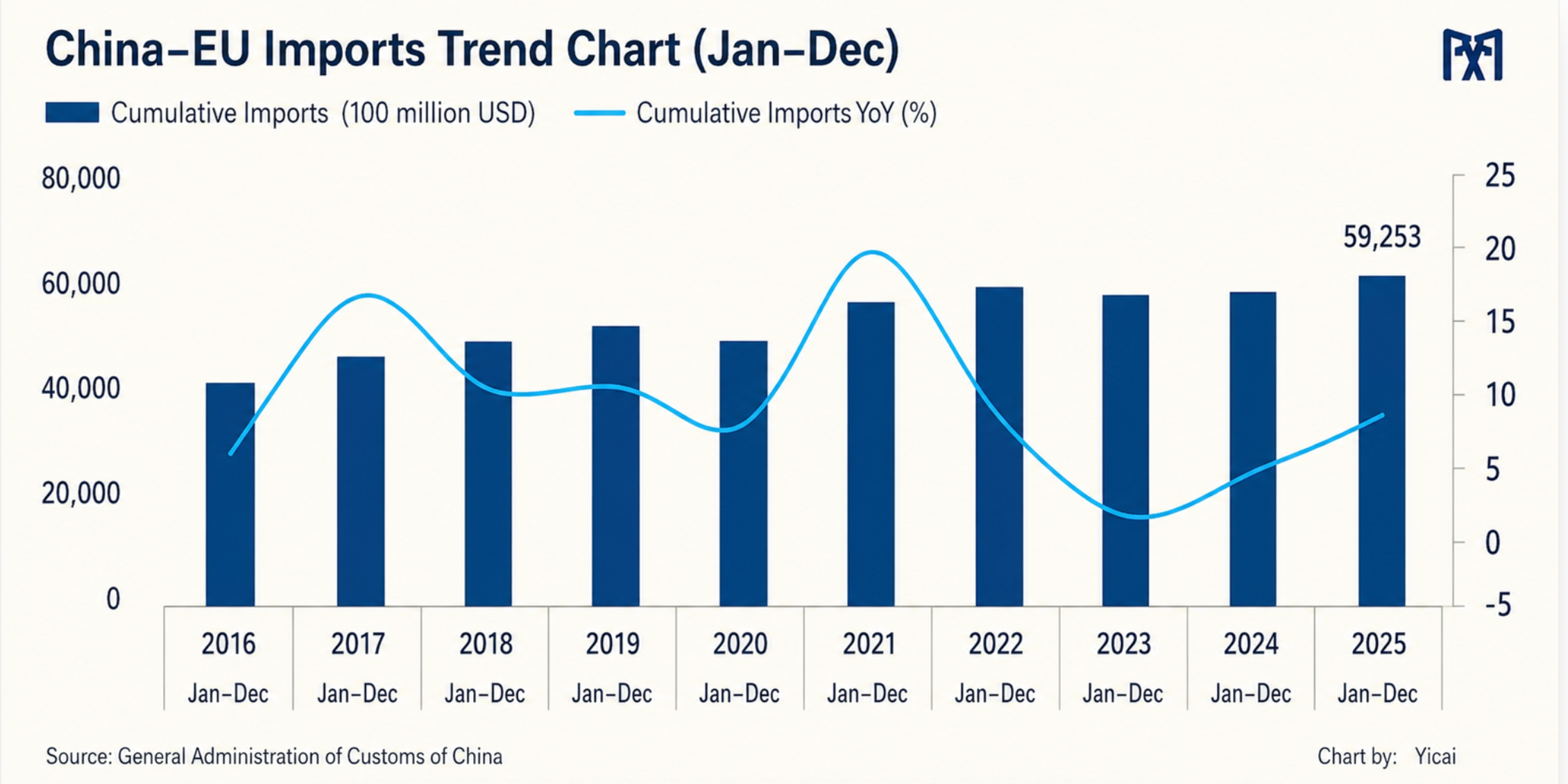
With regard to trade “imbalance,” since the beginning of this century China has deeply integrated into the global industrial chain, and Sino–EU trade in goods has long exhibited a pattern of Chinese surplus. Especially in the past five years, the trade deficit has remained persistently high, ranging from approximately €200 billion to €400 billion. The EU believes that the sustained deficit with China harms the development of European domestic industries, and that unequal market access, industrial subsidies, and China’s overcapacity are the core causes of the trade imbalance. Based on this perception, the EU has successively launched anti‑subsidy investigations into electric vehicles, trade remedy investigations into steel and photovoltaic products, and enacted the Foreign Subsidies Regulation, establishing a review mechanism targeting industrial subsidies across countries and bringing a large number of China’s competitive manufacturing industries under regulatory supervision.
As for supply chain security, against the backdrop of the Russia–Ukraine conflict, the EU believes that economic interdependence is no longer a bond stabilizing China–EU relations; instead, it has been “weaponized” and has become a source of strategic vulnerability. Over‑reliance on China for the supply of strategic goods such as critical minerals, new energy equipment, 5G communication equipment, and photovoltaic modules would, in the EU’s view, place Europe in a fragile and even dangerous situation.
Based on this, the EU has rolled out a systematic “de‑risking” policy mix. In the technology domain, it has restricted Chinese enterprises such as Huawei from participating in EU 5G infrastructure construction. At the legislative level, it has implemented or is advancing acts such as the Net‑Zero Industry Act and the Industrial Accelerator Act, using domestic industrial subsidies and import market access thresholds to support local enterprises and reduce import dependence on China in critical sectors. At the diplomatic level, it has promoted the “Global Gateway” initiative, deploying infrastructure and industrial chains in Central and Eastern Europe, Africa, and Southeast Asia in an attempt to build alternative supply chains decoupled from China.
II. The Perception Gap between China and the EU behind the EU’s Accusations
Regarding issues such as trade imbalances and industrial chain security, China and the EU exhibit completely different, even opposing, understandings. From the European perspective, the responsibility for the China–EU trade imbalance lies with China. First, this is due to large‑scale industrial subsidies. The EU believes that the Chinese government has used fiscal support to lower the production costs of products such as new energy, photovoltaics, and electric vehicles, creating unfair price advantages. Second is the so‑called undervaluation of the renminbi, which artificially reduces the cost of export commodities and amplifies export competitiveness. Third is China’s insufficient domestic demand in its consumer market, which makes it difficult to absorb enormous industrial capacity, causing large quantities of “surplus” products to be dumped on international markets.
Under this logic, Europe perceives itself as being passively harmed, and its introduction of tariffs, trade investigations, and restrictive regulatory legislation is, in essence, a reasonable measure to correct market distortions and maintain a global level playing field, as well as a necessary means to protect domestic industries and safeguard Europe’s economic security.
However, from China’s perspective, China’s surplus is not caused by subsidies or so‑called “overcapacity,” but rather stems from China’s higher international competitiveness compared with Europe. It is also an objective outcome naturally shaped by the international division of labor and differences in industrial structures under globalization, with no artificial distortions or deliberate manipulation. The following factors are the fundamental reasons for China’s surplus with Europe:
First, China possesses the world’s most complete full industrial chain system. From upstream raw material processing and midstream component manufacturing to downstream finished product assembly, this complete industrial cluster significantly reduces production, logistics, and supporting costs, creating a natural cost advantage. This is a core competitiveness jointly forged by decades of industrialization accumulation, infrastructure construction, and a large‑scale industrial workforce, rather than the sole result of policy subsidies.
Second, China’s status as the global manufacturing center. Currently, China’s manufacturing sector accounts for approximately 30% of global production capacity, whereas European domestic industries have relocated extensively, leading to a relative hollowing‑out of local manufacturing. This naturally generates import demand from China, a situation that also applies to many Western countries. Therefore, China’s trade surplus with Europe is an objective product of the global division of labor.
Third, continuous technological innovation and industrial upgrading have constantly strengthened export advantages. In recent years, China has achieved independent technological breakthroughs in fields such as new energy, photovoltaics, energy storage, and power batteries. Relying on technological iteration to build product competitiveness and on cost‑effectiveness to gain global market favor, this is a normal outcome of market competition. In fact, Europe’s own internal problems have reduced its competitiveness, a point acknowledged by the EU’s Draghi Report. It is precisely the simultaneous rise in China’s competitiveness and decline in Europe’s that has, to a certain extent, become a significant cause of the EU’s deficit.
III. The Objectives of the EU’s Restrictive Economic and Trade Policies
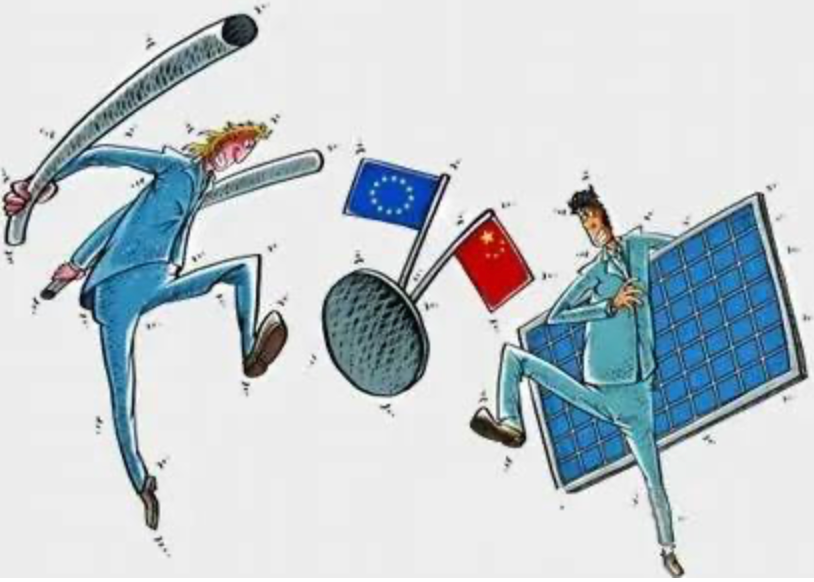
The measures currently adopted by the EU against China ultimately manifest as a strong protectionist policy orientation toward its domestic market. From the EU’s perspective, the short‑term goal of its protectionism toward China is to vigorously protect local industries and alleviate the pressures of industrial hollowing‑out and sluggish economic development.
Currently, Europe is mired in multiple internal economic difficulties, stemming from, but not limited to, the following factors. First, energy shortages: after the Russia–Ukraine conflict, natural gas and electricity prices in Europe surged sharply, causing manufacturing production costs to soar and the competitiveness of local new energy and traditional manufacturing to plummet. Second, an innovation dilemma: Europe seriously underinvests in innovation in high‑tech fields; its inherent high‑end technological advantages are constantly being caught up by external players, making it difficult to escape the “middle‑technology trap” to a certain extent, resulting in heavy reliance on traditional manufacturing and difficulties in industrial transformation. Third, population aging, persistent labor shortages, and chronically high labor costs. Fourth, excessively stringent environmental, labor, and other regulatory measures have raised the operating costs of local enterprises and also hindered the formation of competitive large‑scale high‑tech multinational groups.
Faced with these various problems, Europe is fundamentally unable to resolve them in the short term. It can only use trade barriers and industrial support policies to shield itself from competition with Chinese products, delay the decline of local industries, preserve manufacturing jobs, and ease protest pressures from domestic industry and trade unions. This has also become the most convenient means for the EU to placate internal public opinion, cope with the challenge of “political polarization,” and defuse domestic economic conflicts.
The medium‑ and long‑term objective of adopting protectionism is to attempt to contain China’s industrial upgrading and maintain Europe’s established global industrial advantages. Over the past decades, Europe has occupied the top of the global value chain through high‑end manufacturing, precision equipment, biomedicine, and upstream new energy technologies, relying on technology, standards, and patents to long capture excess profits from the global industrial chain. However, with China’s industrial transformation and upgrading, it has achieved leapfrog development in high‑end manufacturing fields such as new energy, electric vehicles, photovoltaics, energy storage, and artificial intelligence, directly impacting Europe’s traditional advantages. Against this backdrop, the EU has introduced a series of restrictive policies aimed at curbing, to some extent, the growth momentum of China’s high‑end manufacturing, slowing the pace of China’s industrial upgrading, and safeguarding its own dominance in global high‑end industries and technical standards. Representative regulatory instruments include the Industrial Accelerator Act, the Net‑Zero Industry Act, the Cybersecurity Act, and the Foreign Subsidies Regulation, through which the EU attempts to disrupt the current Sino–European economic and trade competition pattern and reshape bilateral economic and trade relations in order to preserve Europe’s long‑term industrial advantages.
IV. The Underlying Logic of Sino–European Economic and Trade Frictions
Behind the trade frictions and their objectives lie the combined effects of multiple underlying logics, manifested as interest gaps, conceptual gaps, strategic choice gaps, and institutional gaps.
The interest gap is one of the fundamental reasons directly prompting the EU to adopt restrictive measures against China. In the past, China and Europe had a complementary vertical division of labor, with Europe providing high‑end technology, capital, and advanced components while China was responsible for processing, assembly, and low‑end manufacturing. Now, China has completed a full industrial chain upgrade, and the two sides have formed horizontal competition in new energy, high‑end equipment, and the digital industry. The original complementary division of labor has gradually dissipated, and competition has become increasingly intense.
The second logic is the conceptual gap. Europe wishes to maintain the old global economic order dominated by the West, in which Europe and the United States hold rule‑making power, relying on their long‑standing control over international trade rules, technical standards, and the financial system to form an inherent economic and trade order characterized by “Western dominance and developing‑country dependency,” thereby reaping high monopoly profits. China, on the other hand, advocates a new global economic order based on sovereign equality, mutual benefit, and win‑win cooperation. China upholds the right of all countries to independently choose their industrial development policies and opposes interference in other countries’ economic development by a single standard. This is a conflict between Europe’s hierarchical order concept and China’s concept of an equitable order.
The third logic is the strategic choice gap between security generalization and globalization. Guided by a macro‑strategic mindset of geopolitical competition, Europe pursues “security first,” securitizes economic issues, and uses political means to forcibly intervene in China–EU economic and trade exchanges. In contrast, China adheres to economic globalization, believing that deep economic integration among countries is an important bond for stabilizing international relations and resolving geopolitical conflicts, and opposes the weaponization and pan‑securitization of economic and trade tools. These represent two different developmental strategic mindsets.
The fourth logic is the institutional gap. There are fundamental institutional differences between China and the EU. China practices a socialist market economy system, while Europe practices a capitalist market economy system. The two sides have natural distinctions in their economic development models, approaches to the government‑market relationship, and the implementation of industrial regulation. The EU uses its own institutional standards as a yardstick, defining China’s industrial support policies as “market distortions,” which amplifies bilateral economic and trade divergences and has become one of the intrinsic root causes triggering economic and trade frictions.
V. How Should China Respond to the EU’s Challenges?
Faced with the EU’s continuously tightening restrictive economic and trade policies toward China, China should adopt a layered approach, distinguishing between compliance‑based measures and discriminatory barriers, while simultaneously refining its policy instruments and expanding diverse cooperation spaces to mitigate the pressures brought by the European side.
First, China should focus on establishing a layered response mechanism and adopt differentiated approaches to various EU regulatory policies. For tariffs, trade investigations, targeted restrictive acts and measures that violate WTO rules and other international trade regulations, carry obvious country‑specific discrimination, harm China’s core industrial interests, or even infringe upon China’s sovereign rights and interests, China may implement reciprocal and precise countermeasures in accordance with WTO rules and protect the legitimate rights and interests of its industries through legal channels. However, for EU industrial regulations, environmental standards, and labor standards that conform to universal international rules and are general and non‑discriminatory in nature, Chinese enterprises can proactively benchmark against international rules, adjust industrial norms, reduce friction points, avoid full‑scale confrontation, and appropriately deepen economic and trade cooperation with Europe.
Second, China should continuously improve its domestic economic and trade countermeasure and interest protection instruments. It should enhance the legal and regulatory framework for foreign trade remedy and industrial security review, enrich countermeasure tools such as tariffs, trade barriers, and investment screening, and build a comprehensive policy toolbox. To guard against the outflow of core industries and the leakage of core technologies, China should, on the basis of regulations such as the Regulations of the State Council on Outbound Investment, gradually introduce and implement an Outbound Investment Law to regulate enterprises’ overseas investment behavior. It should establish review mechanisms for the outward transfer of core technologies and critical industrial chains, guarding against the excessive transfer of core technologies and production capacity in strategic industries such as new energy, semiconductors, and high‑end equipment, so as to safeguard the foundation of domestic manufacturing. At the same time, aligned with WTO rules, China should optimize its domestic industrial support policies to reduce the pretexts for the EU to launch trade investigations on topics such as “subsidies,” thereby enhancing the international compliance of China’s industrial policies.
Third, China should adhere to compliance‑based operations and tap deeply into bilateral cooperation space. Although the EU has introduced multiple pieces of legislation suspected of being discriminatory, unlike the United States’ “one‑size‑fits‑all” tariff approach, there still exists room for China–EU economic and trade cooperation behind these regulations. Therefore, Chinese enterprises going global should adapt to EU laws and regulations, carbon tariffs, industrial standards, and foreign investment screening rules, reducing trade friction risks through compliant operations, stabilizing existing investments and market share in Europe, and using win‑win topics such as green energy, low‑carbon technologies, and circular economy to offset industrial competition conflicts. Pragmatic cooperation can dilute the adversarial atmosphere brought about by geopolitical games. Naturally, all compliance actions should be aimed at profitability and premised on not harming China’s sovereignty and core interests.
Fourth, China should explore third‑party markets and reshape a diversified economic and trade layout. Leveraging the respective free trade agreement networks of China and the EU, China should build new channels for industrial cooperation in third‑party markets such as Southeast Asia, the Middle East, Latin America, and Central Asia, and promote “proxy globalization” (a concept proposed by the author, referring to an economic exchange model in which part of the direct economic and trade exchanges between major economies is replaced by the reconnection of industrial chains between the two parties through third‑party countries), thereby weakening the direct market competition and conflict between China and the EU. At the same time, China should deepen multi‑level economic and trade exchanges with EU member states and local provinces and cities, distinguishing between overall EU policies and the differentiated demands of individual countries. By leveraging the stance of some European countries that value the Chinese market and oppose comprehensive decoupling and supply chain severance, China can expand its buffering space for economic and trade ties with Europe.
VI. The Future of China–EU Economic and Trade Relations
Based on the above analysis, future China–EU economic and trade relations are likely to become even more complex than they are today. The EU’s restrictive economic and trade barriers against China will solidify and become more systematic, but the deep cooperation between the two sides is also inseparable; “decoupling and severing supply chains” is not an option for either side.
First, the EU’s various restrictive regulatory rules targeting China will become normalized, and economic and trade frictions will not disappear in the foreseeable future and may even escalate. Driven by considerations of industrial protection and geopolitical competition, the EU will continue to introduce regulatory legislation aimed at China. Trade remedy investigations, foreign investment security reviews, and technology export controls are likely to increase, and industrial competition frictions will persist over the long term. However, it will be difficult for the EU to completely sever its economic and trade ties with China. European enterprises have huge interests in the Chinese market; full decoupling would severely damage European exports, product competitiveness, consumption, and inflation stability. Moreover, the need for bilateral cooperation in international governance also compels both sides to reduce frictions in the economic and trade sphere to maintain basic mutual trust. Therefore, EU–China economic and trade frictions and cooperation will coexist for a long time.
Second, greenfield investment in Europe will become a new growth point in bilateral economic and trade relations. As export barriers to Europe rise and various restrictions on mergers and acquisitions increase, some Chinese enterprises going global will have to increase greenfield investments in non‑strategic sectors within Europe to circumvent EU regulations. However, the EU’s equity restrictions, localization and advanced technology transfer requirements, security reviews, and other demands may limit the confidence of Chinese greenfield investment in Europe.
Third, technology and standard competition is likely to become a new focal point of contestation. The traditional trade friction in goods between the two sides will gradually extend to competition in high‑end technologies, industry standards, carbon rules, and digital governance. Relying on its mature industry standards, the EU will attempt to continue dominating global green and digital trade rules, whereas China will accelerate the internationalization of its own standards. The standard‑setting game between the two sides in areas such as new energy, artificial intelligence, and carbon tariffs will heat up.
Fourth, third‑party markets have become a new factor shaping China–EU relations. On the one hand, both sides are seeking to reduce their single‑market dependence on each other, continuously expanding into ASEAN, Middle Eastern, Latin American, and African markets. The EU is vigorously promoting FTA negotiations and construction with these regions, deploying its Global Gateway strategy, and seeking key mineral partnerships, thereby engaging in geopolitical competition with China. On the other hand, third countries such as Vietnam, Indonesia, Thailand, and Tunisia are becoming important “proxy countries” that facilitate the reconnection of China–EU supply chains, emerging as critical forces through which China, the EU, and third parties jointly shape “proxy globalization,” and becoming significant actors in reshaping China–EU economic and trade relations.
Editor: Zhao Yiwen
Diana Sáfady Maffei
Se a UE pratica a “economia de mercado capitalista”, a China não deve confiar porque essa economia é baseada na exploração do homem pelo homem, então as duas economias certamente estarão sempre em conflito.
Sokamad
Brilliant. China is winning.
Judith Bello
I find this situation very frustrating. I see the issues you are raising. But in fact, the EU is doing what we call in the US,, biting off it’s nose to spite its face. Very sad. China, of course, must protect itself. But the current crop of self absorbed idiots running the EU are hurting their people. So sad.