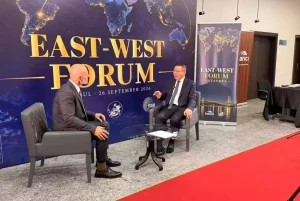




Prof. Zhang Weiwei, Director of the China Institute Fudan University:
More than 60 years ago, in late July 1959, at the American National Exhibition in Moscow, then–U.S. Vice President Richard Nixon and Soviet leader Nikita Khrushchev staged the world‑famous “Kitchen Debate” in front of a model kitchen. Eschewing saber‑rattling diplomatic rhetoric, they sparred over food supplies, housing standards, kitchen appliances, consumer choice—and ultimately, the strengths of their respective systems.
At the exhibition, the United States recreated a full American supermarket scene stocked with frozen foods, canned goods, packaged oats, and ready‑to‑eat snacks, even inviting Khrushchev to taste Pepsi-Cola. Seeing a small lemon-juicing appliance on display, Khrushchev dismissed it as “fancy but useless,” quipping, “Do you also have a machine that puts food straight into your mouth?”—a nod to portrayals in Charlie Chaplin films.
Nixon emphasized the diversity of American food consumption and how household appliances like dishwashers and washing machines made life convenient. Khrushchev countered that Soviet citizens enjoyed basic social guarantees, including housing, and did not face homelessness on the streets as in the United States. Nixon replied that Americans could buy their own homes through installment plans. Khrushchev retorted that American houses were poorly built, often lasting less than 20 years, insisting the Soviet Union would prioritize heavy industry and public welfare—and predicting the USSR would fully surpass the U.S. within seven years.
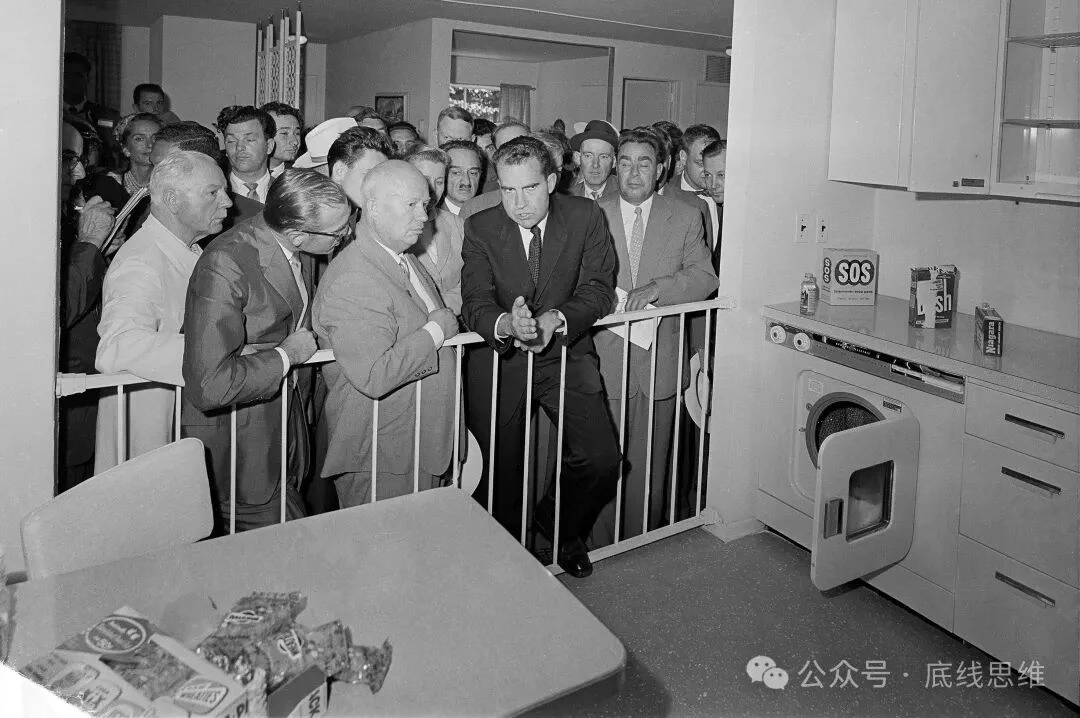
Khrushchev and Nixon in the famous “Kitchen Debate”
The hallmark of that debate was “seeing the system through daily life.” At the time, it was hard to judge the winner. But subsequent developments made one thing clear: chronic shortages of food and consumer goods remained a major weakness of the Soviet system. By the late 1980s under Gorbachev, severe shortages of food and daily necessities sparked widespread frustration and became one of the key factors in the USSR’s collapse. The debate ultimately became a vivid snapshot of Cold War ideological rivalry—and affirmed a simple truth: the effectiveness of a nation’s system must ultimately be measured by ordinary people’s food, clothing, housing, transport, and their sense of well‑being.
Over 60 years later, in 2025, a new “kitchen debate” emerged online between Chinese and Americans—without leaders or official organizers. From the grassroots “big reconciliations” (side‑by‑side comparisons) that swept Xiaohongshu in early 2025 to year‑end viral discussions of the American middle‑class “cut‑off line,” young Chinese extended the logic of “seeing the system through daily life,” starting with food and expanding to lifestyle, living standards, and even political institutions—triggering a broad awakening among Chinese netizens. Chinese and Americans alike got a more candid look at each other. The information silos built by certain Western media, Taiwan’s DPP “1450” cyber troops, and some Chinese “public intellectuals” crumbled. As a result, the Chinese people grew more confident—an outcome that is truly encouraging.
We live in a civilizational state anchored in the belief that “the people regard food as heaven,” so debates about eating are perennial. Not long ago, I mentioned in this program a short video asserting that “in reality, only in China can you eat meat and vegetables in abundance,” which topped a million views on Bilibili that very day. Most netizens—including countless people who have been to the United States—agree that ordinary Chinese do, in fact, eat better than most American middle‑class households. A typical American lunch is a burger or sandwich; even at home, many rely on prepared foods—what Chinese netizens jokingly call “white‑people food,” often deemed unappetizing.
Frankly, eating meat isn’t too difficult for most Westerners, but vegetables—especially leafy greens—are expensive, limited in variety, and not stably supplied. In China, even an ordinary restaurant or any canteen can easily serve dozens of meat and vegetable dishes. When friends and family gather around a hot pot, the wealth of choices is entirely at your fingertips—nothing extraordinary here, though it would be a luxury in most Western countries, to say nothing of so‑called developed nations like Japan and South Korea.
On macro indicators, according to the FAO of the United Nations, since 2021 China has surpassed the United States in per‑capita protein supply (including plant protein) and vegetable consumption. China’s daily per‑capita protein supply is 124.92 grams versus 124.33 grams in the U.S. China’s annual per‑capita vegetable consumption is nearly four times that of the U.S.—399.03 kilograms versus 126.47 kilograms. More importantly, China’s life expectancy has also edged past the U.S.: in 2024 it stood at 79 years in China versus 78.6 in the United States.
China’s world‑leading standard of “what’s on the table” rests on at least three pillars. First, since the 1980s China has implemented the “Vegetable Basket Project.” This landmark people’s livelihood initiative combines government coordination with market mechanisms to ensure a stable, nationwide supply of ample, fresh, and affordable meat, dairy, eggs, vegetables, and fruit—covering both urban and rural areas—so that ordinary people anywhere in the country can enjoy abundant, fresh ingredients year‑round. This is a world‑class achievement in public well‑being by any measure.
Second, the deep culinary heritage unique to a civilizational state. China has long upheld the tradition that “the people regard food as heaven,” integrating food culture into the very bloodstream of Chinese civilization. The diversity of Chinese cuisines and the range of flavors are unmatched. In theory, you could eat something different every day for 365 days—and China is one of the few countries that elevates “eating well” into lifestyle aesthetics and a cultural pursuit.
Third, China possesses a world‑class system of culinary techniques. Stir‑frying, steaming, boiling, deep‑frying, braising, roasting, pan‑frying—our repertoire is arguably the richest in the world. The same ingredients can be transformed into countless flavors and textures. Daily dining combines a vibrant street‑level spirit with color, aroma, and taste—a small miracle of everyday life. In short, the Chinese table offers a steady, four‑season flow of ingredients, balanced combinations of meat and vegetables for sound nutrition, and a civilizational level of culinary depth and diversity. This echoes a common conclusion among seasoned travelers: China is indeed the best place in the world to eat. I’ve often said “going abroad makes you patriotic,” and the first reason is food—Chinese palates are so refined that it’s hard to adapt abroad.
As for the lifestyle, housing, and home appliances at the heart of the original U.S.–Soviet “Kitchen Debate,” China’s socialist market economy has delivered a more diverse range of lifestyles and a higher homeownership rate than the United States. China’s homeownership rate exceeds 90%, compared with about 65% in the U.S. In daily appliances, China has long been the global manufacturing hub: roughly 80% of the world’s air conditioners and 50%–60% of refrigerators and washing machines are made in China.
More importantly, as Chinese and American netizens keep “comparing the bills,” comparisons of living standards have moved from kitchen-table debates to health insurance, education costs, housing expenses, and ultimately to political systems. In the United States, a single ambulance call can cost thousands of dollars. Student loan debt for university tuition often follows a person for 20 to 30 years. There are also sky-high rents and steep property taxes. Thirty-seven percent of Americans cannot cover a $400 emergency expense, and nearly 60% cannot come up with $1,000 for an urgent need. A serious illness or a spell of unemployment can push middle-class Americans below the poverty line. In the past, many people in China could hardly imagine these realities, but today they have become common knowledge for most Chinese. This has led more and more people in China to see more clearly that the fundamental difference between the political systems of China and the United States is whether they are people-centered or capital-centered.
Not long ago, the well-known British writer Pankaj Mishra interviewed me. He said that when he visited China more than 20 years ago—including Beijing and Shanghai—he met many people who strongly admired the United States, and he asked whether that has changed today. I said that such people are now a minority in Chinese society. Starting roughly a decade ago, Chinese society began to look at the United States on an equal footing, especially among young people. From the cost-of-living “tallying” trend on Xiaohongshu early last year to debates about the “kill-line” threshold, and then to the release of the Epstein documents early this year, a series of events has led more and more Chinese—especially the young—to start looking down on the United States and the American model. Behind this shift are China’s comprehensive rise and the many deep-rooted crises revealed in Western societies and the Western model. Indeed, as people have come to understand the real conditions facing America’s lower classes and even its middle class—and, up to January’s grotesque “Lolita Island” saga exposing the decadence of America’s upper elite—it is only natural to look down on, even despise, such a system.
Editor: Zhiyu Wang