



Recently, Bloomberg published a commentary titled *China Holds All the Cards in Global Pharmaceuticals*, bluntly stating:
“Although the U.S.-China trade war appears to have entered a ‘truce period,’ Beijing holds a trump card it has never played.”
This so-called “trump card” Bloomberg refers to is Active Pharmaceutical Ingredients (APIs) and Key Starting Materials (KSMs).
At the same time, the annual report of the U.S.-China Economic and Security Review Commission (USCC) issued a warning: China’s absolute dominance in pharmaceutical raw materials constitutes an “asymmetric threat” to U.S. national security.
If chips are the brain of modern industry, determining the future height of technology, then APIs and KSMs are the **blood** of modern society.
In this silent game of strategy, at least for now, China is both the rule-maker and the biggest player at the table.
Starting with an antibiotic
Imagine this scenario:
Geopolitical tensions rise, and Chinese customs, citing “environmental compliance review,” suspends export clearance for certain chemical products. Three months later, a patient with pneumonia in a community hospital in Kansas is told that the intravenous amoxicillin required for treatment is out of stock. Meanwhile, in an operating room in New York, anesthesia supplies are critically low, and non-urgent surgeries are postponed indefinitely.
This is the core warning of the USCC report: “asymmetric interdependence.”
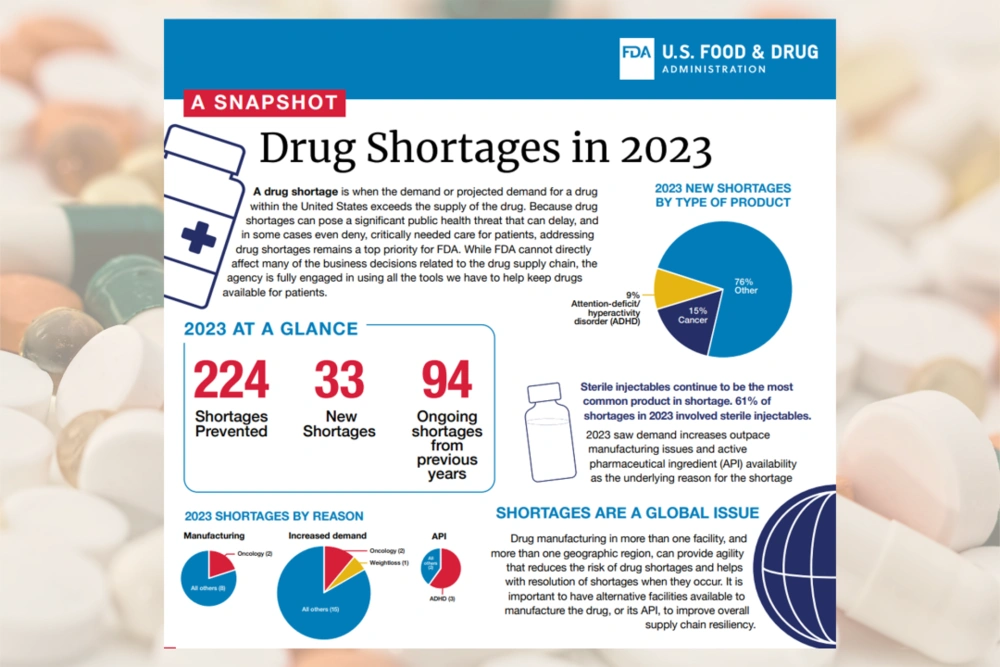 FDA 2023 Drug Shortage Report Drug shortages in the U.S. have persisted since the pandemic
What the Western public sees are Pfizer or Novartis products on the shelves, labeled “Made in the U.S.” or “Made in Switzerland,” but this is highly misleading.
The “manufacturing” here is hardly more than stamping a label on a finished product. The production may indeed occur in New Jersey, but its active ingredients (APIs) might come from Hyderabad, India. And the intermediates needed by Indian factories — even further upstream chemical starting materials (KSMs) — mostly come from China.
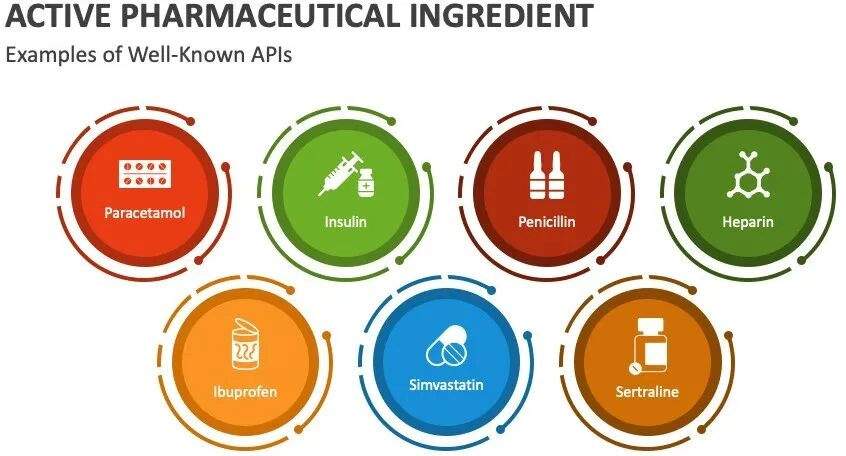 APIs for acetaminophen, ibuprofen, penicillin, insulin, etc.
Currently, the global situation is: the U.S. and Europe dominate patented and biologic drugs; India is known as the “world’s pharmacy,” producing large quantities of generics. Yet India’s pharmaceutical industry relies heavily on China — around 70% of active ingredients and intermediates — primarily from Shijiazhuang, Taizhou, and Lianyungang.
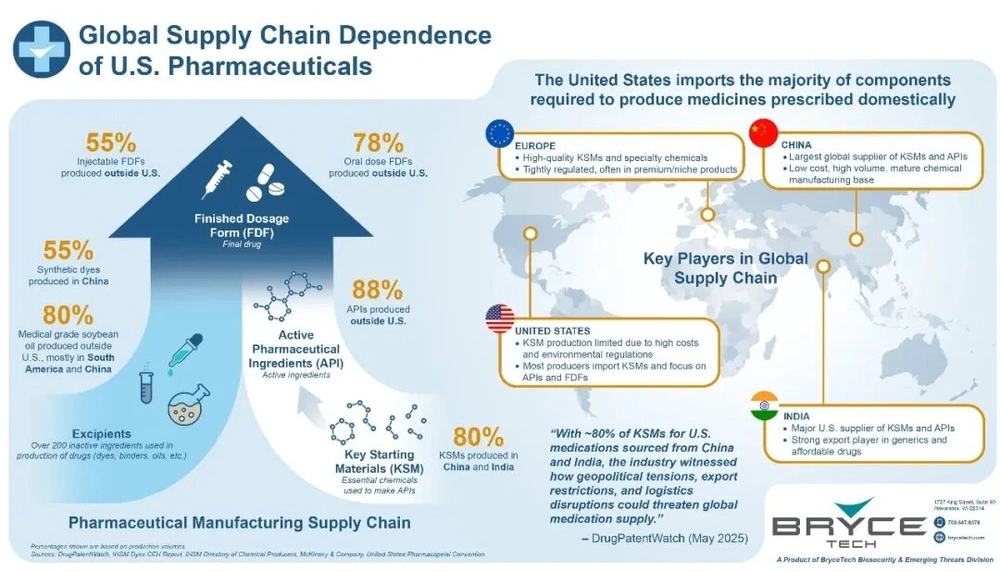 Global distribution of the U.S. pharmaceutical supply chain
China is a low-cost, high-output, technologically mature chemical manufacturing base. According to the latest industry data, China holds near-monopolies in:
1. Antibiotics: Over 90% of global antibiotic intermediates come from China. Production lines for basic anti-infectives like penicillin and cephalosporins cannot run without Chinese fermentation vats.
2. Vitamins: China controls roughly 70–80% of global vitamin production capacity.
3. Bulk APIs: In areas such as antipyretics and analgesics (ibuprofen, acetaminophen) and corticosteroids, China defines prices and production volumes.
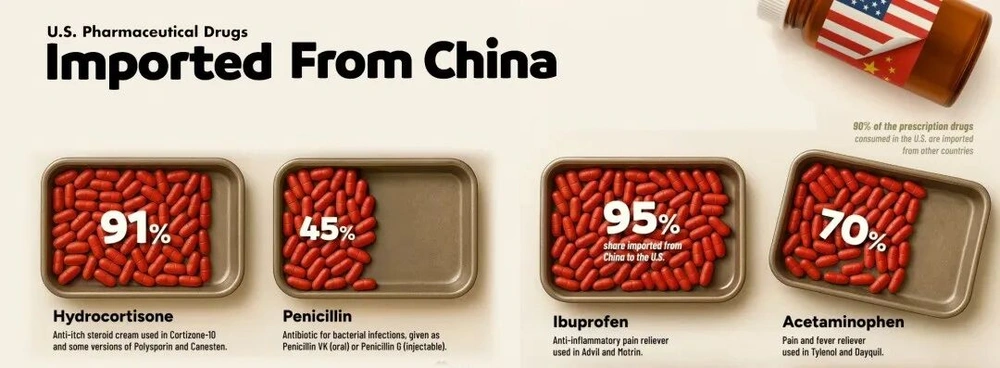 Share of U.S. imported pharmaceuticals sourced from China
Even more concerning to the West, this monopoly is built on a complete value chain.
From basic chemicals (petroleum/coal-based) to fine chemicals to pharmaceutical engineering, China has built the most complete chemical industry chain in human history. This integrated upstream-downstream advantage reduces manufacturing costs 30–40% compared to Europe and the U.S., and even 20% lower than India, which already has low labor costs.
This card was handed to China by the West
In the 1990s, the golden age of Wall Street MBA elites, faced with stricter environmental regulations (EHS) and profit pressures, giants like Pfizer and Merck began to offload low-value API manufacturing.
This segment was quickly outsourced to lower-cost Asian countries, while the West retained the most lucrative parts: R&D and marketing.
What is API manufacturing like? Simply put, it’s dirty, labor-intensive, high-energy, high-pollution, and low-margin.
Under increasingly strict EHS regulations in the West, the cost of treating a ton of penicillin wastewater could consume all profits. Meanwhile, China, amid the “Eighth Five-Year” and “Ninth Five-Year” industrialization boom, was willing to take these orders despite the hardship and low margins.
What Western strategists did not foresee was China’s industrial chain evolution.
API production is essentially fine chemicals. It requires abundant cheap labor, large-scale chlor-alkali, coal-chemical, petroleum-chemical support, park-based coordination of steam, electricity, wastewater treatment, and thousands of chemical engineers skilled in process optimization.
Over the past 30 years, from the North China Plain to the Yangtze Delta, China has built the densest, most complete chemical clusters in history, creating two major barriers:
1. Cost Barrier: Through process improvements (continuous-flow reactions, enzymatic catalysis), Chinese companies have compressed the cost of ibuprofen and vitamin C production to physical limits. This is not just subsidies but also an engineer-driven achievement.
2. Technical Barrier: Many older drug processes lost in the West have been preserved and upgraded in China. Even if the U.S. wanted to bring production back, it would face a “no-rice kitchen” problem — no skilled workers, supporting factories, or even intact historical blueprints.
The West thought it was shedding a burden, but it actually discarded the foundation of industrial capability.
India, the “world pharmacy,” cannot save the U.S.
Whenever “de-Chinafication” is discussed, elites in Washington and Brussels point to India.
Yes, India is the “world pharmacy,” with strong generic formulation capabilities and FDA-certified factories. But the industry consensus is: India is the flour mill, and China holds the wheat and the mills.
A senior pharmaceutical supply chain expert said: “If you open an API factory in India, the first thing you do every morning is call your Chinese supplier to ask when next week’s solvents and intermediates will ship.”
Data from 2024 shows that even with billions invested in PLI (Production Linked Incentive) programs to establish a domestic API supply, progress is slow.
The reason is simple: lack of infrastructure and an entire value chain. Chemical production requires stable electricity and water, efficient port logistics — areas where India lags. More importantly, Chinese companies hold pricing power. Whenever India tries to produce a key raw material, Chinese competitors can simply cut prices by 20%, bankrupting Indian entrants.
India’s business environment, regulatory costs, and frequent quality scandals (e.g., a February 2025 FDA report on a generic manufacturer linked to at least eight deaths) make “friend-shoring” to India largely a false solution.
From Quantity to Quality
If you think China only produces low-end raw materials, you are mistaken. China is moving from pure output to technology and standards export.
Consider names like WuXi AppTec and Asymchem. Over the past decade, through CDMO (contract development and manufacturing) models, Chinese companies have deeply embedded themselves in the heart of global innovative drug development.
From biotech startups in Boston to Swiss pharmaceutical giants, the optimization of synthesis routes and production of clinical samples for blockbuster drugs is often completed in China.
This means China not only controls “quantity” but is starting to control “quality.”
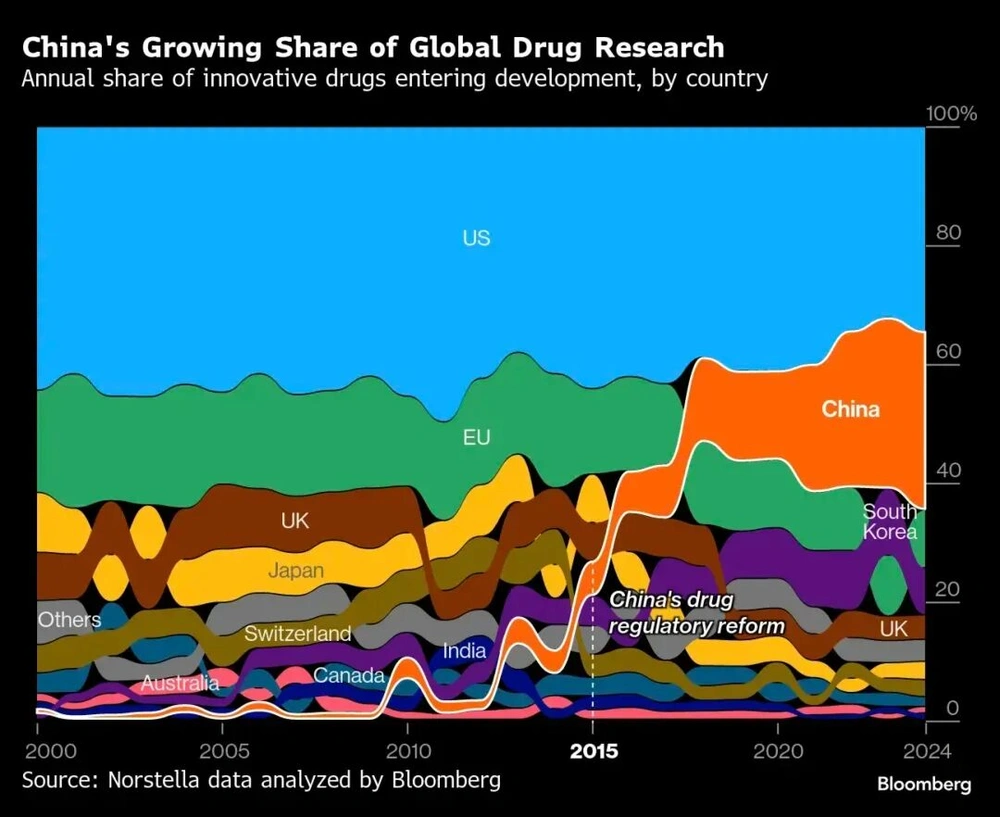
By 2024, as the U.S. Biosecure Act progresses, decoupling anxiety between China and the U.S. in pharmaceuticals reached its peak. The industry’s reaction is mixed: politicians scream national security, while CEOs privately complain — “Leaving China will spike our R&D costs and delay drug launches by at least two years.”
This is the real leverage. China does not need to actively cut off supply; merely slowing customs, tightening biological data exports, or restricting rare lab monkeys is enough to slow Western pharmaceutical innovation.
Rebuilding the pharmaceutical supply chain is even more challenging than semiconductors. Though difficult, the path is clear. Reconstructing a 30-year-lost chemical and fermentation industry requires retraining engineers, reintroducing factories to communities, and reviving a lost industrial culture.
Short term, no force can replace China’s central role in the supply chain.
Looking Ahead
For China’s industry and policymakers, this advantage is both a trump card and a target.
Currently, the West is accelerating biomanufacturing innovation, aiming to bypass traditional chemical synthesis using synthetic biology and continuous-flow manufacturing to reduce dependency on Chinese chemical capacity. Chinese companies must guard against this “dimensionality reduction attack” and accelerate efforts in green enzymatic processes and continuous-flow technologies.
Second, as the Biosecure Act advances in the U.S. Congress, domestic CXO giants face strong geopolitical headwinds. The consensus is: simple contract manufacturing and raw material exports have reached their ceiling. Future core competitiveness must rely on first-in-class innovation at the source.
Maintaining global supply chain stability and deep integration may make decoupling excruciating, which may be wiser than confrontation.
Over the next decade, the pharmaceutical industry will enter a new cycle balancing efficiency and safety. Those who can provide safer drugs at lower costs will retain the trump card.
Editor: Zhongxiaowen

gus auyeung
it is difficult to imagine using this ‘card’ to deny people of medicine to relieve pain, fever ,infections and heart ailments etc even though others have used this ‘Trump Card’ to deny other human beings of Covid vaccine .