



The latest research findings by Chinese botanists may change the landscape of international relations.
The U.S.–China tariff war made the whole world aware of China’s leading position in rare-earth refining technology. And now, the recent discovery by Chinese botanists has once again expanded China’s advantage in this field.
The Guangzhou Institute of Geochemistry under the Chinese Academy of Sciences has found that rare-earth minerals can actually form inside plants.
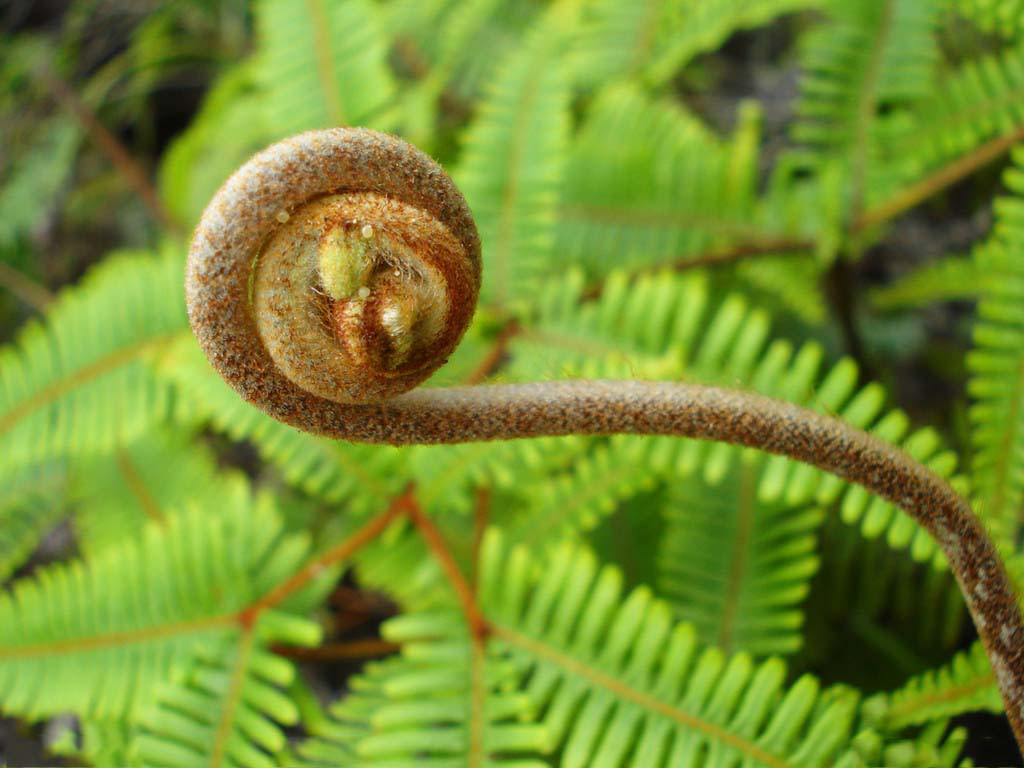
This plant is a fern known as Dicranopteris dichotoma,or Old World Forked Fern. They act like “rare-earth vacuum cleaners” in the soil, efficiently absorbing and concentrating rare-earth elements dispersed in the environment.
By absorbing rare-earth elements from the soil, they form the rare-earth mineral “lanthanum monazite.” This mineral contains mostly cerium and lanthanum, both of which have wide applications in military industry, aerospace, and electronics.
In this study, scientists observed that in the vascular bundles and epidermal tissues of Pteris vittata leaves, the rare-earth elements absorbed from the soil precipitate in the form of nanoparticles and further crystallize into a mineral called “lanthanum monazite.”
It is worth noting that monazite is normally formed deep within the Earth’s crust under extremely high temperature and pressure. Yet plants, relying solely on their biological processes, are somehow doing this at room temperature.
Further research found that this process is actually a self-protection mechanism in plants—like “packaging and sealing” toxic substances inside the plant. Rare-earth ions that might damage cells are securely locked into the mineral structure, achieving passivation and natural “detoxification.”
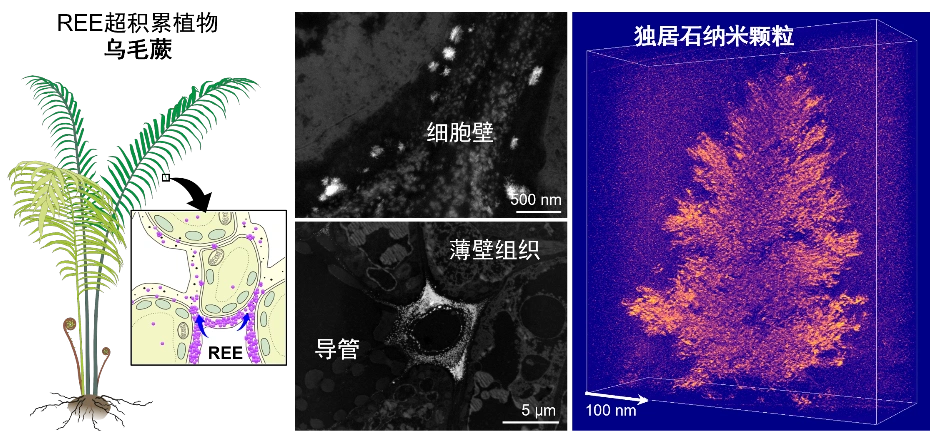 Rare earth elements are biomineralized in Dicranopteris into nanocrystalline monazite aggregates.
According to the paper’s data, among all plant organs, the pinnae contain the highest concentration of rare-earth elements, reaching 0.001735 g/g, which is 1735 ppm when converted into the mining industry’s common unit of parts per million. Rare-earth elements are not highly abundant in nature, and anything above 1000 ppm is already not low.
Moreover, monazite formed through geological processes often contains radioactive elements such as uranium and thorium. This has hindered the development of such ores: rare-earth mining companies in Brazil and Australia have shut down plants due to radiation hazards to workers.
But the “rare-earth minerals” discovered this time inside plants are extremely pure, with absolutely no accompanying radioactive elements—very good news for future extraction and utilization.
One might wonder whether this alternative comes with high extraction costs or unpredictable yields. Yet the U.S. has already proven the new venture worthwhile. For example, the U.S. Bureau of Mines produced 100 kg of nickel per hectare,a remarkable figure, using “hyperaccumulator plants” grown in soils too poor to be mined. The approach proved so promising that last year the U.S. Department of Energy’s ARPA-E program invested $10 million to support plant-based nickel extraction.
In addition, for many elements—even in mining areas—their concentrations are very low, and extraction and separation are costly. For these metals that are “rare, scattered, and precious,” phytomining may not be impossible.
From another perspective, even if direct phytomining is not considered, using plants to absorb heavy metals in mining areas for ecological restoration is both environmentally friendly and cost-effective.
In short, there is still so much in nature that remains unknown and awaits our discovery.
Editor: Zhongxiaowen