





On September 22nd, China’s Fujian aircraft carrier achieved a decisive breakthrough: the successful electromagnetic catapult launch and recovery of the J-35 stealth fighter. As noted by senior Chinese military analyst Wang Qiang, this is not merely a first for China, it marks the world’s first operational integration of a fifth-generation fighter with an electromagnetic catapult system.
It is remarkable to consider that the first U.S. Ford-class carrier equipped with an electromagnetic aircraft launch system was launched as far back as 2012, and the first F-35C stealth carrier aircraft was delivered in 2013. Yet twelve years later, the U.S. Navy’s F-35C still operates exclusively from legacy steam catapults aboard Nimitz-class carriers. What accounts for this 12-year delay in integrating electromagnetic catapults with fifth-generation aircraft? Wang Qiang attributes the root cause to a misguided technological path taken by the U.S. Navy.
The Ford-class carriers have faced well-documented challenges in achieving full operational capability with their Electromagnetic Aircraft Launch System (EMALS). According to a February 2019 report from the Congressional Research Service, EMALS on the lead ship USS Ford (CVN-78) was intended to replace older, less-reliable steam catapults and enable efficient launches of a wide range of manned and unmanned aircraft. However, the system has fallen short of expectations.
“Through the first 747 shipboard launches, EMALS suffered 10 critical failures, far below the required mean time between operational mission failures of 4,166 launch cycles,” the CRS explained.
Equally troubling, because EMALS is integrated into the ship’s electrical grid, maintenance crews cannot easily isolate the system during flight operations for quick repairs. A failure during combat would effectively force the ship to suspend flight operations. The process of electrically isolating equipment is time-consuming; spinning down the EMALS motor-generators alone takes 1.5 hours. This design prevents maintenance while aircraft are being launched.
A report from The National Interest attributes this limitation to a fundamental design flaw. The massive electrical charge required is stored in three Energy Storage Groups, each comprising four heavy flywheel-generators. These groups collectively power all four catapults and cannot be electrically disconnected at the level of an individual failed unit, meaning repairs cannot proceed while other catapults remain in use.
Consequently, any malfunction on a single catapult requires halting all flight operations, or, in the case of multiple failures, suspending launches entirely. This creates a critical vulnerability: the ship could be unable to launch aircraft at a decisive moment due to the lack of independent power sources for each of the four catapults. This risk is compounded by EMALS’ poor reliability, fails approximately once every 400 launches, ten times worse than the contractual requirement of one failure per 4,166 launches.
On the other hand, according to Wang Qiang, the electromagnetic catapult system on the Fujian employs a world-first medium-voltage direct current (MVDC) integrated power system, achieving a failure rate of less than 0.2%, just one-eightieth that of the U.S. Ford-class system. China’s Fujian therefore represents a significant milestone, overtaking the U.S. Navy in a core dimension of carrier aviation.
Why has China’s system achieved such a dramatic improvement in stability? Analysis of the U.S. Navy’s own investigations reveals that the Ford-class EMALS suffers from an overly complex hybrid design that combines electromagnetic propulsion with mechanical energy storage, coupled with a series-wired power distribution architecture where a single point of failure can cripple the entire system.
In contrast, China’s approach features two key innovations. First, it uses supercapacitors for energy storage, enabling full-system electrification. The stable direction and voltage of medium-voltage DC power eliminate the need for frequent AC-DC conversions required in alternating current systems, significantly simplifying the architecture and reducing failure risks from components like transformers and inverters. Second, the Fujian’s system adopts a parallel configuration: each catapult track has its own relatively independent power supply and energy storage module. If one catapult fails, it can be isolated in just 0.8 seconds without affecting the operation of the others.
These inherent flaws in the Ford-class design have been described by the National Security Journal as an “unfixable problem.” Even Donald Trump, in an interview with Time magazine, reportedly stated: “and now they want to buy more aircraft carriers. I said what system are you going to be, ‘Sir, we’re staying with digital.’ I said no you’re not. You going to goddamned steam, the digital costs hundreds of millions of dollars more money and it’s no good.”
But here, Trump is profoundly mistaken. The poor performance of the Ford-class electromagnetic catapults does not mean the technology itself is “no good.” The shift from steam to electromagnetic catapults represents a generational leap that fundamentally enhances combat efficiency, most notably through a surge in sortie generation rate.
In modern carrier operations, rapid sortie generation is a primary determinant of effectiveness. Unlike land-based air forces that can launch entire squadrons simultaneously from long runways, carriers must launch aircraft one by one. The first fighter airborne becomes a lone sentinel, circling and burning precious fuel, like running on a treadmill, while waiting for the rest of the strike package to assemble. The combat radius of the entire mission is thus constrained by the aircraft with the least remaining fuel. Electromagnetic catapults provide a decisive advantage here.
Steam catapults require 30 to 60 minutes to build sufficient steam pressure, a potentially fatal delay during an emergency scramble. China’s electromagnetic system, by contrast, can be ready in as little as 15 minutes, reducing response time by up to 75%.
Moreover, steam catapults need 30–60 seconds to recharge between launches. To deploy a 12-aircraft strike package, the first aircraft could burn 6–12 minutes of fuel before the last one even takes off. After 8–10 consecutive launches, steam pressure drops sharply, requiring a 30-minute or longer pause to “re-boil the water”, a process that also reduces the ship’s speed.
China’s electromagnetic catapult, powered by efficient capacitor banks, maintains a steady 45-second interval regardless of launch sequence, ensuring a rapid and predictable rhythm. This difference translates directly into operational capacity.
According to the U.S. Department of Defense Director of Operational Test and Evaluation (DOT&E) FY2012 report, a Nimitz-class carrier averages about 10 sorties per hour. In contrast, CCTV reported that the Fujian has demonstrated a rate of 12.5 sorties per hour, enough to launch a full 12-aircraft wave within one hour, with all aircraft forming up efficiently. A Nimitz-class carrier would struggle to achieve the same without critically compromising the fuel reserves of its first-launched aircraft.
A 12-aircraft strike package is widely regarded as the minimum viable force for modern carrier operations. A typical “door-kicking” mission to suppress enemy air defenses, for example, usually includes 4–6 strike fighters, 4–6 escorts, and supporting electronic attack and early warning aircraft.
Modern naval warfare places heavy emphasis on air superiority, and modern air combat heavily centers on systemic confrontation. The Indo-Pakistani air engagement in May of this year demonstrated that in beyond-visual-range combat, each sensors serve as critical nodes in a data-link system. More comprehensive and sustained battlefield awareness enables earlier detection, which cascades into firing first, and destroying first. Given that China has now matched the U.S. in carrier aircraft generation capability, the sortie rate advantage conferred by its next-generation catapult technology allows Chinese carriers to assemble more complete strike formations or fleet air defense networks within the same timeframe. This marks the critical inflection point where China’s operational efficiency surpasses that of the United States.
In conclusion, Wang Qiang emphasizes that the successful electromagnetic catapult launch of the J-35 is highly significant, symbolizing the Chinese Navy’s transformation from a technological follower to a leader in a key domain relative to the United States. China’s carrier development, from importing and refitting foreign hulls, to building experimental domestic platforms, and now to the truly modern Fujian, alongside its progression from modifying imported carrier-based aircraft to independently developing next-generation fighters, has compressed a developmental path that took other nations several decades into just over ten years.
This advancement positions China’s carrier air wing firmly in the fifth-generation fighter era, making it one of only two countries in the world capable of operating such aircraft from carriers. Moreover, it establishes a generational lead in catapult technology, a landmark achievement.
Looking back, the fundamental reason for China’s technological overtaking lies in its commitment to an independent and self-reliant development path, avoiding blind adherence to foreign technological templates. The Fujian, from hull to aircraft, is tailored to China’s own technological and operational ecosystem. As a key phrase in an official Chinese Navy report states, this lays “a solid foundation for the integration of subsequent types of carrier-based aircraft into the carrier formation system.”
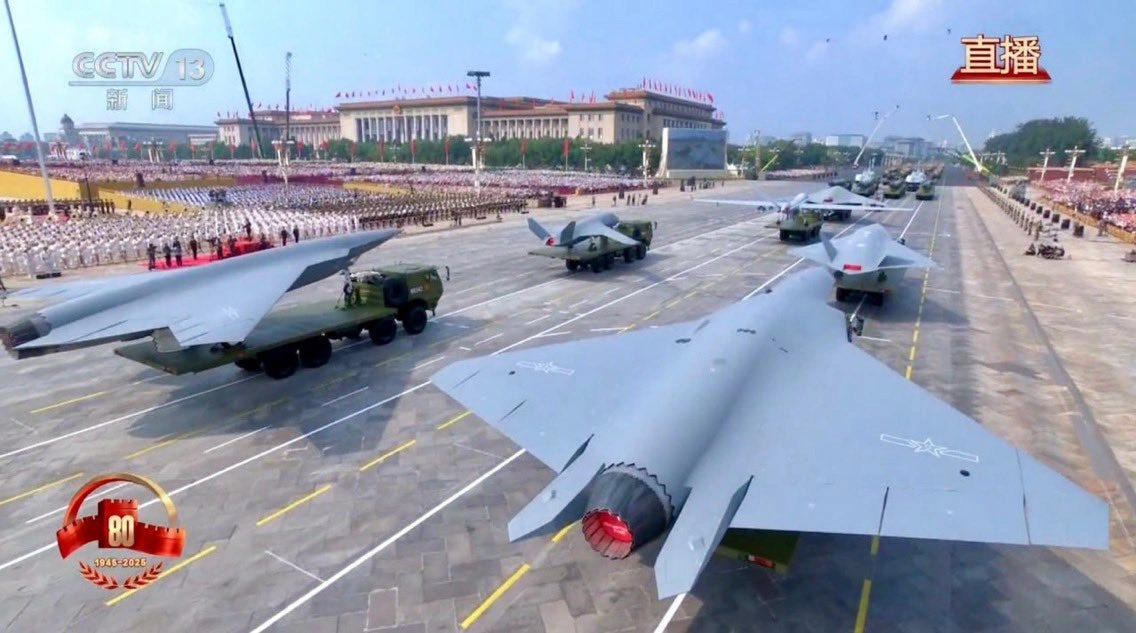
The foreseeable trend of future air combat is the contest between integrated systems of manned and unmanned platforms. China’s “Loyal Wingman” platform has already appeared in victory day parades, indicating its delivery and operational use within the air force. The next step is simply its integration onto carriers. In this aspect, with more mature and advanced electromagnetic catapult technology, and the parallel iteration of multiple Loyal Wingman programs, China is already positioned at the leading edge worldwide.
Editor: Charriot Zhai
https://www.dote.osd.mil/Portals/97/pub/reports/FY2012/navy/2012cvn78.pdf
https://v.cctv.com/2025/05/27/VIDEDsbZ9KOGZpOnH5hlrmkn250527.shtml
https://nationalinterest.org/blog/buzz/us-navys-new-ford-class-aircraft-carriers-have-lots-problems-44252
https://nationalinterest.org/blog/buzz/did-america-make-big-mistake-building-new-ford-class-carrier-104037
https://nationalsecurityjournal.org/the-us-navys-ford-class-aircraft-carrier-has-an-unfixable-problem/
https://time.com/4775040/donald-trump-time-interview-being-president/
Raymond Li
Good comparison info! Would like to see how this updates those table top war games ♟️