



A while ago, I came across news online saying that Germany has experienced serious deindustrialization in recent years, which is reflected in a significant decline in power generation over the past decade or so.
So I decided to verify this. On the IEA (International Energy Agency) website, the data is publicly available.
I downloaded the Excel file and made the following chart:
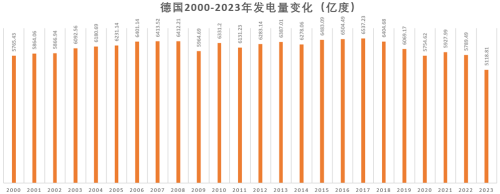
In 2000, Germany’s total electricity generation was 576.543 billion kWh.
By 2017, it reached an all-time peak of 653.723 billion kWh.
But since then, it has been on a downward trajectory.
* 2019: 606.917 billion kWh
* 2020: 575.462 billion kWh
* 2021: 592.799 billion kWh (a rebound)
* 2022: 578.949 billion kWh
* 2023: 511.881 billion kWh
By 2023, Germany’s electricity generation had fallen 21.7% compared with the peak year of 2017.
Since the IEA’s official data only goes up to 2023, I turned to the *Statistical Review of World Energy 2025*. This report is published by the Energy Institute (EI), which took over from BP after BP announced in 2023 it would stop releasing the *Statistical Review of World Energy*. In partnership with KPMG and Kearney, EI has now released the report for the third consecutive year, with the 2025 edition published on June 26, 2025, based on 2024 data.
According to it, Germany’s total power generation in 2024 was 497.288 billion kWh, down 3.0% year-on-year. Notably, Germany’s power generation still declined in 2024, and that year it ranked only tenth in the world!
I compared it with IEA’s 2023 data, and they are roughly consistent.
Keep in mind that for over a decade Germany was the world’s third- or fourth-largest economy.
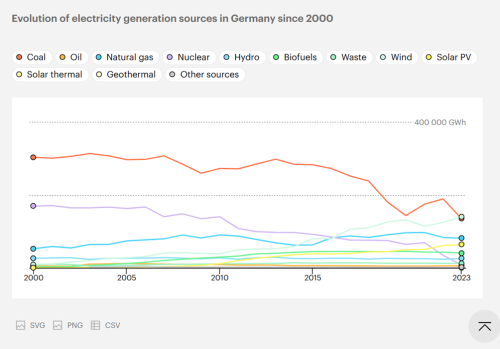
So why has Germany’s electricity generation declined? Let’s look at the next chart (still IEA data). There are two main reasons:
First, coal-fired power generation has dropped drastically—by more than half.
* In 2003, coal-fired power generation was as high as 314.555 billion kWh, accounting for 51.63% of total electricity generation.
* By 2023, it had fallen to 134.892 billion kWh, down 57.12%, accounting for only 26.4% of total generation.
Germany did this in the name of environmental protection and climate change mitigation, to meet carbon reduction commitments (carbon neutrality by mid-century). The Green Party in particular has been very vocal about opposing coal-fired power, and coal plants—large emitters of carbon—became the primary targets for elimination.
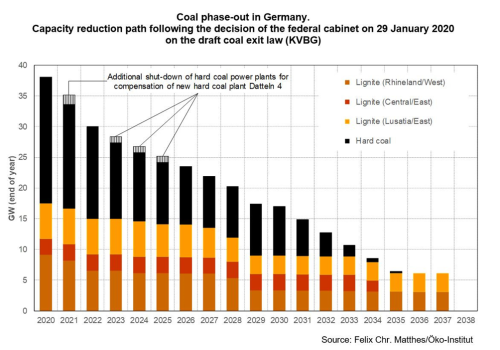
On July 3, 2020, the German parliament passed the *Coal Exit Act*, which mandates that Germany must phase out coal by 2038 at the latest. This timeline was originally proposed in 2019 by Germany’s “Coal Exit Commission”—yes, Germany actually has a commission dedicated to phasing out coal. But even this schedule did not satisfy the more radical Greens, who demanded that all coal plants be closed by 2030.
In April this year, a major news story broke: the famous Moorburg coal power plant in Hamburg was literally blown up. Yes, blown up in the literal sense.
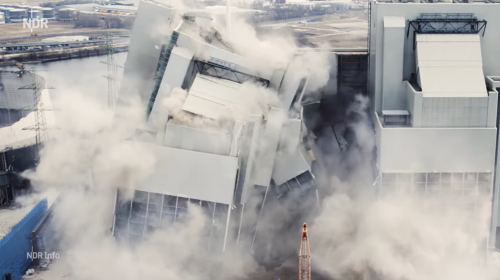
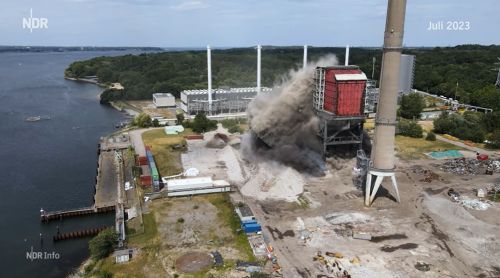
This plant was one of the most efficient in Germany, with an installed capacity of 1,640 MW. It was completed in early 2015, but officially shut down in July 2021 (in fact, it had already ceased generation in December 2020). The total investment was about €3 billion.
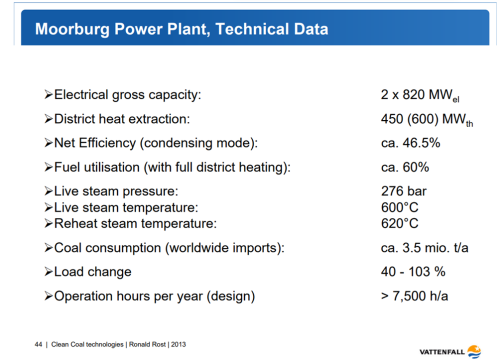
From 2015 to 2020, it generated 34.288 billion kWh. Including annual operating costs, the average cost per kWh was estimated at €1,000—a staggering figure.
Why was this plant blown up?
1. **Low wholesale power prices** during its operation made it hard to sell electricity profitably.
2. The plant sought to connect to the local heating network to increase revenue, but this was rejected on the grounds that coal-based heating conflicted with climate goals, and new heating pipelines would harm the environment.
3. The plant planned to run at full capacity, but required water from the adjacent river for cooling. Heated discharge water would then return to the river, which environmental groups claimed would harm fish. The EU Commission ruled that river water could not be used, forcing the plant to rely on cooling towers with much lower capacity, meaning it could only run at reduced load.
4. Under the EU’s ETS carbon emissions trading scheme, emitters must pay per ton of CO₂. For example, in 2019 this plant emitted 4.7 million tons of CO₂—thus paying a hefty carbon tax.
5. Germany introduced an exit subsidy scheme, whereby coal plants could bid for compensation to shut down. The system did not prioritize phasing out old, inefficient plants, but simply awarded contracts to whoever demanded less money. As a result, the efficient Moorburg plant was selected for closure—it was unprofitable anyway, so it made sense to take the payout and shut down.
In short, environmental policies created a power plant with a cost of €1,000 per kWh, which ultimately ended up being demolished altogether.
Second, Germany abandoned nuclear power.
In April 2023, Germany shut down its last three nuclear plants:
* Isar 2 (Bavaria)
* Neckarwestheim (Baden-Württemberg)
* Emsland (Lower Saxony)
On the night of April 15–16, they were disconnected from the grid, marking Germany’s official farewell to the “nuclear era.”
Yet in 2022, these three plants still provided about 6% of Germany’s electricity.
The background is Germany’s anti-nuclear movement, which began in the early 1970s. Many Germans saw nuclear plants as unsafe. In fact, the Green Party—founded in the late 1970s—was formed largely by anti-nuclear activists and other environmental groups, with environmentalism as its founding mission.
* After the 1979 Three Mile Island accident in the US, mass protests broke out in Germany against nuclear power.
* The 1986 Chernobyl disaster further fueled anti-nuclear sentiment. After 1989, no new commercial nuclear plants were built.
* The 2011 Fukushima disaster in Japan gave new momentum to the German anti-nuclear movement.
In 2001, nuclear power still generated 171.305 billion kWh, 29.21% of Germany’s total. By April 2023, it was gone completely.
It’s not just the Greens: the Social Democrats (SPD), their coalition partner, also support renewables, though less radically.
We all know that industrialization requires energy. Germany’s 2024 electricity generation was nearly 24% lower than its 2017 peak. For Germany, that is deindustrialization.
Europe is fiercely anti-Russia and politically staunch in supporting Ukraine, yet Germany—the core—has deindustrialized so severely that it cannot even function as a qualified arsenal of mass production. Despite so many European countries backing Ukraine, their combined weapons output still falls far short of Russia’s industrial capacity. From shells to drones, Ukraine’s supply is only a fraction of Russia’s.
Germany’s case reminds me of China’s philosophy of moderation—that extremes are never good. Humanity can indeed uphold noble ideals such as racial equality and environmental protection, but we must not ignore the huge gap between ideals and reality.
Europe’s ideals in recent years have become extreme, entrenched in interest groups, and thus difficult to reverse.
* In the name of racial equality, they ignored the interests of their own ordinary citizens, importing masses of illegal migrants, which has worsened public security.
* In the name of environmental protection, they delayed construction projects, obstructed industrialization, shut down power plants, and triggered deindustrialization.
* In the name of democracy, they bred bureaucracy and inefficiency, where even building a bridge or airport takes decades of debate.
People say corruption causes economic losses, but losses from inefficiency may be larger by an order of magnitude or more.
Chinese culture values moderation, for extremes never bring good results.
Environmental protection is a noble cause. But extreme environmentalism imposes huge social costs—and may even be the start of new pollution.
China’s own experience shows that development is the only real solution to environmental problems.
For example, I once mentioned my trip home during Spring Festival, where I noticed that the Yangtze River water has become clearer year by year. This is not just my impression—it is an objective fact, achieved through development.
It’s not just the Yangtze: the Yellow River is also clearing.
According to CCTV in August 2024, the sediment load of the Yellow River has fallen by 80% compared to the average over 1952–2020.
At the Tongguan hydrological station (Shaanxi), using optical sensors to measure silt content, it was found that in 2024, each cubic meter of Yellow River water carried 5.76 kg of sediment, down from the long-term average of 27.5 kg.
The key factor: tens of thousands of silt dams were built on the Loess Plateau to trap floods and sediment. Currently, the Yellow River basin has 58,300 such dams, blocking 7.4 billion tons of sediment.
Afforestation also played a huge role.
98% of Yellow River sediment comes from the Loess Plateau, with Shaanxi province contributing the most. In Shaanxi’s “Three-North Shelterbelt” zone, forest coverage rose from 12.9% in 1978 to 28.89% in 2024.
This is the benefit of development.
At the same time, development must guard against the rise of “identity politics” groups. As Germany’s deindustrialization shows, within such groups, extreme voices often dominate—extremism is often the way to stand out internally—leading to outcomes that harm mainstream society.
Editor: Zhongxiaowen


gus auyeung
while extreme commitment in this case is not true courage but zealotry , moderation in our tradition is sometimes Chinese wisdom but can also reveal itself as timidity , inaction or even wishy washy-ness