



Last Tuesday, after more than a decade of preparation and construction, the Jiangmen Underground Neutrino Observatory—JUNO— in Guangdong province officially began operation.
Neutrinos—known as “ghost particles”—are among the most abundant particles in the universe, second only to photons. Yet they are notoriously difficult to detect. No fewer than four Nobel Prizes have been awarded for neutrino-related discoveries, underscoring their importance.
Scientists know neutrinos come in three “flavors”: electron, muon, and tau. JUNO’s mission is to determine their mass hierarchy—an extraordinarily delicate measurement.
To achieve this, JUNO was built 700 meters underground, shielding it from the constant bombardment of cosmic rays. Think of it as turning off city lights in order to see faint starlight.
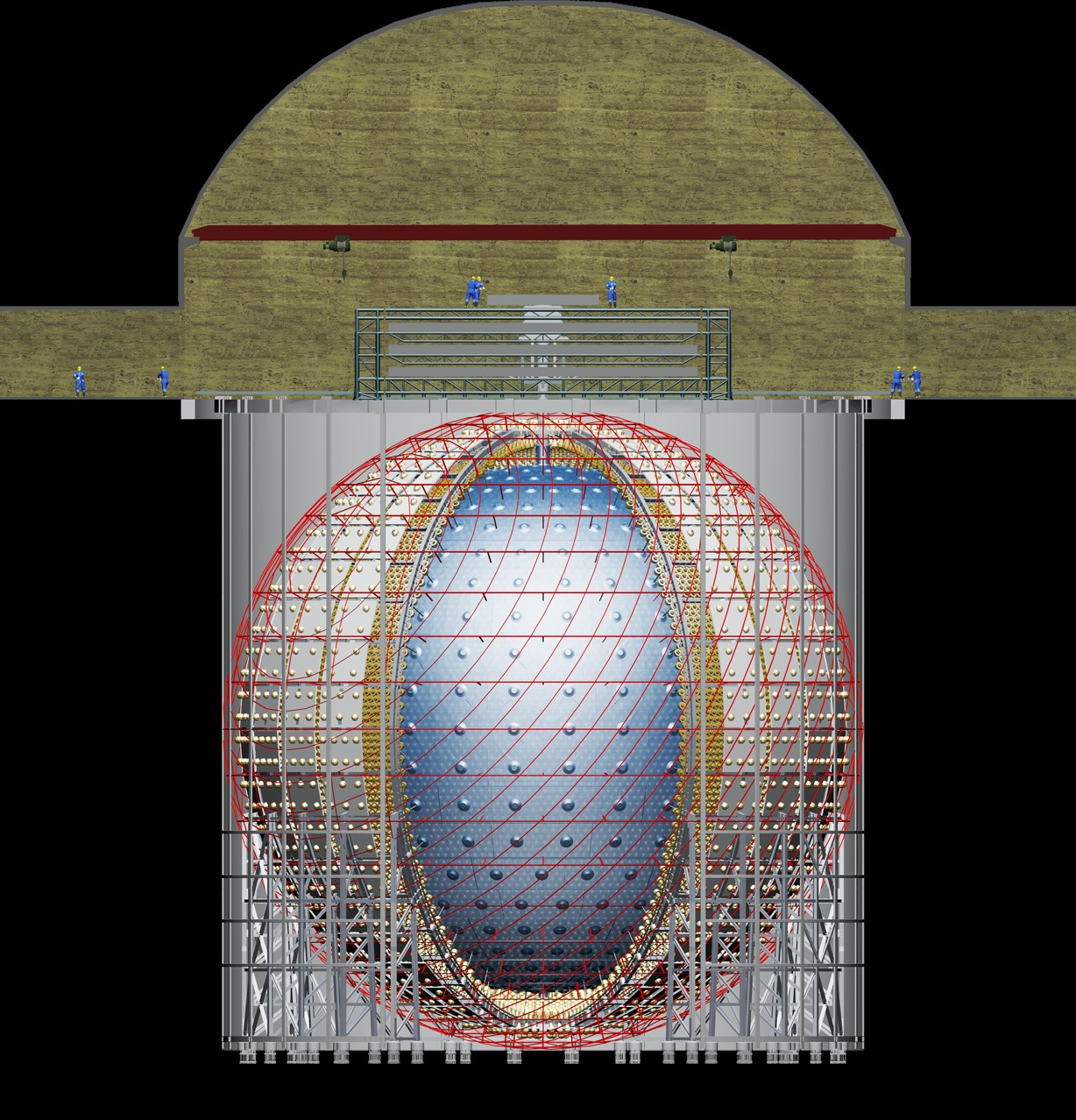 Jiangmen Underground Neutrino Observatory
Its core detector is a 35.4-meter acrylic sphere holding 20,000 tons of liquid scintillator, surrounded by a 41.1-meter stainless steel support frame fitted with 45,000 photomultiplier tubes. Together, these instruments capture the faint traces of passing neutrinos and amplify their signals.
First proposed in 2008 and under construction since 2015, JUNO is a major international collaboration. Nearly 700 researchers from 74 institutions in 17 countries will participate. Its results may shed light on solar nuclear reactions, nearby supernovae, nuclear reactor monitoring, and even the Earth’s internal structure.
Research on the elusive particle of neutrinos is, in fact, also driving advances in humanity’s practical engineering capabilities.
Take JUNO’s core device, the “liquid scintillator,” for example: its transparency requirements are extremely strict—out of 20,000 tons of liquid scintillator, the total amount of dust allowed cannot exceed 8 milligrams, a standard even higher than the cleanliness required for semiconductor surfaces. China’s domestically produced liquid scintillator has set a new world record, extending its lifespan from the commonly used 3–5 years to several decades.
In addition, during the construction of JUNO, China mastered the manufacturing of photomultiplier tubes, ending the monopoly once held by Japan’s Hamamatsu Corporation.
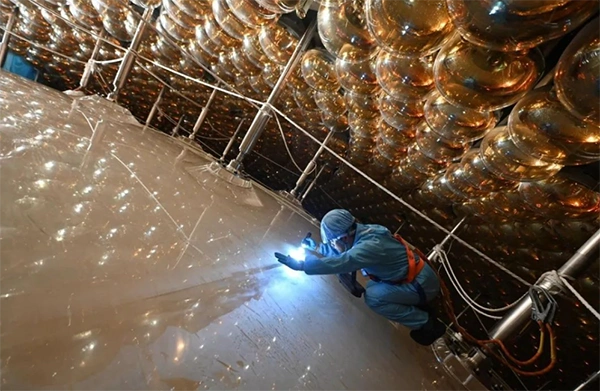 The acrylic sphere and photomultiplier tubes inside the central detector
These two achievements alone, coupled with Chinese enterprises’ outstanding cost-control capabilities, are bound to drive the global industrial chain in this field toward higher quality at lower cost.
Editor: Zhongxiaowen