
Forgotten History:
China in WWII

Editor's note:

What was China’s role in WWII? What is the on-the-ground sentiment regarding the legacy of WWII? How do narratives shape China’s policies?

China is set to stage a massive military parade on September 3 to commemorate the 80th anniversary of the victory in the Chinese People’s War of Resistance Against Japanese Aggression and the World Anti-Fascist War, with 26 heads of state or government attending at the invitation of President Xi Jinping. We delve into the specifics of the military parade, as well as the perceptions of WWII that it reflects in China.

427f1e45-3885-45e2-a6aa-57b6105dd518
Wang Xiangsui

Deputy Secretary General, CITIC Foundation for Reform and Development Studies; Former Senior Colonel, People's Liberation Army; Co-author, Unrestricted Warfare;

" How the West Got China’s Parade So Wrong?"
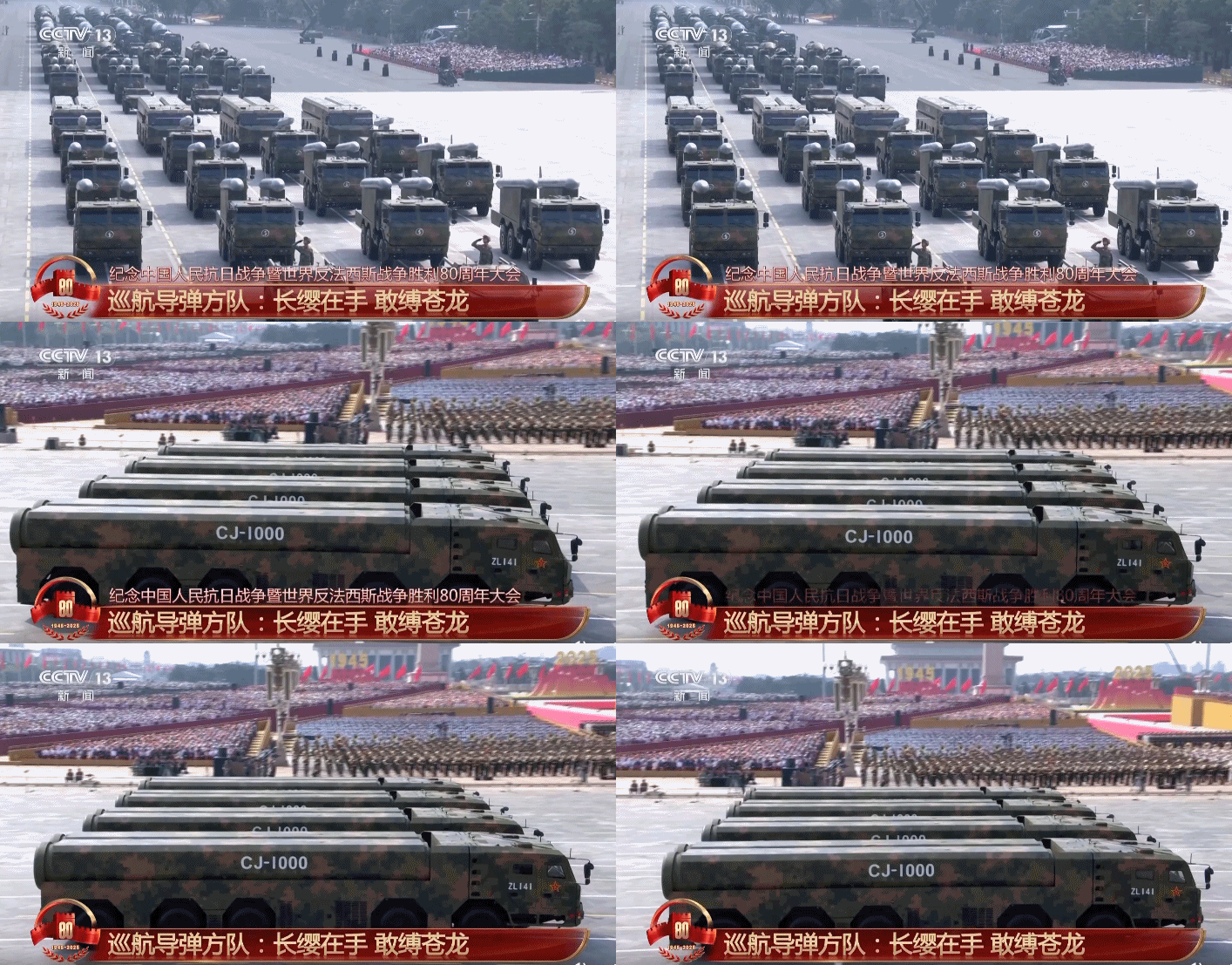
On September 3rd, China held a grand military parade in Beijing. Western media such as the BBC immediately focused on the ballistic missiles, hyping up the “China threat,” while Trump, seeing Putin and Kim Jong-un attending the parade, immediately claimed this was “conspiring against the U.S.”

Regarding such rhetoric, Chinese strategist Professor Wang Xiangsui pointed out that this shows the West not only failed to decode the signals from China’s parade, but even lacks common sense about historical and contemporary global development trends. Yet, the true signals Beijing sent through this parade are far more profound than their fabricated narrative—and something they desperately need to comprehend.

1. This is Not Intimidation Against America, But Retribution for American Arrogance and Brutality

>>
More
1111
The China Academy


" Three Key Takeaways from China’s Latest Military Parade"

On September 3, Beijing’s Tiananmen Square hosted a grand military parade commemorating the 80th anniversary of victory in the Chinese People’s War of Resistance Against Japan and the global fight against fascism.

The event showcased China’s consistent pursuit of peace, the development of the People’s Liberation Army, and its world-class advanced weaponry.

Debut of New Forces

The Space Force, Cyberspace Force, and Information Support Force made their debut as new additions to the military.

The weapons formations, divided into eight sections, highlighted the Chinese military’s main active equipment. Official Chinese commentary emphasized that the weapons had been modified to meet the demands of modern warfare.

Cutting-Edge Weaponry

Particularly noteworthy were three aspects:

First, the air defense and missile defense troops displayed a counter-drone combat group, capable of neutralizing and even destroying drones.

>>
More
wq
Wang Qiang

Political Commentator Specializing in Military Analysis

" China’s Pivotal Role in the Anti-Fascist War: A Commemoration Beyond Politics"

China was the first country to suffer from fascist aggression and also the first to fire the opening shots against fascism.

From Japan’s unprovoked attack on China in 1931 to Japan’s attack on Pearl Harbor, over more than a decade, only China on the Eastern front stood alone against Japanese invaders, bearing almost the entire pressure of Japan’s aggression. During World War II, most European countries were conquered by Germany, yet China—a relatively weak nation—persisted in resisting a much stronger enemy. The Chinese theater in the global anti-fascist war not only lasted a long time, covered a vast area, and involved numerous battles, but it also continuously tied down Japan’s main forces. This played a crucial role in stabilizing the anti-fascist situation in the East and achieving ultimate victory, making China the indisputable main battlefield of the anti-fascist war in the East.

Why do we solemnly commemorate and celebrate victory today? One important reason is that the victory in the global anti-fascist war gave birth to the founding of the United Nations, establishing a governance mechanism based on rules and cooperation to prevent war and safeguard peace, laying the foundation for today’s international order. China becoming a founding member of the UN and a permanent member of the Security Council is, in essence, recognition by the world’s anti-fascist allies of China’s contribution to the war.

We solemnly commemorate the victory of the Anti-Japanese War and the global anti-fascist war, and the inclusion of a military parade in these commemorations serves an important purpose: to showcase China’s firm commitment to defending the achievements of peace and justice, upholding international fairness and justice, and safeguarding the postwar international order.

While AFP relishes the opportunity to highlight that, politically and militarily, it was the Kuomintang-led Republic of China government that stood on the front lines of the war, it conveniently omits the fact that the Communist Party’s army was also part of the National Revolutionary Army.And most importantly, from 1949 onward, the People’s Republic of China became the sole legitimate government representing China. That is why in 1972 the PRC was able to restore its legitimate seat in the United Nations—and why today, the PRC government can rightfully hold grand ceremonies to commemorate the victory of the Anti-Japanese War and the global anti-fascist war!

微信图片_20250513141012
Yu Yuantantian

A new media news column launched by China Media Group (CMG)

" China Challenges Japan Over Billions Spent to Rewrite Its “Comfort Women” History "

On August 26, China’s Ministry of Foreign Affairs lodged a serious protest with Japan in response to negative remarks made by the Japanese side regarding the upcoming commemorative events and military parade in Beijing marking the 80th anniversary of China’s victory in the War of Resistance Against Japanese Aggression. The Chinese side demanded clarification. Japan’s actions appear to have been premeditated. Since China first held a parade in 2015 to commemorate its victory in the war, Japan has allocated 56 billion yen in an attempt to construct a so-called “correct image” internationally.

According to annual budget data from Japan’s Ministry of Foreign Affairs, from 2015 to the present, the total budget for projects directly related to “overseas strategic information dissemination” has exceeded 56 billion yen, with the 2025 allocation reaching 6.22 billion yen. By comparison, since Japan’s defeat in World War II, the total compensation it has offered regarding the “comfort women” issue amounts to less than 10 billion yen, and to this day, it has failed to provide sufficient and sincere reparations or apologies to the victims.

The “overseas strategic information dissemination” projects are not ordinary information campaigns; they represent a key budget category newly established by Japan’s Ministry of Foreign Affairs in 2015. At the time, China was marking the 70th anniversary of the victory in the Chinese People’s War of Resistance Against Japanese Aggression and the World Anti-Fascist War, holding the first parade focused on commemorating that victory. According to relevant documents from the Japanese Ministry of Foreign Affairs, this newly created budget category was designed to promote to the international community Japan’s “correct image” regarding territorial integrity, historical awareness, and positive contributions to peace. The budget has been allocated to initiatives such as cultivating “pro-Japan” foreign individuals and revising records of “comfort women” in overseas textbooks. Among the institutions under the Ministry of Foreign Affairs, the Japan Foundation for International Exchange has reportedly funded foreign scholars and media personnel for several consecutive years to disseminate “pro-Japan” content.

Now, on the 80th anniversary of China’s victory in the Chinese People’s War of Resistance Against Japanese Aggression and the World Anti-Fascist War, Japan continues these practices. We ask three questions: Will Japan face its history with honesty and integrity? Will Japan genuinely learn from the lessons of history? Is Japan truly committed to peaceful development?

WechatIMG255
The China Academy Picks

Top picks selected by the China Academy's editorial team from Chinese media, translated and edited to provide better insights into contemporary China.

" Photo Gallery: China Unveils Cutting-Edge Military Technology on 80th Anniversary of Victory"

AJX002 Unmanned Mine-Laying System Draws Attention

According to military commentators, the AJX002 utilizes large unmanned submersibles as delivery platforms. The system can covertly deploy mines in deep-sea areas, forming blockade zones to sever enemy maritime supply lines and navigation channels. Equipped with advanced detection and identification modules, it can autonomously search for targets and distinguish between friendly and enemy vessels in real time, significantly reducing the risk of accidental activation. The system can operate in conjunction with other unmanned submersibles and unmanned surface vessels to form an intelligent combat cluster, enabling multi-node information sharing and tactical coordination to establish a three-dimensional blockade network.


>>
More
蔡正元
Cai Zhengyuan

Former Taiwanese Legislator;Kuomintang Member

" Who Fought Japan More in China During WWII: the Nationalists or the Communists?"

During the recent military parade in Beijing marking the 80th anniversary of victory in the War of Resistance Against Japan, debates flared up in the media and social media over who contributed more to the victory: the “Nationalist Army” or the “Communist Army.”

But real history actually invalidates the premise of that debate. Before the Xi’an Incident of 1936, China had two armies: the “National Revolutionary Army” (NRA) and the Communists’ “Red Army.” After the Xi’an Incident, the Red Army was incorporated into the NRA to jointly resist Japan. Thus, during the War of Resistance, almost all anti-Japanese forces were part of the NRA.

Although nominally under Chiang Kai-shek’s command, in practice only the “Central Army” belonged to Chiang. The NRA was a broad umbrella: there were NRA units under Communist leadership, under Beiyang warlord leadership, under the Qing Dynasty general’s leadership, and under regional warlord leadership. All of them made significant contributions to the war effort.

Famed anti-Japanese general Zhang Zizhong, for example, came from the Beiyang faction. The Sichuan Army’s sacrifices and performance in the war were no less than those of the Central Army.

>>
More
logo
Wave Media

Original articles from our Wave Media editorial group

" How China’s Parade is Stopping World War 3? | Roughly Chinese Podcast"

 
>>
More
5a42f3042b9b4
Shen Yi

Professor of International Relations at Fudan University

" The Blurry Divide Between Axis and Allies "

China is about to hold the military parade marking the 80th anniversary of the War of Resistance Against Japanese Aggression and the World Anti-Fascist Victory, an event attracting global attention and high expectations. At the same time, the contest surrounding the parade on the international stage is also becoming increasingly intense.

This week, China announced the list of 26 foreign heads of state and government leaders who will attend the parade. It should be noted that this is not a complete list of all participating countries, but only covers representatives at the level of heads of state and government. Including deputy prime ministers, parliamentary speakers, other high-level representatives, international political figures, and former leaders would add countries such as South Korea, East Timor, Venezuela, Singapore, Egypt, and Bulgaria to the list, bringing the total number of participants to 32.

Looking back at 2015, 30 foreign leaders attended, including heads of state, 19 senior government representatives, and 10 heads of international organizations and institutions.

This number is an important indicator. It signifies that, 80 years after the end of World War II, the international community once again has the opportunity to examine and confirm who were the steadfast members in the fight against fascism.

>>
More
download
Guancha.cn

Guancha.cn (Chinese: 观察者网; lit. 'Obsr Net') is a privately owned news site based in Shanghai, China.

" China’s Ministry of National Defense addresses the role of Kuomintang WWII veterans, including those from Taiwan."

According to China’s Ministry of National Defense website, on the afternoon of August 28, the Ministry held a routine press conference, during which spokesperson Senior Colonel Zhang Xiaogang answered reporters’ questions.

Reporter: The upcoming military parade in Beijing has drawn much attention. How does the mainland view the contributions of the Nationalist forces during the Anti-Japanese War? In addition, at China’s State Council Information Office press conference, it was announced that Kuomintang veterans of the war would be invited to attend. Could the spokesperson provide details on the arrangements? Will there be veterans from Taiwan among them?

Zhang Xiaogang: The War of Resistance against Japan was a just struggle in which all Chinese people, united in will and purpose, resisted Japanese militarist aggression. More than 80 years ago, the Communist-led behind-the-lines battlefields and the Nationalist-led frontlines cooperated strategically, forming a joint effort to fight Japanese invasion. We are inviting Kuomintang veterans to participate in the commemorative activities to honor their heroic efforts and contributions in defending the country. Specific arrangements were introduced at the State Council Information Office press conference.

images
Global Times

An international news publication organized and published by the People’s Daily, the official newspaper of the Central Committee of the Communist Party of China.

" Japan Has No Right to Tell the World How to Remember WWII"

Recently, Japan’s Kyodo News cited “diplomatic sources,” claiming that the Japanese government had recently, through its “embassies abroad” and other diplomatic channels, “asked” other countries to refrain from attending a military parade and other events that China will hold to mark the 80th anniversary of the victory in the Chinese People’s War of Resistance Against Japanese Aggression and the World Anti-Fascist War. Citing reasons such as “excessive focus on history” and “anti-Japanese overtones,” Japan “conveyed” to other nations that the participation of leaders should be carefully considered.

If this reported move is true, it not only exposes Japan’s seriously erroneous view of World War II (WWII) history and its misperception of China, but is also a blatant provocation against historical justice and the post-war international order, a deliberate sabotage of the foundation of peace in Asia and the world, and an affront to all nations that once suffered from Japanese militarist aggression. The Japanese government should issue a clear response to this news and clarify its position; otherwise, it will not only damage China-Japan relations but also tarnish Japan’s international image.

The grand gathering to mark the 80th anniversary of the victory in the Chinese People’s War of Resistance Against Japanese Aggression and the World Anti-Fascist War will be held on September 3 at Tian’anmen Square. China’s commemoration of the victory of the War of Resistance Against Japanese Aggression aims to bear history in mind, honor all those who laid down their lives, cherish peace and open up the future. This is both a solemn expression of China’s memory of WWII and an important opportunity for the international community to jointly commemorate the Anti-Fascist cause. The Chinese people went through 14 years of arduous war of resistance against Japanese aggression, made great national sacrifices, and made indelible contributions to the victory of the World Anti-Fascist War. It is beyond reproach for China to hold commemorative activities on the day marking the victory in the Chinese People’s War of Resistance Against Japanese Aggression, it is not open to criticism, and the country responsible for the war’s aggression back then has no right whatsoever to make irresponsible remarks.

>>
More