


From May 10 to 14, Brazilian President Luiz Inácio Lula da Silva visited China accompanied by several cabinet ministers, members of the National Congress, and more than 200 business elites. He also attended the Fourth Ministerial Meeting of the China-CELAC Forum, elevating China–Brazil and China–Latin America cooperation to a new height. During the visit, China and Brazil signed 20 cooperation agreements covering a wide range of areas including development strategy alignment, science and technology, agriculture, the digital economy, finance, inspection and quarantine, and media. The two sides also issued a Joint Statement on Strengthening the China Brazil Community of Shared Future for a More Just World and a More Sustainable Planet, and Jointly Upholding Multilateralism and a joint statement on the Ukraine crisis.
Against the backdrop of profound changes in the international landscape, China–Brazil cooperation is reaching new heights. Centered on four key areas—economic and trade development, scientific and technological innovation, social governance, and multilateral collaboration—the bilateral cooperation is deepening and becoming increasingly substantive. It is characterized by firm strategic guidance, steady renewal and upgrading, and a solid foundation of public support. In the face of short-term global shocks caused by Donald Trump’s return to the White House, the Lula administration has made strengthening cooperation with China a top priority to ensure Brazil’s stable development and enhance its regional and international influence.
Deepening and Strengthening Bilateral Cooperation
Economic and Trade Development
China has remained Brazil’s largest trading partner for 15 consecutive years, while Brazil is China’s largest trading partner in Latin America. In 2024, bilateral trade between the two countries reached USD 188.17 billion, a year-on-year increase of 3.56%, marking the seventh consecutive year that trade volume exceeded USD 100 billion. China is the top export destination for Brazil’s key commodities, including soybeans, iron ore, crude oil, pulp, and beef. By the end of 2024, China’s cumulative investment in Brazil exceeded USD 70 billion, covering a wide range of sectors such as energy, electricity, agriculture, infrastructure, telecommunications, science and technology, and finance, providing strong momentum for bilateral economic and trade cooperation.
Scientific and Technological Innovation
The two countries have jointly developed six China-Brazil Earth Resources Satellites, with data widely applied across sectors such as agriculture, forestry, water management, land and resource administration, environmental protection, and disaster prevention and mitigation. These satellites directly support economic and social development in China, Brazil, and other developing countries, setting a benchmark for South-South cooperation in science and technology. Platforms such as the China-Brazil Research Center for Climate Change and Energy Technology Innovation, the China-Brazil Joint Agricultural Science Laboratory, and the China-Brazil Joint Nanotechnology Research Center have emerged as new engines of bilateral science and technology collaboration. In recent years, China-Brazil cooperation has evolved from a space-focused partnership into a broader framework spanning climate change, energy technology, agricultural science, nanotechnology, and semiconductors.
Social Governance
In recent years, China and Brazil have engaged in multi-sectoral, multi-level, and multidimensional dialogue on governance topics such as poverty reduction and rural development, national modernization, energy transition, and green development. Forums and exchanges such as the China-Brazil Forum on Poverty Reduction and Rural Revitalization, the China-Brazil Seminar on Governance, and the China-Brazil Youth Leaders Dialogue have built channels of communication between government agencies, political parties, academic institutions, media, and businesses. Together, the two countries are exploring modernization paths suited to their respective national contexts and have reached a series of key consensuses on major issues, further enriching the contemporary relevance of the China-Brazil community with a shared future.
Multilateral Cooperation
China and Brazil firmly oppose unilateralism, protectionism, and hegemonism, and are jointly committed to upholding multilateralism, defending international fairness and justice, and promoting the development of a multipolar world. Guided by the vision of building a more inclusive and sustainable international order, the two countries engage in regular policy coordination and dialogue within multilateral frameworks such as the United Nations, the World Trade Organization, the G20, and BRICS, where they have established common positions. For example, the two nations actively promote the reform of global governance institutions to enhance the representation of the Global South; they participate deeply in global climate governance to uphold climate justice; and they advocate for resolving the Ukraine crisis and the Israeli–Palestinian conflict through political dialogue and peaceful negotiation, contributing to global stability and harmony.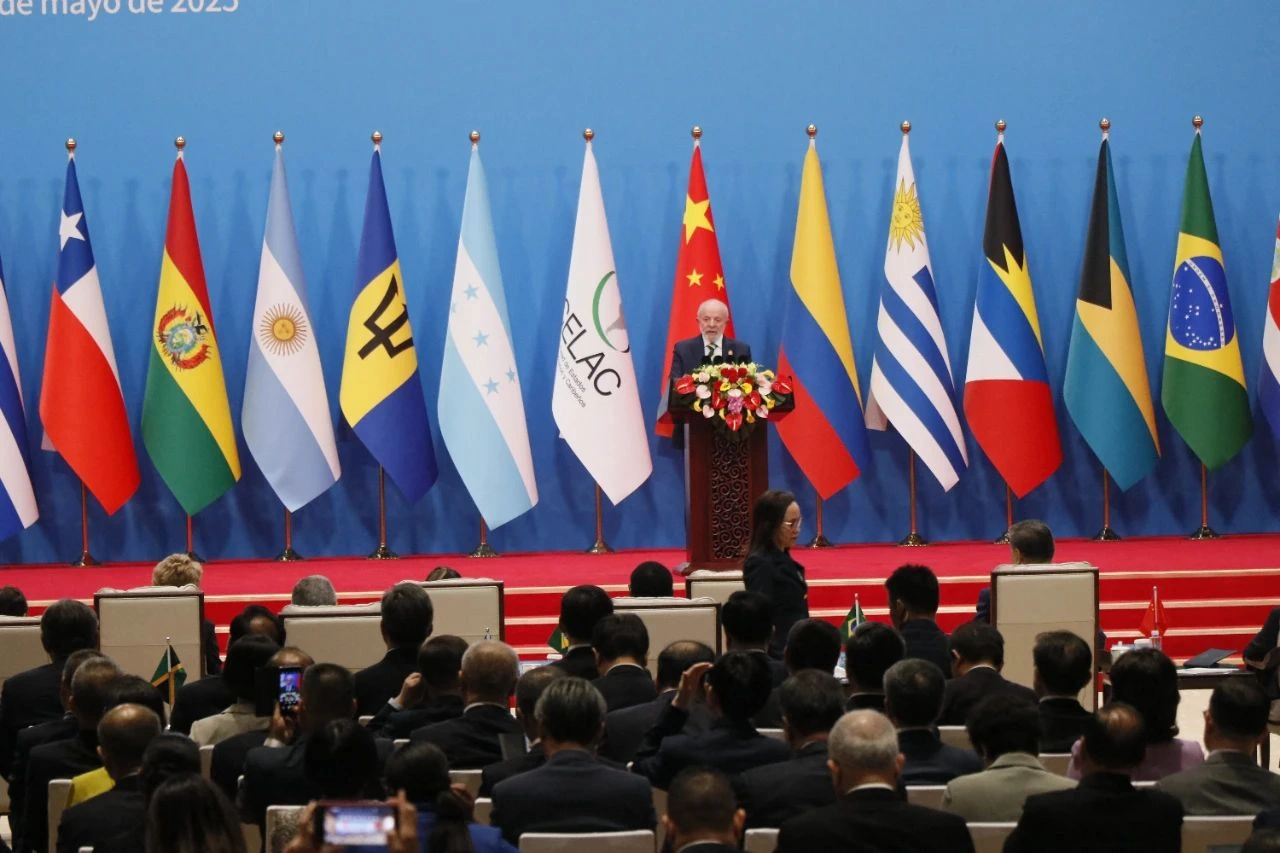 On May 13, 2025, the Fourth Ministerial Meeting of the China–Community of Latin American and Caribbean States Forum was held in Beijing. Brazilian President Luiz Inácio Lula da Silva delivered a speech at the conference.
Cooperation Embodies Three Distinct Characteristics
First, head-of-state diplomacy has played a pivotal role in strategically guiding China–Brazil cooperation. Under the leadership of top-level exchanges, bilateral political trust has deepened, and cooperation has expanded comprehensively across multiple levels and sectors. Since President Lula took office in early 2023, high-level visits between China and Brazil have continued frequently. Shortly after assuming the presidency, Lula paid a state visit to China, and President Xi Jinping attended the G20 Leaders’ Summit in Brazil in November last year, also paying a state visit to the country. These high-level interactions have elevated political dialogue and cooperation to new heights. In 2024, the 50th anniversary of diplomatic ties between China and Brazil, both leaders jointly announced the elevation of bilateral relations to a “China–Brazil community with a shared future for a more just and sustainable world,” laying out an ambitious blueprint for the next “golden fifty years.” Guided by top-level diplomacy, both sides have continued to support each other on core interests and major concerns, further deepening their strategic mutual trust.
Second, driven by both energy transition and technological innovation, China–Brazil cooperation has undergone a robust upgrade, accelerating from traditional sectors to emerging industries. In recent years, bilateral economic and trade cooperation has increasingly shifted toward green development and integration into high-tech value chains. Supported by Brazil’s “Growth Acceleration Program” and a series of industrial policies, Chinese investment in Brazil has expanded into renewable energy, electric vehicles, and green infrastructure. Chinese energy companies such as State Grid Corporation of China, CGN, and China Three Gorges Corporation have actively participated in Brazil’s hydropower, solar, and wind energy projects. Automakers like Great Wall Motors, BYD, and Chery have ramped up efforts to build factories in Brazil and localize Chinese automobile production. Envision Group is building Latin America’s first zero-carbon industrial park in Brazil. Meanwhile, companies like Huawei and CRRC are playing active roles in Brazil’s smart city development. In agriculture, cooperation has also deepened. Initiatives like the China–Brazil Science and Technology Courtyard and the Demonstration Farm for Agricultural Mechanization Cooperation have promoted the localization of Chinese agricultural technologies in Brazil, injecting new momentum into the country’s agricultural modernization.
Third, people-to-people exchanges between China and Brazil are growing ever closer, enhancing mutual understanding and recognition and further consolidating the public support for stable and long-term bilateral cooperation. In the face of natural disasters, the people of both nations have stood in solidarity, giving concrete meaning to the concept of a China–Brazil community with a shared future. Since late April last year, as Brazil’s southern region experienced severe rainfall and flooding, the Red Cross Society of China, Chinese communities in Brazil, and Chinese enterprises jointly contributed nearly 10 million reais in relief supplies to assist in the reconstruction efforts. Exchanges in education, culture, sports, think tanks, and media have also become more active. Marking the 50th anniversary of diplomatic ties, various sectors in both countries organized celebrations such as themed seminars, think tank forums, photo exhibitions, artistic performances, book publications, commemorative medal and stamp issuances. Next year will mark the “China–Brazil Year of Culture,” which is expected to further strengthen cultural bonds, enhance mutual understanding among the people, and inject fresh vitality into the China–Brazil community with a shared future.
Strategic Considerations Behind Strengthening China–Brazil Cooperation
Strengthening cooperation between China and Brazil aligns with the shared aspirations of both peoples. Especially in the context of the Trump administration’s global tariff wars and the promotion of a “New Monroe Doctrine,” the Lula administration, guided by strategic considerations of complementarity, stability, and global positioning, has prioritized deepening ties with China as a means to ensure Brazil’s stable development and to enhance its regional and international influence.
First, for Brazil, China serves as a potential alternative to the United States in mitigating the risks and challenges associated with national development. Given that U.S. tariff policies impact global trade flows and increase production costs worldwide—thus threatening Brazil’s socio-economic stability—it has become an urgent task for Brazil to establish alternative trade networks. In today’s complex and volatile global landscape, China’s market and financing capabilities have become increasingly vital for Brazil. Meanwhile, Brazil’s role as a stable supplier of primary agricultural and mineral commodities and aerospace products to China has been further reinforced. At the same time, China is increasingly emerging as a reliable partner for Brazil’s emerging industries. For example, in the satellite communication sector, Brazil’s telecom company signed a Memorandum of Understanding with Shanghai-based Yuanxin Satellite at the end of last year. Yuanxin Satellite will provide Brazil with satellite communication and broadband internet services—challenging the current monopoly held by Starlink in Brazil’s low-earth orbit internet market.
Second, in the face of the short-term global shocks triggered by Trump’s return to office, deepening strategic cooperation with China is viewed as a key pillar for Brazil’s long-term economic and social stability. At present, U.S. politics and economy are marked by instability, and its trade policies are aggressive and unpredictable, generating widespread uncertainty and insecurity across the globe. Against this backdrop, the Lula administration is actively considering and promoting the alignment of China’s Belt and Road Initiative with Brazil’s major development strategies such as the “Growth Acceleration Program,” the “New Brazilian Industrialization Plan,” and the “South American Integration Route Plan.” Such coordination can help cushion the negative impacts of Trump’s policies on Brazil. During the China–Brazil Business Seminar held on May 12, several Chinese enterprises announced a combined investment of over 27 billion reais in Brazil, covering sectors such as express delivery, fast food, semiconductors, new energy, automobile manufacturing, and renewable energy. These initiatives demonstrate the enormous potential of bilateral cooperation and are expected to make significant contributions to Brazil’s socio-economic development.
Finally, based on the shared identity of both countries as members of the Global South—and their common understanding of the challenges faced by developing countries under current international conditions, as well as the urgent need for reform in global governance—strengthening China’s support in regional and international affairs is of great significance for Brazil. Compared to the “New Monroe Doctrine” and strategic neglect of neighboring regions under the Trump administration, China firmly supports Brazil and other Latin American countries in safeguarding sovereignty and independently choosing their development paths. Together with Latin American nations, China has launched five major initiatives—solidarity, development, civilization, peace, and people-to-people ties—demonstrating a sincere and responsible commitment to pursuing common development and building a China–Latin America community with a shared future.
At present, China–Brazil cooperation shows strong vitality and broad prospects in key areas of Brazil’s regional diplomacy, including infrastructure financing, regional security, and regional integration in Latin America. As the international landscape undergoes profound adjustments and the reconstruction of the global order accelerates, Brazil’s partnership with China and joint leadership within the Global South can not only safeguard the shared interests of developing countries, but also enhance Brazil’s voice and influence in a multipolar world. China has clearly expressed its understanding and support for Brazil’s aspiration to play a greater role within the United Nations, including on the Security Council. China actively participates in the “Global Alliance Against Hunger and Poverty” proposed by Brazil, supports Brazil’s “Global Governance Reform Action Initiative,” and will fully assist Brazil in hosting the 2025 BRICS Summit and the UNFCCC Conference of the Parties. The two countries have also reached consensus and proposed solutions on the political resolution of the Ukraine crisis. China and Brazil’s shared positions on major international issues not only reflect their responsibilities as major nations but also their commitment to forging Global South consensus and practicing the vision of a community with a shared future for mankind. Strengthened strategic coordination in international affairs will help both countries lead the Global South in advancing the global governance system toward greater equity and justice, making positive contributions to global peace and stability.
Editor: LQQ