



In 2025, Nanshan District in Shenzhen became the first county-level administrative division in China whose GDP exceeded one trillion yuan. This milestone placed it firmly in the “trillion-GDP club,” giving it an economy larger than roughly 90% of China’s prefecture-level cities — truly “one district equal to one city.” Its economic output even surpasses that of countries like Iceland and Estonia.
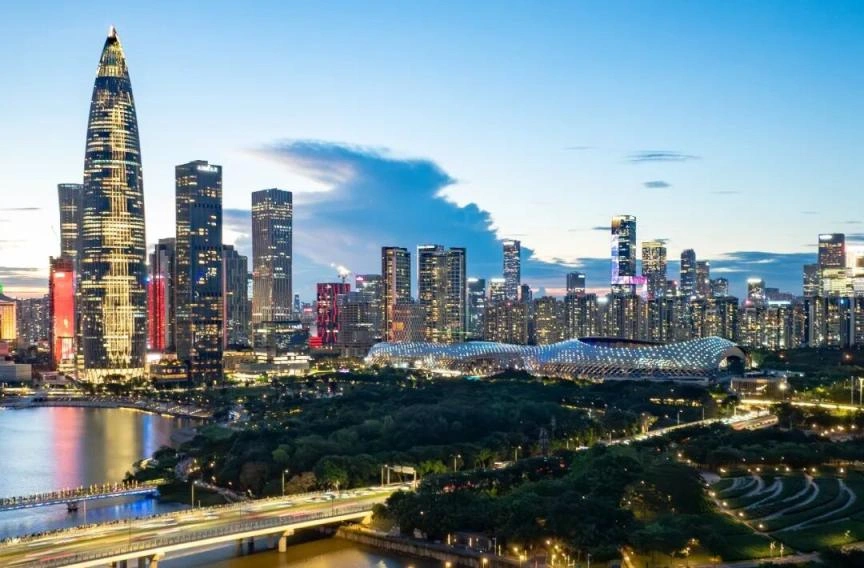 Nanshan District in Shenzhen
Yet the most astonishing feature is not the sheer size of its economy — but its density.
With less than one-tenth of Shenzhen’s land area, Nanshan produces more than one-quarter of the city’s economic output. It hosts 218 publicly listed companies and accounts for roughly 0.7% of China’s GDP. Output reaches 5.4 billion yuan per square kilometer — three times Shenzhen’s average and more than three times that of Pudong New Area. On average, each square kilometer in Nanshan contains more than one listed company.
As a frontier district of China’s reform and opening-up, how did Nanshan rise from economic periphery to trillion-yuan powerhouse in just 35 years?
Its rise did not depend on natural resources — it has no mineral wealth. Nor did it rely on the administrative privileges of a national-level new district — for most of its history it has been only a standard bureau-level district.
In essence, Nanshan’s trillion-yuan journey reflects more than four decades of reform and opening-up, where market mechanisms, technological innovation, and urban governance underwent intense “chemical reactions” within a high-density spatial environment.
I. From the World’s Factory to a Tropical Rainforest
Nanshan is often called “China’s Silicon Valley,” yet it differs fundamentally from Silicon Valley.
Silicon Valley represents the ultimate “software + venture capital” model. Nanshan is unique in its “hardware-software integration + closed industrial chain.”
The district hosts more than 600,000 market entities, including 6,037 nationally recognized high-tech enterprises — forming a complete “tropical rainforest” ecosystem:
* Canopy (giants):companies like Tencent, ZTE, and DJI provide platforms and large-scale demand.
* Shrubs (core firms):218 listed companies — the highest density in China — build barriers in specialized sectors.
* Moss (startups): hundreds of thousands of small firms iterate rapidly in niche spaces.
The true power of this ecosystem lies in its extreme efficiency of vertical industrial integration.
In the Lixiandong “Robot Valley,” more than 20 complete-machine manufacturers — including UBTECH — and over 200 component suppliers cluster together. A concept for a humanoid robot joint can be finalized in the morning, prototyped in nearby factories by noon, and tested back in the lab by afternoon. Hardware iterations that take two weeks in Silicon Valley can be completed in 24 hours in Nanshan.
Crucially, Nanshan is backed by the entire supply-chain network of the Pearl River Delta. Nanshan is the “brain” of this massive industrial organism, while Dongguan, Huizhou, and Foshan serve as its “limbs.” This geographically proximate manufacturing base — enabling lightning-fast response — forms an almost impossible-to-replicate moat.
With land nearly fully developed, Nanshan is no longer doing simple “addition” — it is doing “multiplication.”
R&D intensity has reached 7.87% of total economic output — far above China’s national average of about 2.5%, and even higher than innovation powerhouse Israel at roughly 5.6%.
This pressure-driven investment has produced 860 invention patents per 10,000 people — more than 20 times the national average.
While many regions still rely on land-finance growth, Nanshan has already completed its transition to innovation-driven momentum.
Unlike many industrial parks dependent on a single sector, Nanshan has deeply integrated manufacturing and services. The tertiary sector accounts for nearly 80% of the economy — not traditional services, but producer services such as software and R&D. Manufacturing’s share may have declined, but its technological intensity is extremely high: strategic emerging industries now account for nearly 60% of GDP. Every increment of growth is driven by technological innovation — true “high-quality growth.”
II. Institutional Code: A Capable Government and an Efficient Market
Nanshan’s success is often attributed to markets, but a highly competent government is equally crucial.
Its governance philosophy is simple: “no unnecessary interference, immediate response when needed,” combined with a strong product-manager mindset.
At the startup stage, government acts as an angel investor. Nanshan has established large industrial guidance funds and offers exceptional tolerance for innovation failure — including lead investment with up to 100% loss tolerance. This willingness to underwrite risk helps tech firms survive the “valley of death.”
During growth stages, government becomes the assistant to a company’s CTO. Policies such as instant approvals and automatic eligibility for benefits — seemingly minor administrative innovations — generate enormous institutional dividends across hundreds of thousands of firms.
Few realize that Nanshan has built one of China’s most comprehensive intellectual property courts and protection centers.
For high-tech firms, patents are lifelines.
Nanshan accounts for roughly one-fourteenth of China’s international PCT patent filings — made possible by strict IP protection that punishes infringement and rewards innovation. This is the institutional foundation that allows innovation to spread.
Even more emblematic is Qianhai — a “special zone within a special zone.”
Established in 2010, Qianhai serves as a testing ground for deepened reform and cooperation between mainland China and Hong Kong. Legal, financial, and talent systems are closely aligned. This not only channels global capital into Nanshan but also pushes local governance toward international standards, making it a bridgehead for institutional innovation in the Guangdong-Hong Kong-Macao Greater Bay Area.
III. Spatial Restructuring: Breaking the Ivory Tower
Many university towns are isolated enclaves — but Nanshan’s Xili Lake International Science and Education City shows another possibility.
First is seamless integration of industry, academia, and research.
Institutions such as Shenzhen University, Southern University of Science and Technology, and Tsinghua Shenzhen International Graduate School are not distant academic towers but industrial backyards.
Labs and companies often share a single wall. Professors launch startups, students work in factories, and firms collaborate directly on campus. High-frequency talent mobility dissolves the barriers between research and industry. Many core technologies of Nanshan’s listed companies originated in nearby university labs.
Second is deep integration of industry and urban life.
Nanshan avoided the old industrial-zone model of daytime noise and nighttime emptiness. Shenzhen Bay Talent Park, coastal leisure belts, premium commercial districts, and headquarters towers coexist. The model of “working in parks, living in the CBD” dramatically reduces psychological stress for high-pressure innovators.
For global talent, Nanshan offers not just high salaries but an international, high-quality lifestyle.
In a single café, a biotech PhD may sit beside a cross-border e-commerce operator. Cognitive collisions across industries spark cross-disciplinary innovation — AI + pharmaceuticals, drones + logistics.
This is the essence of urban economics: density equals efficiency; density equals innovation.
IV. Deep Reflection: The Growing Pains of a Super-District
As “China’s No.1 District,” Nanshan faces structural tensions shared by major global urban cores.
First, high costs risk hollowing out industry.
As rents and labor costs approach those of Manhattan, manufacturing relocation becomes inevitable. Moves such as Huawei shifting terminal operations to Dongguan signal this trend.
The challenge: how to preserve high-end manufacturing with scarce land? If supply-chain distances grow, will Nanshan’s 24-hour hardware-iteration advantage weaken?
The district is exploring a “headquarters + satellite enclave” model — but this requires sophisticated cross-regional coordination.
Second, governance mismatch — a small administrative unit managing a giant economy.
Nanshan’s economy rivals that of entire countries, yet administratively it remains just a district. Fiscal authority, major planning powers, and regional coordination remain constrained. It must think like a nation but operates with district-level tools — a structural bottleneck in China’s urbanization process.
Third, human well-being.
In efficiency-driven Nanshan, individuals can become mere data points in corporate algorithms. High housing costs form a barrier against ordinary young dreamers. If a district can host only geniuses and the wealthy, can its innovation vitality endure?
Nanshan’s next task is to prove it can not only generate trillion-yuan GDP — but also sustain both bodies and souls.
For the broader regions of China, Nanshan offers an advanced blueprint: shifting from factor-driven growth to innovation-driven development, from expansion to refinement.
The trillion mark is only Nanshan’s new starting line. Ahead lies the vast horizon of becoming a global innovation center — and the ultimate test: balancing high-quality growth with high-quality living in an ultra-dense urban space.
Editor: Zhongxiaowen