



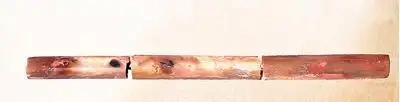
 A jade tube containing medical acupuncture needles, unearthed from the tomb of Marquis Haihun. Photo courtesy of the Jiangxi Provincial Institute of Cultural Relics and Archaeology.
Not long ago, the Jiangxi Provincial Institute of Cultural Relics and Archaeology released a research finding: the needle-like metal objects unearthed from the tomb of Marquis Haihun were confirmed to be medical acupuncture needles made using the forged-steel technique. This provides direct evidence of the material and structural evolution of medical instruments during the Western Han period.
The tomb of Marquis Haihun belongs to Liu He, the first Marquis Haihun of the Western Han dynasty. During laboratory archaeology and the study of excavation reports on Liu He’s main coffin, a batch of valuable artifacts was discovered, among which was this set of medical acupuncture instruments.
How was this artifact discovered?
Through laboratory archaeology, a jade tube and multiple measuring spoons were found inside a gilt-lacquered wooden box in Liu He’s main coffin. The jade tube is made of white jade and shaped as a cylindrical tube, containing several needle-like metal objects. When discovered, the needles were broken into multiple fragments and heavily corroded. Close inspection of a broken section of the jade tube revealed at least five needle fragments, one of which could be removed. Residual mud-like textile fragments were attached to the surface of the needles inside the tube. Based on this, researchers inferred that the needles were likely wrapped in textile before being placed inside the jade tube, a method that was both hygienic and convenient for handling.
How was it determined to be medical needles?
This set of needles had been carefully wrapped in the jade tube at the time of burial and placed in a gilt-lacquered box at the head of the inner coffin. The diameter of the needle cross-section measures only 0.3–0.5 mm. Additional tools, such as measuring spoons possibly used for dispensing medicine, were also found in the same lacquered box. Moreover, a token unearthed alongside the needles was inscribed with “nine needles in one set.” Taken together, researchers infer that this set of needle-like objects corresponds to one of the “Nine Needles” mentioned in traditional medical texts.
Notably, the material of the needle fragments is significant.
Analysis shows that the needle fragments are made of forged steel, produced by hammering pig iron, resulting in needles with excellent ductility and toughness. Compared with gold and silver needles of the same “hao needle” type unearthed from the Han tomb in Mancheng, Hebei, the needles from Liu He’s tomb have a finer diameter. This makes them less painful when inserted, easier to retain in the body during treatment, and more suitable for techniques such as twisting, lifting, and thrusting. The Mancheng Han tomb predates the Haihun tomb by half a century, indicating that acupuncture tools underwent a qualitative transformation during this period.
Considering different materials for medical needles: ordinary iron needles corrode easily and can cause infection when repeatedly inserted; silver needles are soft, prone to breaking, and difficult to make sufficiently fine; gold needles are prohibitively expensive. The forged-steel acupuncture needles from Liu He’s tomb demonstrate that by the mid-Western Han period, craftsmen had mastered the properties of steel and were able to produce extremely fine, well-crafted needles with both ductility and toughness. Advances in materials science thus facilitated the evolution of acupuncture instruments and the development of acupuncture medicine.
Editor: Zhiyu Wang